

Decoding a Ring Product Listing: What All Those Terms Actually Mean Before You Spend Anything
You've found the ring. The photo is beautiful, the price feels fair, and then you scroll down to the details — and it suddenly reads like a foreign language. Prong count. Pavé. Vermeil. Simulated versus lab-grown. Carat weight versus carat total weight. If you've ever closed a browser tab out of sheer overwhelm rather than admit you didn't fully understand what you were about to buy, this guide is for you.
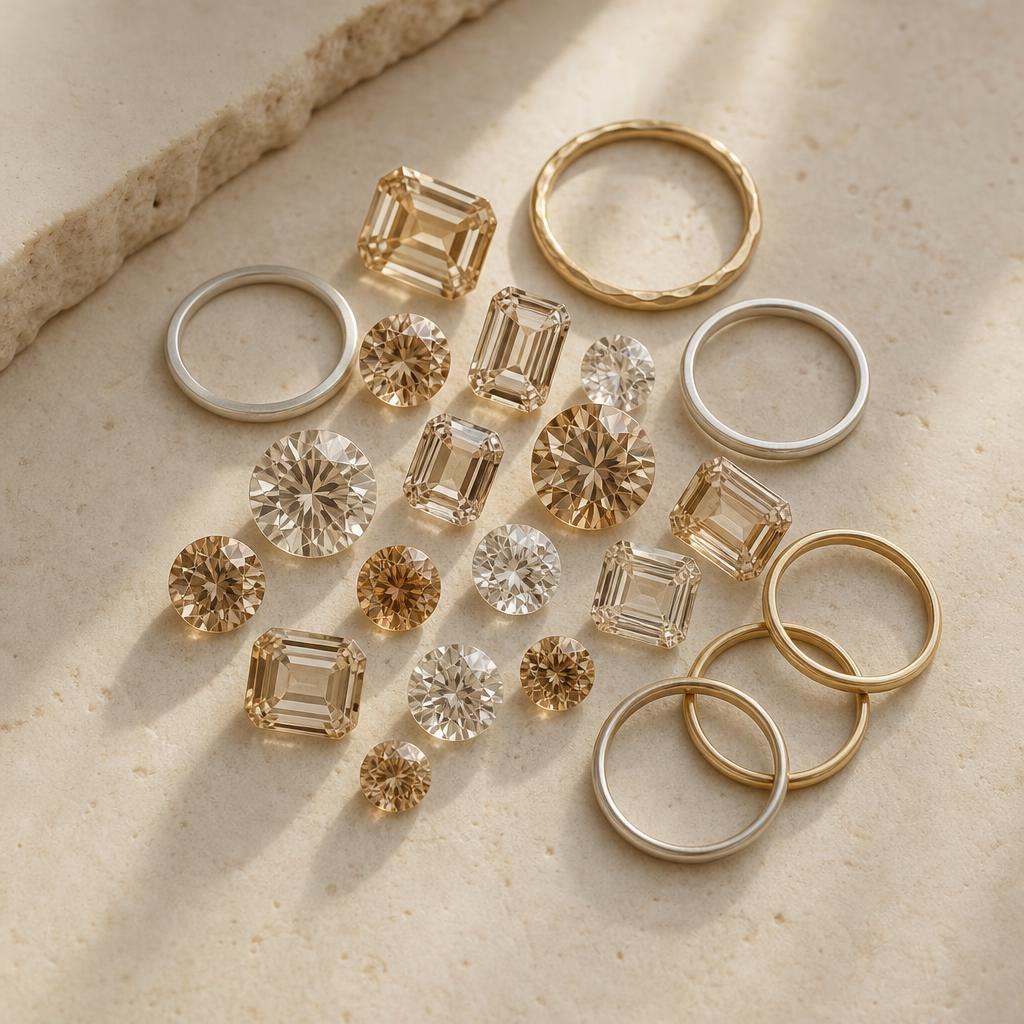
A ring listing is really just a translation problem — every phrase on it is trying to tell you something specific about how the ring is made, what it's made of, and how it will hold up over years of wear. Once you know what the terms actually mean, reading a listing takes about ninety seconds and you'll never have to guess again. Here's a spread of rings that show these terms in action, followed by a full breakdown of what to actually look for.


Start With the Stone: Cut, Shape, and Carat Weight
Most listings lead with the stone, and that's usually where the confusion starts. "Cut" and "shape" get used interchangeably in casual conversation, but on a proper listing they mean two different things. Shape is the outline — round, oval, cushion, emerald, pear. Cut refers to how the facets are angled to catch and return light. Two oval stones can look completely different depending on how they're cut, even if the shape on paper is identical.
Then there's carat weight, which is probably the single most misread number on any listing. A carat is a unit of weight, not size — 0.2 grams, to be exact. Two stones of the same carat weight can look different sizes depending on their cut and how deep or shallow they're set. If a listing lists "carat total weight" (often shortened to CTW or TCW), that number includes every stone on the ring — the center plus every accent stone in a halo or pavé band. It is not the size of the center stone alone, and mixing the two up is the single most common reason a ring looks smaller in person than a buyer expected. We've broken this down stone by stone in our guide to what carat weight actually means, which is worth a slower read if you're comparing two listings side by side.
Worth knowing: If a listing shows a large carat number but the price feels unusually low, check whether the stone is simulated rather than mined — more on that distinction below. It explains the gap without anything being misrepresented.
Setting Types: What's Actually Holding the Stone in Place
The setting is the architecture of the ring — the metalwork that holds the stone and shapes the ring's whole silhouette. It's also where listings get the most jargon-heavy, because there are genuinely a lot of setting styles and most of them do something specific.
Prong settings
A prong setting uses small metal claws — usually four or six — to hold the stone in place while leaving most of it exposed to light. It's the setting most people picture when they think "engagement ring," and for good reason: fewer prongs generally means more visible stone and more sparkle, while more prongs means a more secure hold. Neither is better across the board — it depends on how the ring will actually be worn day to day.
Halo, hidden halo, and pavé
A halo setting surrounds the center stone with a ring of smaller accent stones, which makes the center look larger and adds overall sparkle without changing the actual carat weight of the main stone. A hidden halo tucks that ring of stones underneath the center stone instead of around it, so it's invisible from a straight-on view and only catches light from certain angles — a quieter, more unexpected version of the same effect. Pavé (pronounced pah-VAY) describes tiny stones set closely together along the band itself, giving the impression that the entire ring is dusted in sparkle rather than concentrated in one place.

The Fleur Ring
A radiant-cut center stone framed by a floral halo — a good reference point for what "halo" actually looks like once it's on the hand rather than described in a bullet point.
Shop The Fleur Ring →Cathedral and bezel settings
A cathedral setting raises the stone up on arched shoulders, similar to the curved ribs of a cathedral ceiling — it's a distinctive, slightly formal silhouette that some buyers love and others find sits a little too high for daily wear. A bezel setting takes the opposite approach entirely, wrapping a thin band of metal fully around the stone's edge rather than using prongs at all. It's the most protective setting available and reads as noticeably more modern and minimal. If you're deciding between the two, it's worth reading how each one actually wears before choosing based on the photo alone.
Metal Language: What "Vermeil," "Plated," and "Solid" Actually Mean
This is the section that causes the most buyer's remorse, because the terms sound similar but describe very different products. "Solid gold" means the metal is gold all the way through. "Gold-plated" means a base metal — often brass or sterling silver — has a thin layer of gold applied to the surface, which will wear thinner over time depending on how often the ring is worn. "Gold vermeil" sits in between: it's specifically sterling silver plated with a thicker layer of gold than standard plating, and by law it has to meet a minimum gold thickness to legally use the vermeil name. None of these are "better" in an absolute sense — they're a tradeoff between look, durability, and how a ring interacts with skin.
Sterling silver on its own is worth understanding too, since it appears constantly in listings without much explanation. It's an alloy — 92.5% pure silver mixed with other metals for strength, which is exactly why it's stamped 925. On its own, without any plating, it gives a cooler, brighter tone than gold and tends to be the most budget-friendly base metal option. If you want the full picture on what 925 sterling silver actually means, we cover it in detail elsewhere.
✦ Pro tip: If a listing doesn't specify plating thickness or whether the ring is solid, vermeil, or plated, it's worth asking directly before buying — especially for a ring you plan to wear daily rather than occasionally.
Stone Language: Simulated, Lab-Grown, and Moissanite
The word "diamond" on its own tells you almost nothing about what you're actually buying, which is exactly why listings get specific. A mined diamond is pulled from the earth. A lab-grown diamond is chemically identical to a mined one but grown in a controlled setting, which is why it's still legally sold as a diamond. A simulated diamond is a different story — it's a stone designed to mimic the look of a diamond without sharing its chemical structure, and it's the category that makes rings like the ones on this page possible at a fraction of mined-diamond pricing. None of these terms are trying to deceive you; they're doing exactly what they're supposed to do, which is tell you what the stone actually is before you commit.
Moissanite and cubic zirconia are the two simulated stones you'll see most often, and listings don't always explain the difference. Moissanite has more fire — more of that rainbow-colored sparkle — and holds up better to years of daily wear. Cubic zirconia is softer and typically more budget-friendly, but tends to lose its shine faster with regular contact. If a listing doesn't specify which simulated stone is used, it's a fair question to ask before buying, and one worth understanding fully if you're comparing two similarly priced rings.

The Kensington Ring
A 3-carat emerald-cut solitaire on a smooth, unadorned band — a clean example of how shape, cut, and setting language come together on a single listing.
Shop The Kensington Ring →Sizing Terms You'll See Before You Check Out
Once you've decoded the stone, the setting, and the metal, the last block of text on most listings is sizing — half sizes, quarter sizes, and a size chart that assumes you already know your number. If you don't, it's genuinely faster to figure it out at home than to guess and deal with a resize later. And if a ring does end up fitting differently than expected, it's worth knowing ahead of time whether resizing is even possible for the setting you've chosen, since not every style adjusts the same way.
Quick Reference: Common Listing Terms
| Term | What it actually means |
|---|---|
| Carat total weight (CTW) | Combined weight of every stone on the ring, not just the center |
| Prong setting | Metal claws holding the stone, leaving most of it exposed |
| Halo | Ring of small stones surrounding the center stone |
| Pavé | Small stones set closely along the band itself |
| Vermeil | Sterling silver with a legally regulated minimum thickness of gold plating |
| Simulated diamond | A stone made to resemble a diamond without sharing its chemical structure |
Quick Takeaways
- Carat weight measures the stone by weight, not size — check whether a listing means total weight or center-stone weight alone.
- Setting type (prong, halo, pavé, cathedral, bezel) shapes both the look and the day-to-day durability of a ring.
- "Solid," "vermeil," and "plated" describe three genuinely different metal products, not interchangeable marketing terms.
- Simulated diamonds, lab-grown diamonds, and mined diamonds are chemically distinct categories — none is a lesser version of the others, just a different one.
- When a listing is vague on plating thickness or stone type, it's reasonable to ask before you buy.
Frequently Asked Questions
What's the difference between carat weight and carat total weight?
Carat weight typically refers to the center stone alone. Carat total weight (CTW or TCW) adds up every stone on the ring, including a halo or pavé band. A 2ct CTW halo ring will have a noticeably smaller center stone than a 2ct solitaire.
Is gold vermeil the same as gold-plated?
No. Vermeil is sterling silver plated with a legally required minimum thickness of gold, which makes it more durable than standard gold plating over a base metal like brass. Both will eventually show wear with daily use, but vermeil generally holds its color longer.
Does a simulated diamond mean the ring is fake?
No — it means the stone is a different material designed to look like a diamond, rather than being marketed as one it isn't. It's an honest, specific category, not a lesser imitation.
Why do two rings with the same carat weight look different sizes?
Cut quality, stone depth, and setting style all affect how large a stone appears from the top down. A shallow, well-cut stone can look larger than a deeper stone of the same actual weight.
What should I check before buying if a listing feels vague?
Look for stone type, setting type, metal composition, and plating thickness. If any of those are missing or unclear, it's reasonable to ask before purchasing, especially for a ring meant for daily wear.
None of this is meant to turn ring shopping into homework. It's the opposite — once you know what carat total weight, vermeil, and pavé actually mean, you can read a listing in under a minute and know exactly what you're getting, without the nagging feeling that you missed something important in the fine print. That's the whole point of a good listing, and now you know how to read one.


