

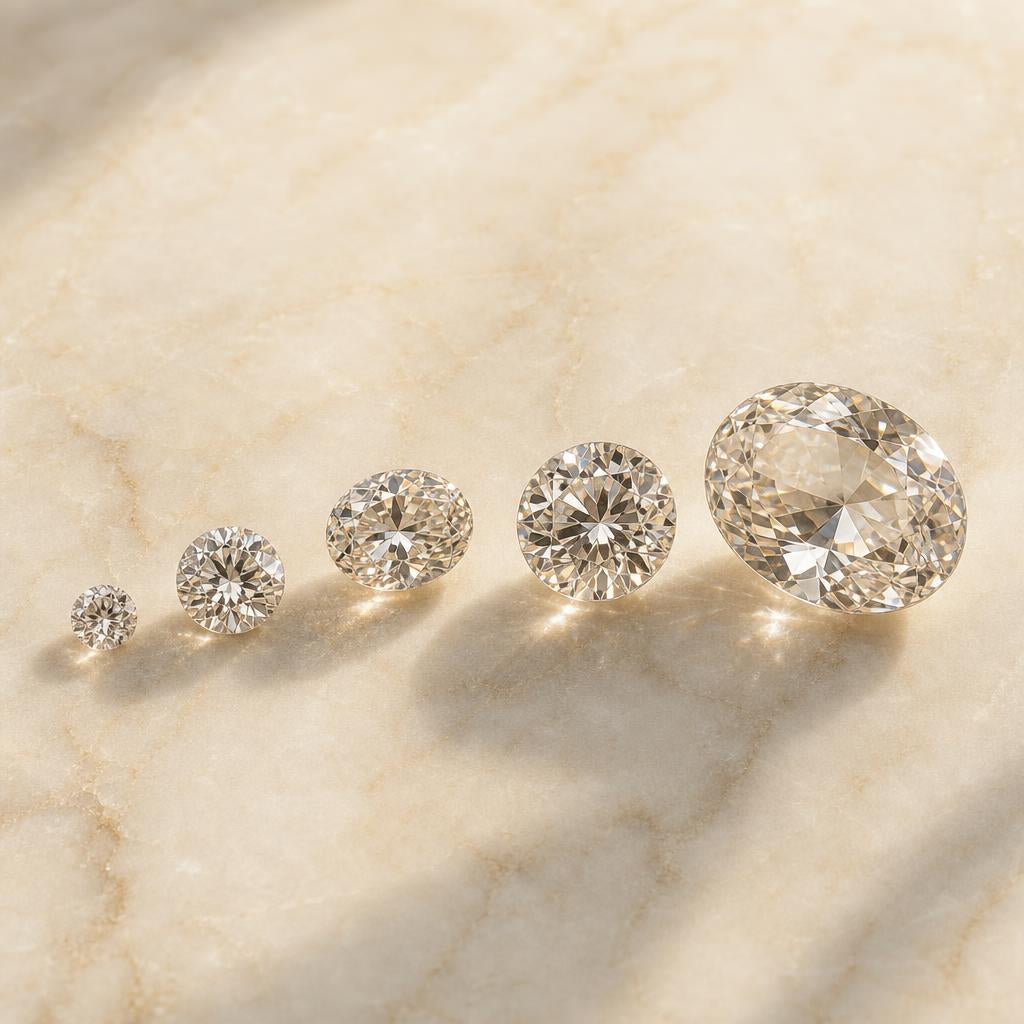
Carat Weight Explained: What the Number Means, What It Doesn't, and When It Stops Mattering
Ask most people what they want in an engagement ring and the word "big" will come up within the first thirty seconds. What they mean is presence — a stone that reads across the table, catches light from every angle, and looks genuinely significant on the hand. What they think they mean is carats. Those are not the same thing, and the gap between them is where most buyers go wrong.
Carat weight is the most quoted number in fine jewellery — and the most misunderstood. It is not a size measurement. It does not directly predict what a stone looks like on your finger. And past a certain point, adding carats does very little for visual presence while doing quite a lot to the price. This guide breaks it all down so you can stop fixating on the number and start thinking about what actually matters.


What "carat" actually measures
A carat is a unit of weight, not size. One carat equals exactly 0.2 grams. The measurement comes from the ancient practice of using carob seeds as counterweights on balance scales — their unusually consistent weight made them a reliable standard. The modern metric carat was officially standardised in the early twentieth century and has not changed since.
When you see a ring listed as 1ct, 2ct, or 4.5ct, you are being told how heavy the centre stone is. That is all. A 1ct round brilliant, a 1ct oval, and a 1ct asscher-cut stone all weigh exactly the same — but they look completely different on the hand, because each cut distributes that weight differently across the stone's geometry. The carat number is a starting point for understanding scale, not an end point, and certainly not a reliable guide to visual impact.
Worth knowing: Carat weight is divided into 100 points, like cents in a dollar. A 0.75ct stone is sometimes listed as "75 points." You will mostly see this notation in trade contexts, but it is useful to recognise — a "50-point stone" is simply a half-carat.
Why visual size and carat weight are different things
Here is what surprises most first-time buyers: two stones with identical carat weights can look dramatically different in person. A shallow-cut stone spreads its weight across a wider surface area, appearing larger from the top but losing depth and brilliance. A deep-cut stone carries most of its weight below the setting where it is invisible — it looks smaller than its carat weight suggests, and you never see that hidden mass on the finger.
This is why cut quality matters independently of carat weight. A well-cut stone uses its weight efficiently — it spreads mass where the light catches it, optimises facet angles for maximum light return, and creates a stone that reads larger than a poorly cut stone of the same weight. The practical upshot: a beautifully executed 0.9ct stone will often outperform a lazily cut 1.1ct stone both in visual size and in the quality of sparkle it produces.
Setting depth also plays a role. Some settings hold a stone higher off the finger, allowing more light to enter from below and increasing brilliance. Lower, more protective settings reduce light entry but can make a ring safer for everyday wear. Both are valid choices — but they affect how the same carat weight reads in practice.
How cut shape changes perceived size — dramatically
Certain cuts are simply better at looking large. This is about geometry, not quality. Elongated shapes — oval, marquise, pear, emerald — distribute their weight along a longer footprint. When set in a ring, they stretch across more of the finger, creating the impression of a significantly larger stone compared to a round brilliant of identical carat weight.
An oval cut tends to look 10–15% larger face-up than a round of the same carat weight, because it covers more of the finger's surface. A marquise can look even larger — its extreme elongation creates a dramatic visual footprint that maximises the stone's apparent size relative to its weight. Pear cuts sit somewhere in between, depending on the length-to-width ratio.
Round brilliants, by contrast, are the most compact shape relative to their carat weight. They are extraordinarily efficient at trapping and returning light — nothing beats a well-cut round for fire and brilliance — but they do not have the visual spread of an elongated cut. A 1ct round and a 1ct oval weigh exactly the same. On most fingers, the oval will look noticeably larger.

The Empress Ring
A 3.5-carat elongated oval centre flanked by tapered baguette side stones — a perfect illustration of how the oval cut's extended footprint creates a dramatically larger-looking stone than its weight alone would suggest. Rhodium-plated 925 sterling silver, nickel-free.
Shop The Empress Ring →Halo settings and what they actually do to perceived size
A halo setting — small stones encircling the centre stone — is one of the most effective ways to increase a ring's visual presence without touching the centre stone's carat weight. A well-executed halo can make a 1ct stone read like 1.5ct or even 2ct, because the eye perceives the entire cluster rather than just the centre stone alone.
This is why halo rings have remained enduringly popular despite trends toward minimalism in other areas of jewellery design. They are genuinely effective at their job. The centre stone's actual carat weight becomes somewhat secondary when a halo is involved — what matters more is the quality and consistency of the halo stones, and how well the setting proportions the halo relative to the centre.
A hidden halo takes this a step further: the accent stones sit beneath the girdle of the centre stone, invisible from directly above but adding to the visual weight when the ring is viewed at any angle. The cushion cut pairs particularly well with hidden halos, as its softened corners complement the rounded halo profile. A double halo — inner and outer rings of pavé — amplifies this effect further, creating exceptional visual presence that extends well beyond what the centre stone's weight alone would suggest.

The Duchess Ring
A cushion-cut centre stone set within a double halo — inner and outer rings of pavé — creating far greater visual presence than the centre stone's carat weight alone. This is the halo effect in its most dramatic form: maximum perceived size, beautifully proportioned. Rhodium-plated 925 sterling silver, nickel-free.
Shop The Duchess Ring →The sweet spots — and when more stops mattering
The relationship between carat weight and visual impact follows a curve with diminishing returns. Going from 0.5ct to 1ct makes a very noticeable difference to most people. Going from 1ct to 1.5ct is still clearly visible. But beyond roughly 2.5–3ct in a round brilliant, the incremental visual difference between sizes becomes genuinely hard to see without placing the rings directly side by side.
There are also psychological inflection points in how buyers perceive numbers. A 1ct stone feels meaningfully different from a 0.9ct stone in the imagination, even though the two are almost indistinguishable in person. This is partly why jewellery listings cluster around round numbers — and why a 0.95ct stone can be meaningfully less expensive than a 1ct stone of identical quality in the natural diamond market, despite looking essentially the same on the finger.
Hand proportions also matter significantly. On a US size 5 finger, a 2ct round brilliant is a clear statement stone. On a US size 8 finger, the same ring can feel understated. What reads as "large" is entirely relative to the hand it sits on — which is why thinking in carat numbers, divorced from finger context and setting style, so often leads to mismatched expectations.
Where simulated diamonds change the whole equation
With natural diamonds, carat weight is one of the four main pricing variables — the others being cut, colour, and clarity. Add a carat and you can multiply the price several times over, because large high-quality rough diamonds are genuinely rare. The market prices that scarcity aggressively.
Simulated diamond rings do not work this way. A 4.5ct simulated stone does not cost twenty times more than a 0.5ct one. This changes the decision entirely: you can choose your carat weight based on what actually looks right on your hand and suits your aesthetic — not on what trade-offs the budget forces you to make.
The result is that buyers of simulated diamond rings often end up with rings that look more impressive — objectively, visually — than natural diamond buyers at the same budget. Because they are free to prioritise cut quality, setting design, and visual weight, rather than counting grams. The number on the listing tells you what the ring weighs. What it actually looks like is the result of everything else: the cut, the setting, the shape, the way it sits on your specific hand.
✦ Practical tip: Before settling on a carat number, ask yourself what you actually want from the ring's presence. If you want elongated and finger-flattering, go oval or marquise. If you want dense concentrated sparkle, go round with a halo. If you want a genuinely large-looking statement, a radiant or cushion cut with a higher carat weight delivers both size and brilliance. The number follows the vision — not the other way around.
How to read a carat weight listing properly
A few things worth checking whenever you see carat weight on a listing:
- Centre stone weight or total stone weight? A listing that says "2ct total" might mean a 1ct centre with 1ct of pavé and halo stones combined. Always check whether the carat figure refers to the centre stone specifically or to every stone in the ring.
- What is the cut shape? As covered above, cut shape affects visual size significantly and independently of weight. A 2ct oval and a 2ct round look noticeably different on the hand.
- What is the setting style? A solitaire shows all of the centre stone's face. A halo adds substantial perceived size. A bezel setting partially covers the girdle and can make a stone appear slightly smaller than its weight suggests.
- How does it relate to your finger proportions? Think about how the ring will actually sit on your hand, not how it looks on a standard display hand in a product photo.
None of this is to say carat weight is irrelevant. It is a useful reference point and a workable shorthand for overall scale. But it is a starting point — and it is certainly not the thing that determines whether a ring looks beautiful on your hand. That is down to the cut, the setting, the proportions, and the quality of the stone itself.
Quick Takeaways
- Carat is a weight measurement (0.2 grams = 1ct), not a size measurement
- Two stones with the same carat weight can look completely different sizes depending on cut shape
- Elongated cuts (oval, pear, marquise) look larger face-up than rounds at the same carat weight
- Halo settings add significant perceived size without increasing centre stone weight
- Beyond roughly 2.5–3ct, incremental size gains become hard to see without direct comparison
- With simulated diamonds, carat weight can be chosen based on aesthetics — not budget trade-offs
- Always check whether a listing shows centre stone weight or total stone weight
Frequently asked questions
What is a good carat weight for an engagement ring?
There is no universal answer — it depends on finger size, setting style, and personal preference. For a round solitaire on an average-sized hand, 1–1.5ct is a comfortable visual middle ground. For maximum presence at the same weight, an oval or elongated cut will read larger. Think about the look you want first, then find the carat weight that delivers it in your chosen cut and setting.
Does a higher carat always look bigger?
Not necessarily. A well-cut 1ct stone will often look larger than a poorly cut 1.2ct stone. Cut shape also matters — an oval 1ct typically looks bigger than a round 1ct. And a solitaire 1.5ct can look smaller than a 1ct with a halo, because the halo adds substantial visual width to the ring. Carat weight is one input among several, not the determining factor.
Why do simulated diamond rings often list much higher carat weights than natural diamond rings?
Because with natural diamonds, carat weight drives price exponentially — a 4ct natural diamond of good quality costs far more than most budgets can absorb. Simulated stone pricing does not follow this curve, so designers can create rings with 3ct, 4ct, or 5ct centre stones at genuinely wearable price points. The visual impact is real; only the pricing mechanics differ.
What is the difference between total carat weight and centre stone carat weight?
Total carat weight (TCW) includes every stone in the ring — the centre stone plus any pavé, halo, or side stones. Centre stone carat weight refers to the main stone only. These can be significantly different: a ring with a 0.8ct centre and 0.5ct of pavé might be listed as "1.3ct TCW." When comparing rings, make sure you are comparing like for like.
At what point does a ring start looking genuinely large?
This varies by finger size and cut shape. As a rough guide, a 1.5–2ct round on a US size 6 finger starts to read as a statement ring. An oval at 2ct or above is unmistakably large on most hands. For step cuts like asscher or emerald, the wider face-up surface means 1.5ct can have the visual footprint of a 2ct round brilliant — so perceived size often exceeds what the carat number suggests.
The most useful thing you can do before buying is look at rings on actual hands — not just product photography on a standardised display hand. Carat weight is a number on a listing. What matters is what arrives on your finger, and that is a question of cut, setting, shape, and proportion working together. Get those right and the carat number takes care of itself.


