

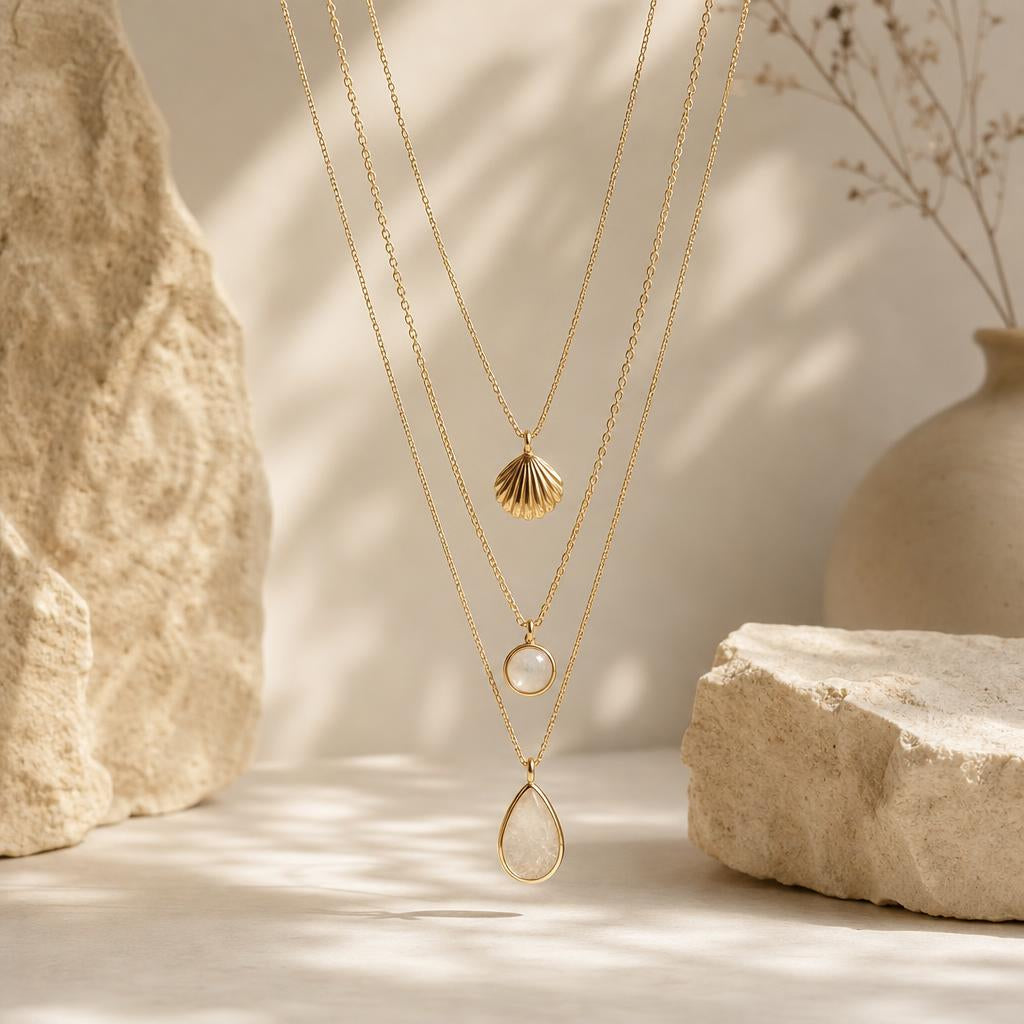
Necklace Layering Order: What to Layer First, Chain or Pendant
Two necklaces on a nightstand look effortless. The same two necklaces on your neck, clasped in the wrong order, look like you got dressed in the dark. Layering isn't about owning more jewelry — it's about knowing which piece leads and which one follows, and almost nobody explains that part.
Most layering advice stops at "mix your lengths" and calls it done. That's true, but it's not the whole answer. The real skill is knowing whether a pendant or a plain chain goes on first, and why that single decision determines whether the whole stack reads as intentional.


The Order Question Nobody Actually Answers
Search "how to layer necklaces" and you'll get the same three tips everywhere: vary the lengths, mix your textures, keep everything two inches apart. All correct. None of it tells you which necklace to put on first, or why that decision changes how the whole look reads.
Here's the part that gets skipped: a layered look isn't a pile of equally important pieces. It has a hierarchy. One necklace is doing the talking — usually a pendant, a stone, a shape with some visual weight — and everything else is there to support it. Decide which piece is the lead before you touch a clasp, and the rest of the sequencing sorts itself out.
Necklace Layering Order, Step by Step
Put your longest piece on first. It sits lowest, so it needs to go on before anything shorter crosses in front of it. Work upward from there — each successive necklace sits a little higher and a little closer to the collarbone. This is the same logic jewelers use when they talk about necklace lengths: shorter measurements sit high on the neck, longer ones drop toward the chest, and the gap between each length is what keeps them visually separate instead of merging into one tangled line.
Where most people go wrong is treating every necklace as interchangeable. A fine, unadorned chain and a necklace with real visual weight — a pendant, a cluster of stones, an asymmetric shape — don't behave the same way on the body, and they shouldn't be layered as if they do.

The Clover Moissanite Necklace
A small, symmetrical shape like this one is built to support, not compete. It sits closest to the neck and lets a longer, bolder piece take the lead below it.
Shop The Clover Moissanite Necklace →Pendant First, or Chain First?
Here's the actual rule: the piece with the most visual weight goes on last, sitting lowest, so it becomes the base your eye lands on. A plain or lightly detailed chain goes on first, higher up, framing the statement piece rather than fighting with it. Put a bold pendant on first and a delicate chain on last, and you've buried your best piece under a necklace that was never meant to lead.
This is also why a single dramatic pendant almost always wins over two loud pieces stacked together. One necklace gets to be the sentence. The others are punctuation. If two pieces are both trying to be the headline, the whole stack stops reading as a look and starts reading as clutter — however nice each individual necklace actually is.

The Crescendo Necklace
Three stones set in a vertical cascade give this piece enough visual movement to anchor a stack on its own — worn as the lowest, last-on layer, with quieter pieces framing it above.
Shop The Crescendo Necklace →The 2:1:1 Approach
If you want a shortcut that removes the guesswork entirely, stylists often build a three-piece stack around a simple ratio: two shorter, quieter pieces closest to the neck, one mid-length piece as a bridge, and one longer, more deliberate piece as the anchor. It's not a strict formula so much as a reminder that a stack needs a clear top, middle and bottom — not three necklaces competing for the same real estate.
Applied to an actual stack: a dainty solitaire sits highest and first. A station-style chain, with its evenly spaced stones, bridges the middle distance. A pendant with real presence — a starburst, a cluster, a single elongated stone — goes on last and sits lowest, doing the job a focal piece is supposed to do.
✦ Pro tip: Leave at least two inches of length between each necklace. Any tighter and even a well-planned order starts to overlap and tangle by midday.
What Changes With a High vs. Low Neckline
The order logic holds regardless of outfit, but the starting length shifts. A crew neck or turtleneck gives you room to layer three or four pieces, since a longer pendant necklace still has space to sit below the fabric line. A deep V-neck or off-the-shoulder top usually looks more deliberate with fewer pieces — one shorter necklace close to the collarbone and a single longer pendant necklace doing the rest of the work, rather than a full stack competing with the neckline itself.
The same hierarchy applies either way: whichever piece has the most visual weight is the one sitting lowest and going on last, framed rather than crowded by whatever sits above it.
Building Your First Layering Set
You don't need five necklaces to layer well — you need three that are actually built to work together. Start with one dainty solitaire, one piece with some texture or repetition (a station chain, a small cluster), and one necklace with genuine presence to anchor the bottom. That's the whole formula. Everything after those three pieces is expansion, not a requirement.
Buy in that order, too, if you're building the set from nothing. The anchor piece is the one worth spending the most thought on, since it's doing the visual work every time you wear the stack. The two supporting pieces matter less individually — their job is to frame, not to compete — which is exactly why they should stay simple rather than trying to be interesting on their own.
Mixing Metals Without It Reading as an Accident
Gold and silver together isn't a mistake — it's a choice, and it reads as one when it's deliberate. The easiest way to make mixed metals work inside a layered stack is to let one metal lead, the way one necklace already leads in visual weight. If your anchor piece is silver, let the supporting pieces skew silver too, with maybe one small gold accent breaking the pattern on purpose. Match every piece to the last one exactly and the stack starts to look less like a considered choice and more like you couldn't decide.
The same logic that governs order also governs metal: consistency lower in the stack, with room for a single deliberate break higher up, near the collarbone, where it reads as intentional rather than incidental.
Quick Takeaways
- Put your longest necklace on first — it needs to sit lowest before anything shorter crosses in front
- The piece with the most visual weight (a pendant, a cluster, a bold shape) goes on last and sits lowest
- Plain or lightly detailed chains go on first and sit higher, framing the statement piece instead of competing with it
- Leave roughly two inches between each necklace's length to keep the order from collapsing into one tangled line
- Fewer, more deliberate pieces read better with a low or dramatic neckline; a high neckline gives you room for a fuller stack
Frequently Asked Questions
What's the correct necklace layering order?
Longest first, shortest last, with your most visually weighted piece — usually a pendant — sitting lowest so it anchors the stack rather than getting buried underneath everything else.
Should the pendant or the plain chain sit closest to my neck?
The plain chain. Save the pendant for the lowest position, where it has room to be the focal point instead of competing with shorter pieces sitting above it.
What is the 2:1:1 approach to layering jewelry?
It's a simple way to build a three-piece stack: two shorter, quieter pieces near the neck, one mid-length piece bridging the gap, and one longer, more deliberate piece anchoring the bottom. It gives the stack a clear top, middle and bottom instead of three pieces all fighting for attention.
How do I keep layered necklaces from tangling once they're in the right order?
Getting the order right solves most of it, since necklaces at different lengths naturally sit apart instead of overlapping. For the mechanics of keeping them separated all day — spacing, texture, and a few practical habits — see our full guide on layering without the tangle.
Is necklace layering still worth doing, or is it a passing trend?
Layering has outlasted plenty of jewelry trends because it solves a real problem: it lets a handful of necklaces work as one considered look instead of sitting in a drawer being worn one at a time. Get the order right and it reads as intentional in any season.
None of this requires a jewelry box you don't already have. It requires knowing which piece leads. Start with what you own, figure out which necklace is doing the visual work, and build the order around it — longest to shortest, quietest to boldest, every piece earning its place in the stack instead of just adding to it.


