

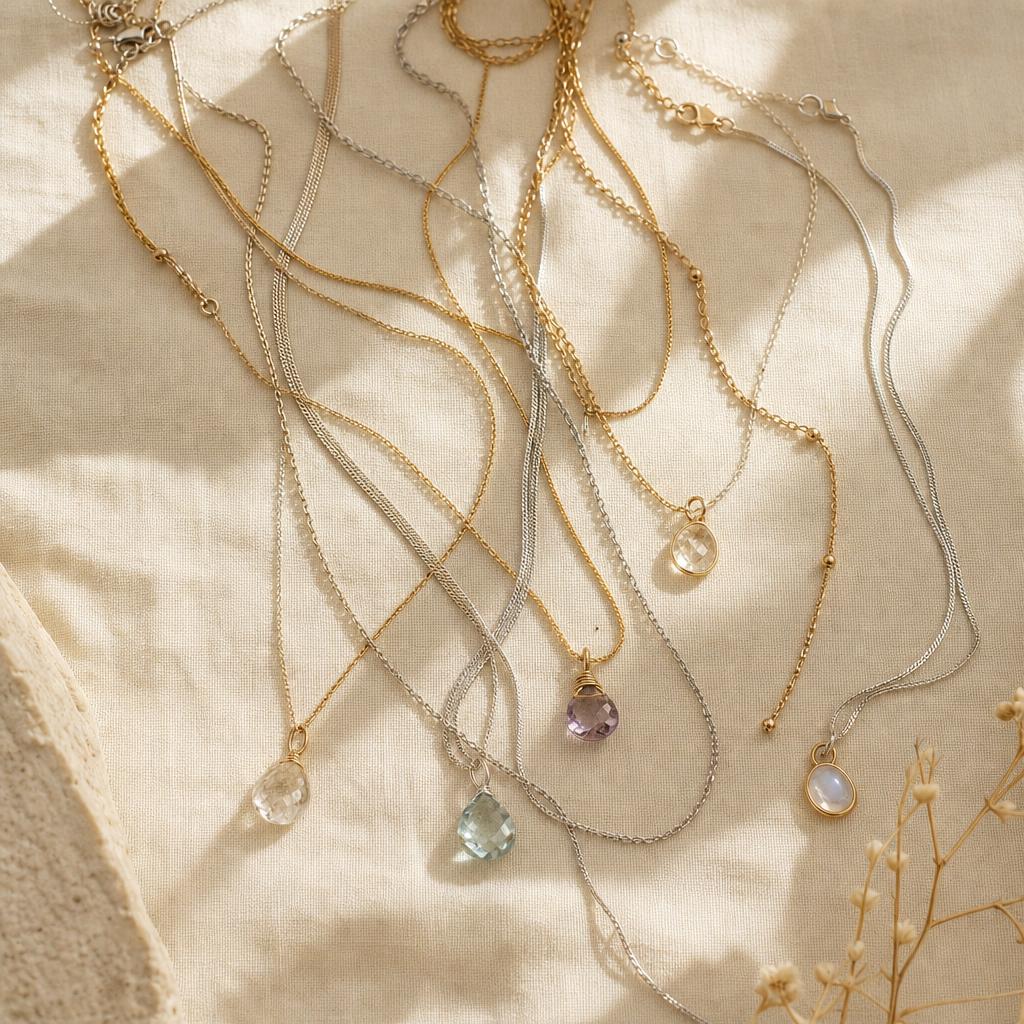
Layering Gold and Silver Necklaces: Does Mixing Metals Actually Work?
Somewhere along the way, someone decided that gold and silver couldn't sit on the same neck. It was never a rule about taste — it was a rule about matching sets, the kind sold in a single box so you'd buy the whole thing at once. The woman who's actually paying attention has already noticed: the jewelry she admires most, on the women she thinks dress the best, is rarely one metal. It's layered, mismatched on purpose, and unmistakably hers.
So does mixing metals actually work, or is it just something Pinterest talked you into? The short answer: it works when it's deliberate. Below is a place to start — four necklaces that pair naturally across warm and cool tones, then the actual mechanics of building a mixed metal necklace stack that reads as styled, not accidental.


Why "Don't Mix Metals" Was Never a Real Rule
Ask where the no-mixing rule actually came from and nobody has a straight answer. It wasn't etiquette. It wasn't chemistry — gold and silver sitting near each other on your neck does nothing to either metal. It was retail logic: a matching set is one purchase, easy to display, easy to describe on a hangtag. Somewhere between the counter and the culture, that convenience got repackaged as a style law.
The women actually setting trends right now ignored the memo years ago. Runway styling, editorial spreads, the jewelry closets of the people you'd call effortlessly put-together — all of it treats a gold and silver necklace pairing as a given, not a risk. If a rule only ever existed to sell matching sets, it was never really about you. It was about moving inventory.
Worth knowing: Every Gemiros necklace is 925 sterling silver, finished in rhodium, 18k gold, or rose gold — hypoallergenic, nickel-free, and built to hold its finish through daily wear. That's what makes mixing tones across pieces low-risk: you're not gambling on how a cheap plating will age next to another.
How to Mix Gold and Silver So It Looks Intentional
The difference between "mixed metal necklace" done well and done by accident comes down to three habits, all borrowed from stylists who've been doing this for a decade longer than Pinterest has existed.
Pick an anchor piece. Start with one necklace that already carries both tones — a two-tone pendant, or a piece with metal-colored stone settings that read warm against a cool chain. That single piece gives your eye permission to see the rest of the stack as coordinated rather than mismatched.

Belle Necklace — Gold
A round halo pendant with enough presence to sit as the focal point of a mixed-tone stack, while a slimmer silver chain works quietly behind it.
Shop Belle Necklace →Repeat each metal at least twice. A single stray silver clasp against three gold chains reads as an error; the same silver tone showing up in your earrings or a ring reads as a choice. Stylists sometimes call this the 2:1:1 approach — one metal carries the look, a second echoes it in at least two places, and nothing appears only once.
Let one tone lead. Choose whether the stack skews warm or cool overall, then let the other metal act as an accent rather than an equal partner. A gold-forward stack with one silver pendant reads as curated; an even 50/50 split more often reads as unfinished.
Building a Mixed Metal Stack Without It Getting Messy
Once you've settled on a lead tone, the stacking itself follows the same rules as any layered necklaces project — vary the lengths, vary the weight, and let the shortest piece sit closest to your throat. The metal mixing works with that structure instead of against it: put your accent metal on the shortest or the longest chain, never the middle one, so it reads as a deliberate bookend rather than a stray link.

Solène Necklace — Silver
A round solitaire pendant sized to sit as the shortest layer in a stack, giving a gold-forward look one deliberate cool-tone moment.
Shop Solène Necklace →If tangling is what's kept you from layering at all, that's a separate, solvable problem — a good length chart and a couple of tricks for keeping chains from locking together will get you there faster than any rule about which metal goes first.
✦ Pro tip: Building toward a full capsule necklace wardrobe rather than one-off pieces makes mixing metals almost automatic — once you own a few pieces in each tone, you're choosing from a set instead of solving a puzzle every morning.
When to Keep It Simple
None of this means every day calls for a full mixed metal jewelry moment. A single necklace in one tone is still the right answer for a lot of mornings — under a collared shirt, for a video call, for anything where you want the piece doing quiet work rather than announcing itself. The point isn't that mixing is mandatory. It's that the old rule against it was never load-bearing, and you're free to ignore it exactly as often as you want to.
Where karat and plating actually matter is durability, not whether tones can sit together — knowing the difference between solid gold, gold-filled, gold vermeil, and plated finishes tells you far more about how a piece will wear over the next five years than any metal-matching myth ever did.
Where the Look Falls Apart
Most mixed-tone stacks that don't work fail for one of three reasons, and none of them are "you mixed metals." The first is proportion: pairing two pieces of nearly identical weight and size, so the eye can't tell which one is meant to lead. Fix it by contrasting scale — a fine chain against something with more presence, not two competing focal points at the same volume.
The second is randomness. A silver ring, a gold necklace, and silver earrings with no third silver moment reads as three separate decisions rather than one outfit. The fix is the repetition habit from earlier — every metal needs at least one echo somewhere on the body, or it reads as leftover rather than chosen.
The third is overcorrection: trying to balance the tones exactly evenly out of fear of getting it wrong. Perfect 50/50 splits are, ironically, the hardest version of this to pull off well. Committing to a lead metal and treating the second as an accent removes the guesswork almost entirely, and it's the fastest way to stop overthinking something that was never actually complicated.
Quick Takeaways
- The rule against mixing warm and cool metal tones started as a retail convenience, not a style law.
- Anchor the look with one piece that already blends both tones, then repeat each metal at least twice.
- Let one tone lead the stack — an even split tends to look unfinished, not balanced.
- Place your accent metal on the shortest or longest chain in a layered stack, never the middle.
- Sterling silver with rhodium or gold plating holds its finish, so mixing tones across pieces is low-risk.
Frequently Asked Questions
Is it okay to wear gold and silver necklaces together?
Yes. There's no rule, chemical or otherwise, against it — the idea that metals "shouldn't" mix comes from retail habit, not etiquette. Modern styling treats wearing both tones together as standard practice, not a risk, and most people you'd call well-dressed are already doing it without thinking twice.
What do you call jewelry that combines gold and silver?
It's generally called mixed metal jewelry, or a two-tone piece when both tones appear within a single item rather than across separate necklaces.
Are layered necklaces still in style?
Yes — layering has held as a steady styling approach for several years now rather than fading as a single-season trend, and mixing metals within that stack has become just as common as sticking to one tone.
What's the easiest rule for mixing metals without it looking accidental?
Pick a lead tone, then repeat the second metal in at least two places — a necklace and an earring, or a necklace and a ring — so it reads as intentional rather than a single stray piece.
Why did we used to avoid wearing gold and silver together?
Mostly because matching jewelry sets were sold as single units, and mixing pieces from different sets didn't fit that sales model. It was never a rule about how the metals actually look together.
Is mixing metals considered classy or trendy?
Both — it reads as classy when it's deliberate (one anchor piece, one lead tone, each metal repeated) and has been a consistent trend on runways and in editorial styling for years rather than a passing moment.
None of this requires buying an entirely new jewelry box. Most women already own pieces in both tones — the shift is just letting them share a neckline instead of living in separate drawers. Start with one gold piece and one silver piece you already reach for, put them on together, and see how quickly it stops feeling like a rule you're breaking.
The occasion matters less than people assume, too. A mixed-tone stack works for a desk job as easily as it works for dinner — the formality comes from how much you're wearing and how deliberately it's arranged, not from whether every piece matches. Keep it to two or three pieces for daytime, let the stack get fuller for evening, and the metals themselves can stay exactly as mixed either way. The rule you actually need isn't about gold versus silver at all. It's the one that's always applied to getting dressed well: decide on purpose, then commit to it.


