

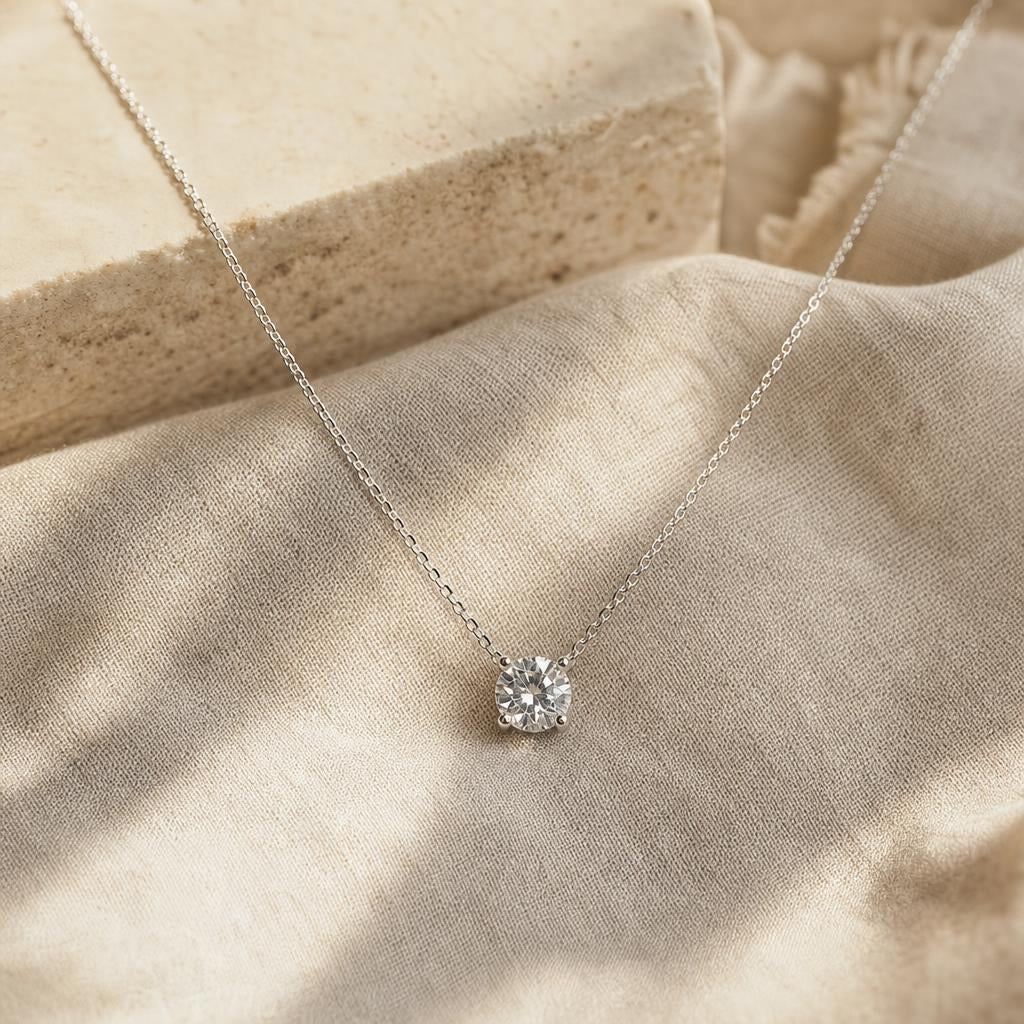
Single Pendant Necklace: The One-Necklace Rule for Saying More With Less
There is a particular kind of confidence in a bare collarbone with exactly one thing on it. No stack to manage, no chains to untangle at the mirror, no wondering whether the third necklace is doing anything the first two weren't. Just a single stone, placed on purpose.
The jewelry industry has spent years telling you that more is the modern move. Layer it, stack it, add one more. But the women who always look put together tend to have worked out something quieter: one well-chosen pendant, worn daily, does more than a handful of pieces that have to compete for attention. Below, the pendants that make that rule work.


The One-Necklace Rule, Explained
The rule is simple: choose one pendant, give it the whole neckline, and let it carry the look. It is not minimalism for its own sake. It is a decision that you have already found the piece that works, and you do not need to hedge with a second and third.
A well-chosen minimalist necklace style built around one signature pendant becomes part of how people recognize you. It is the necklace they picture when they think of you, and that is a stronger result than any stack can deliver.
Worth knowing: A single pendant is not a lesser version of a layered look. It is a different design decision: all of the attention goes to one stone, so the stone has to earn it.
Why One Pendant Often Beats a Stack
Stacks are skilled work. Chain lengths have to step down evenly, metals have to agree, and every piece has to sit without tangling against the next. Done well, a layered look is lovely, and there is a smart way to build one in three necklaces that work as one look. Done on a rushed morning, it is a knot.
A single pendant removes every one of those variables. You fasten it and you are finished. It also photographs cleanly, sits well under a blazer collar, and never competes with earrings or a ring stack. For the woman who researches before she buys, that predictability is a feature, not a limitation.
It reads as a decision, not a trend
Anyone can follow a layering tutorial. Wearing one stone, every day, with full conviction, signals that you chose it. That is the identity Gemiros is built around: you have worked out what you actually like and you are not paying for the extras.
It keeps the stone in focus
When a stone is the only thing at your throat, its cut, its light and its setting all show. A round brilliant throws sparkle in every direction, and nothing next to it dulls the effect. Moissanite is indistinguishable from a diamond to the naked eye and passes diamond testers, so a single stone is exactly where that matters.
How to Choose a Single Pendant Necklace
If it is going to be the only piece you wear, a single pendant necklace has to be right on four points: the stone, the setting, the size and the length.
1. Pick the shape you will still want in five years
Round is the most versatile. Oval elongates. Marquise is the distinctive pick, for the woman who wants people to ask about it. If you are unsure, hold the shape up against the earrings and rings you already reach for most, and choose the one that echoes them.
2. Decide how the stone is held
The setting changes the whole personality of the pendant:
- Bezel: a smooth metal rim around the stone. Modern, snag-free and very clean against fabric.
- Prong: lets in the most light, so the stone looks livelier. Six prongs reads as classic; four reads lighter.
- Floating: the stone appears to hover on the chain. It is the quietest option of all, and the one covered in this guide to quiet drama that only shows when you move.
- Halo: a ring of small stones around the center. More presence, the right call when the pendant is your only piece and you want it to hold its own.
3. Size the stone to your neckline, not to a rule
A larger stone suits open necklines and a smaller one suits high collars. If you wear both, choose the middle and let the chain length do the adjusting.
4. Get the length right
Sixteen inches sits at the base of the neck, and eighteen drops slightly lower. A one-pendant look depends on the stone landing where you want it, so use the necklace length chart before you buy online.

The Stella Necklace
A round solitaire in 925 sterling silver, designed to be the one piece you reach for every morning.
Shop The Stella Necklace →
The Odette Necklace
An oval pendant that lengthens the line of the neck. A good fit if you want one piece with a little more presence.
Shop The Odette Necklace →Solitaire or Halo: Choosing the Personality
A solitaire pendant necklace is the purest version of the one-necklace rule: a single stone, nothing around it. If you want more of a statement from one piece, a halo adds a ring of smaller stones that makes the pendant read larger. There is a clear breakdown of that choice in solitaire versus cluster as two different philosophies.

The Belle Necklace
A round center stone with a halo, for the day you want a single pendant to do the work of a whole stack.
Shop The Belle Necklace →The Smarter Math Behind Buying One
There is a quiet financial logic here too. Three mid-range pieces bought to build a stack often cost more than one pendant chosen carefully, and you end up wearing only the favorite anyway. Putting the whole budget into a single stone means you can choose the setting and the metal that you actually love, rather than settling for whatever completes a set.
That is the same instinct behind choosing Gemiros over the jewelry store counter: you have seen how the markup works, and you would rather spend on the piece than on the name above the door. One pendant, chosen well, looks like it cost far more than it did. Nobody at the dinner table needs to know the difference, including the jeweler.
When a Stack Is Still the Right Call
The rule is not a vow. A layered look makes sense when you are dressing for an event, when you want to play with texture, or when you simply enjoy the build. If you do layer, the order matters, and what to layer first, chain or pendant settles most tangles before they begin.
The point is that layering should be a choice you make on purpose, not a default you fall into because everyone else is doing it.
✦ Pro tip: Wear your single pendant for a full week before you decide whether to add anything. If you never miss the extra pieces, you have your answer.
Wearing One Necklace Well
A single pendant works hardest when everything around it is edited too. Keep earrings simple, let a ring be the second point of sparkle at most, and choose a neckline that frames the stone instead of covering it. Silver reads cool and crisp; gold reads warmer. Pick the one that flatters your skin and commit to it.
It also holds up to daily wear. Gemiros pendants are 925 sterling silver and nickel-free, so the same piece can go from desk to dinner to the gym bag without a second thought. The best piece is the one you actually wear.
Quick Takeaways
- One pendant, worn on purpose, usually reads stronger than a stack worn by default.
- Choose the stone shape first, then the setting, then the length.
- Solitaire is purest; halo gives a single piece more presence.
- Layer when you want to, not because you feel you have to.
Frequently Asked Questions
What is a solitaire pendant?
A solitaire pendant features one stone, with no accent stones around it, hanging from a chain. It is the simplest and most versatile style, which is why it works so well as a one-necklace look.
Are dainty necklaces still in style?
Yes. A fine chain with one small stone is a staple because it works with almost everything. If you like the idea of a dainty pendant necklace, choose a stone with enough brilliance to carry the look on its own.
What is the best chain length for a single pendant?
Sixteen to eighteen inches suits most necklines. Sixteen sits at the base of the neck; eighteen drops slightly lower and works better with open collars.
What is a pendant necklace called?
It is simply a pendant necklace: a chain with a single hanging piece. The hanging element is the pendant, and the chain it sits on is usually sold with it.
Can I wear one pendant every day?
Yes. Sterling silver with a moissanite stone is built for daily wear, and a one-piece routine means less handling and less wear on the chain.
Wear one pendant, and wear it like you meant it. That is the whole rule, and it is the reason the women who follow it never look like they are trying too hard.


