

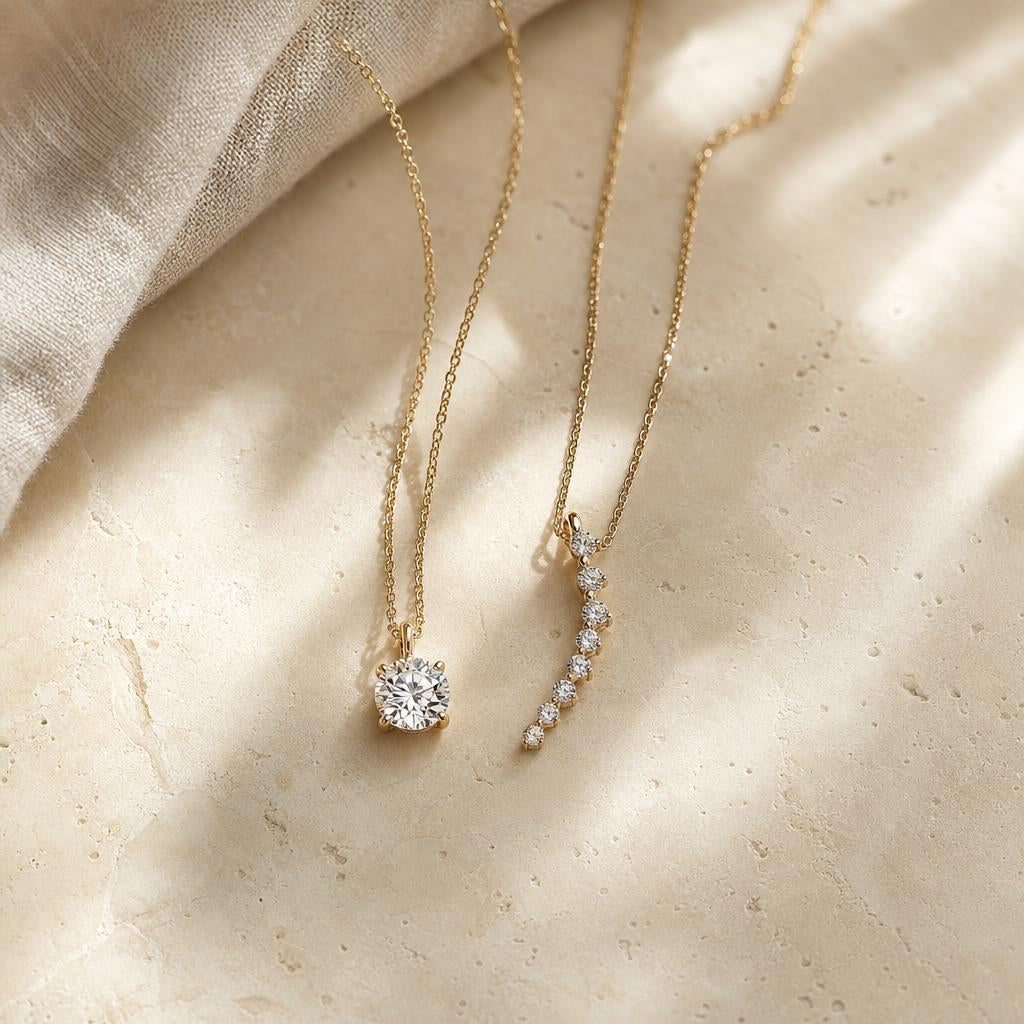
Solitaire Pendant Necklace vs. Cluster Pendant: Two Completely Different Philosophies
Some pendants make one decision and stand behind it. Others gather a handful of stones and let them argue the case together. Choosing between a solitaire and a cluster is rarely about sparkle. It's about what you want your necklace to say before you say a word.
Most buying guides treat the two as interchangeable options on a filter menu. They aren't. A solitaire is a philosophy of restraint, and a cluster is a philosophy of abundance. Pick the one that matches how you actually dress, and the necklace stops being an accessory and starts being a signature. Here are four pendants that show both sides of the argument.


The solitaire pendant necklace philosophy: one decision, fully made
A solitaire pendant is a single stone with nowhere to hide. There is no pavé to distract the eye, no halo to flatter a smaller center, no supporting cast. The stone either holds the space or it doesn't. That is exactly why people who choose it tend to choose it for years.
The solitaire rewards a particular kind of confidence. You are saying that one well-chosen thing is enough, and that you don't need volume to be noticed. It is the necklace equivalent of a perfectly cut white shirt: the quality is in the proportions, not the embellishment. It also happens to be the least fussy piece in a jewelry box, because it pairs with nearly every neckline and nearly every other piece you own.
The honest tradeoff is that a solitaire shows everything. The cut, the way light moves through the stone, and the way the setting holds it are all on display. This is where moissanite earns its place. It carries more fire than most buyers expect, passes diamond testers, and is indistinguishable from a diamond to the naked eye. A single stone has to perform, and this one does.
How the setting changes the personality
Within the solitaire family, the setting quietly changes the message. A six-prong setting reads classic and symmetrical. A four-prong floating setting reads airy and modern, letting the stone sit almost weightless against the skin. A bezel wraps the stone in metal for a flush, low-profile look that feels secure and deliberately minimal. Three necklaces, one stone each, and three distinct temperaments.

The Aria Moissanite Necklace
A round-cut moissanite encased in a sleek bezel. The flush design lets light reflect cleanly off the stone, and the silhouette stays secure and minimal for everyday wear.
Shop The Aria →If the round solitaire feels too expected, the shape itself can do the differentiating. A marquise set vertically lengthens the line of the neck and brings a sharper edge to an otherwise quiet design.

The Meridian Moissanite Necklace
A 1.0 carat marquise-cut moissanite set vertically on a polished box chain. Elongated, sleek, and a distinctive take on the classic round solitaire.
Shop The Meridian →If the solitaire philosophy appeals to you, it's worth knowing how it sits next to other quiet styles. Our guide to quiet luxury necklaces explains why the most understated pieces tend to be the ones people notice last and remember longest.
The cluster philosophy: abundance, arranged
A cluster takes the opposite position. Instead of one stone carrying everything, several stones share the work, and the effect is richer, more textured, and a little more playful. Where a solitaire says "this is enough," a cluster says "look at all of this." Neither is louder than the other in the way that matters. They are just louder in different directions.
The practical advantage of a cluster is forgiveness. Several smaller stones catch light from more angles at once, so the piece keeps sparkling even when it shifts, twists, or sits slightly off-center. Movement is part of the design instead of a flaw in it. That makes clusters a natural fit for people who want their necklace to look alive on a busy day, not posed for a photo.
A cluster also gives you more room for meaning. A trio can mark three people, three chapters, or simply a rhythm that feels right. A diamond cluster necklace in any form is built around the idea that the whole is more interesting than any single stone, and the best versions arrange their stones with intent rather than just piling them on.
Two ways to be abundant
Not every multi-stone pendant is a cluster in the strict sense, and the shapes carry different personalities. A graduated trio builds a quiet crescendo, each stone slightly larger than the last. A clover-shaped arrangement turns the stones into a motif, geometric and a little playful. Both belong to the abundance philosophy, but they get there differently.

The Belle Pendant Necklace
A 0.8-carat round-cut simulated diamond surrounded by a full halo of radiant stones, on a floating pendant design. It sits between the two philosophies: one clear center, with the sparkle of a crowd around it.
Shop The Belle →If a halo has you wondering where it falls between the two camps, we've broken down how a halo pendant compares with a solitaire in its own guide.
Solitaire vs. cluster at a glance
| Question | Solitaire | Cluster |
|---|---|---|
| The message | One decision, fully committed | Abundance, arranged with intent |
| How it catches light | One focused flash from a single stone | Scattered sparkle from many angles |
| Best with | Clean necklines, tailored pieces, minimal outfits | Simple tops where it can be the one detail |
| Layering | Easy: it plays well with chains and other pendants | Works best worn alone or with a plain chain |
| Everyday wear | Almost any day, any outfit | Most days, especially when you want some personality |
| The risk | Looks too plain if the stone or setting is an afterthought | Looks busy if the arrangement lacks structure |
How to choose the philosophy that fits you
Start with your closet instead of the jewelry case. If most of what you wear is structured, neutral, and edited, a solitaire will feel like it was always supposed to be there. If your wardrobe is simple but you like one element of texture or play, a cluster gives you that without clashing.
Then think about how you want it to behave over a full day. A solitaire holds its line. A cluster moves and glints. Neither is better, but one will match how you actually live. Someone who sits at a desk and moves between meetings tends to enjoy the steady presence of a solitaire. Someone who is on her feet, outdoors, or constantly changing context often prefers the forgiving, light-scattering quality of a cluster.
✦ Pro tip: Hold the necklace in natural light, not just under shop lighting. A solitaire should flash cleanly. A cluster should shimmer. If the effect disappears away from a spotlight, the cut or arrangement isn't doing the work.
The most useful question may be the simplest. When you picture yourself wearing it in a year, are you imagining the same necklace every day, or a rotation? A solitaire suits the first answer, and the idea of building a signature necklace look around one pendant follows naturally from it. A cluster suits the second, because its personality makes it feel like a choice you make for the day instead of a uniform.
You don't have to pick only one
The two philosophies are rivals in theory and partners in practice. A solitaire at the neckline with a cluster on a longer chain gives you contrast without clutter, as long as the stones, metals, and lengths are chosen deliberately. If you wear both, what to layer first, chain or pendant is the question that keeps the combination looking intentional.
If you're drawn to both, start with the solitaire. It's the easier piece to build around, and you'll learn a lot about your own taste from wearing it for a few weeks. Then add the cluster when you know exactly what personality you want it to bring.
The same logic holds when the pieces are meant to be worn at the same time. Solitaires and clusters pair best when one of them clearly leads. Let one pendant be the statement and give the other room to be supporting detail, and the effect reads as layered intelligence instead of competing stones.
Whichever side you land on, the principle is the same: choose the philosophy first, then the product. A well-made piece in the wrong philosophy will sit in the drawer. A well-made piece in the right one becomes the necklace people associate with you. And when you've found it, delicate and statement necklaces each follow completely different rules about everything you wear around it.
Quick Takeaways
- A solitaire is a philosophy of restraint: one stone, one decision, almost no rules to follow.
- A cluster is a philosophy of abundance: several stones sharing the work, with more movement and more forgiveness.
- The setting changes the personality. Six-prong reads classic, four-prong floating reads airy, and bezel reads flush and secure.
- Choose the philosophy that matches how you dress and how you want the necklace to behave over a full day.
- If you want both, start with the solitaire and add the cluster once you know what it should bring.
Frequently asked questions
What does a solitaire necklace symbolize?
Traditionally, a single stone stands for commitment and clarity: one choice, made fully. In practice, many women wear it as a personal statement. It says that she chose it for herself, and that restraint is its own kind of confidence.
Are solitaire diamond necklaces in style?
Yes, and they have stayed that way because they are defined by proportion instead of trend. A well-made solitaire pendant necklace never depends on a passing aesthetic, which is why it keeps getting rediscovered.
What type of chain is best for a diamond solitaire pendant?
A fine, polished chain keeps the attention on the stone. A box chain adds a little structure and holds the pendant steady, while a delicate cable chain feels lighter. Match the chain's weight to the stone: a bold chain can overwhelm a small solitaire.
Can I wear a cluster pendant every day?
Absolutely. Clusters are forgiving because the stones catch light from many angles, so the piece keeps sparkling as you move. Choose a secure setting and a chain length that sits comfortably at your collarbone.
Is a solitaire or a cluster easier to layer?
A solitaire layers more easily because its clean line leaves room for other chains. A cluster usually looks best when it leads and the rest of the stack stays simple.
Both philosophies are worth owning. What matters is knowing which one you're reaching for, and why. Choose clarity over habit, and let the necklace be the proof that you know exactly what you want.


