

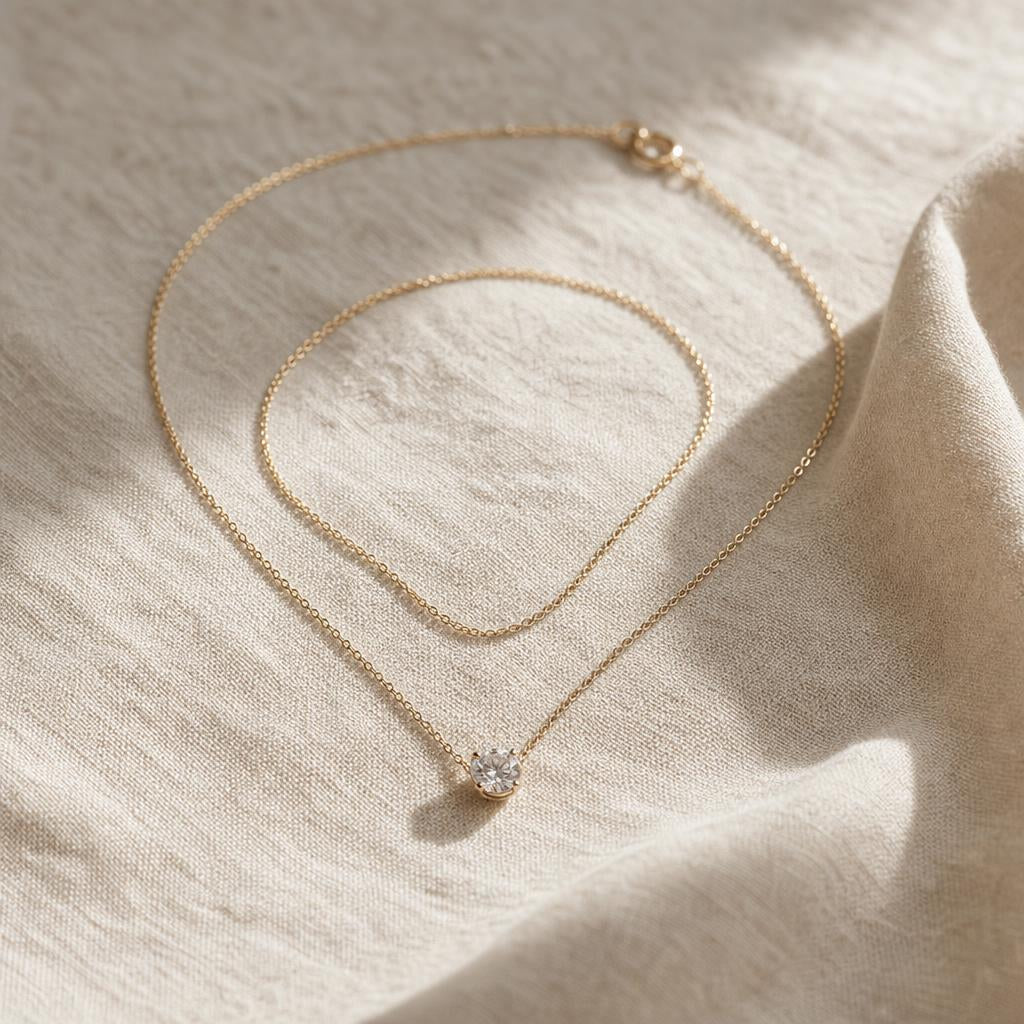
Quiet Luxury Necklaces: What a Minimalist Necklace Gets Right
There is a version of luxury that doesn't announce itself. No logo, no oversized stone doing the talking, no need to explain what something cost. It just sits there, catching light at exactly the right moment, and lets you do the rest.
That's the whole premise behind a minimalist necklace done well — and it's a very different skill than most jewelry counters give it credit for. Before we get into what actually makes one work, here's where to start looking.


What "Quiet Luxury" Actually Means in Jewelry
"Quiet luxury" gets thrown around as a label for anything expensive-looking, which misses the actual point. The idea isn't the absence of sparkle — it's the absence of a story you have to tell someone else. A logo tells people what something cost. A well-cut stone in a clean setting just gets worn, and the rest takes care of itself.
That distinction matters more for necklaces than almost any other category, because a necklace sits closest to the face, in the frame of every conversation and every photo. It's the piece people register even when they're not looking at your jewelry on purpose. Loud settings compete with your face. Quiet ones frame it.
What Actually Makes a Necklace "Minimalist" — Not Just Small and Plain
The mistake most people make is assuming the smallest necklace available is automatically the most restrained one. Size is part of it, but the real work happens in the setting. A stone that floats cleanly against the collarbone, with no visible prongs fighting for attention, reads as more deliberate than a larger piece crowded with detail — even at a fraction of the size.
The Lume Moissanite Necklace is a good example of that logic in practice: a minimal four-prong setting built specifically to let the stone appear to hover, rather than sit inside a heavier frame. The setting disappears. The light doesn't.

The Solène Necklace
A row of round-cut stones stationed evenly along a fine chain — enough movement to catch light without ever reading as a statement piece.
Shop The Solène Necklace →Bezel settings do a version of the same job from a different angle. Instead of prongs, the stone sits inside a smooth metal rim — durable, low-profile, and quietly architectural. The Aria Moissanite Necklace uses this setting for exactly that reason: it reads as considered rather than ornamental, which is the entire point of doing understated well.
The setting matters more than the carat weight
Worth knowing: two necklaces with the same size stone can read completely differently depending on how it's set. A halo adds visual weight and drama. A hidden prong or floating setting subtracts it. If the goal is understated, look at the setting description before you look at the carat number — it tells you more about how the piece will actually sit and photograph.
Worth knowing: A well-cut moissanite or Gemiros Signature Simulated Diamond isn't a compromise version of the sparkle — it passes diamond testers and reads as the real thing to the naked eye. The quiet-luxury logic works precisely because nobody can tell the difference from across a table, let alone across a room.
Gold or Silver: Reading the Room Before You Read the Metal
Metal tone is where a lot of people overthink the wrong variable. The honest answer is that both work — the decision comes down to your existing pieces and your undertone, not a rule about which one is "more quiet luxury." A dainty necklace in gold tends to read warmer and slightly more traditional against warm skin tones and yellow-gold jewelry already in rotation.
Silver, meanwhile, reads cooler and a little more modern. A dainty necklace in silver tends to disappear more completely against cooler skin tones, which is part of why it's become the default for the minimalist aesthetic online — it recedes rather than announces. Neither is objectively quieter than the other. The quiet comes from the setting and the proportions, not the metal color.
The Old Money Instinct, Without the Costume
A lot of what gets filed under "old money" style in jewelry is really just this same instinct taken to its logical end: fewer pieces, better proportioned, worn the same way every day instead of rotated for effect. The signet ring, the plain gold hoop, the single pendant on a fine chain — none of it is expensive by design, it's just restrained by design. That restraint is learnable. It doesn't require inheriting anything.
What it does require is choosing pieces that hold up to that kind of repetition — something you can wear five days a week without the setting loosening, the stone clouding, or the metal reacting against your skin. That's a materials question, not a style question, and it's the one most "quiet luxury" content skips entirely.
How to Wear a Minimalist Necklace So It Reads Intentional
A single quiet piece, worn consistently, reads more deliberate than three different necklaces rotated at random. That's the actual mechanism behind why understated jewelry photographs and reads as expensive: repetition signals confidence. Someone who wears the same considered piece every day looks like she isn't still deciding what she thinks about her own style.
If you do want to layer, keep the second piece shorter or longer than the first rather than matching lengths — the goal is a clean visual gap, not a cluster. A floating solitaire like the Stella Necklace works well as the anchor piece precisely because its clean 4-prong setting doesn't compete with whatever you layer beside it.

The Éclat Moissanite Necklace - Gold
A round-cut moissanite in a refined 6-prong solitaire setting — the kind of single-stone piece built to be worn every day, not saved for occasions.
Shop The Éclat Moissanite Necklace →Why This Matters More at Gemiros' Price Point, Not Less
There's an assumption that quiet luxury requires spending real money to earn the right to look understated — that restraint only reads as intentional when the price tag backs it up. That's the exact idea the whole category exists to push back on. A 925 sterling silver setting with a precision-cut moissanite or simulated diamond holds up to daily wear the same way a heavier price tag would, without the markup that's paying for a brand name rather than the piece itself.
The Leighton Necklace is a clean example: a cushion-shaped halo built specifically for daily brilliance rather than special-occasion sparkle, in nickel-free sterling silver that won't discolor skin or need babying. That's the actual definition of quiet luxury — a piece good enough that you stop thinking about it and just wear it.
Quick Takeaways
- Quiet luxury in jewelry is about setting and restraint, not logos or price tags
- An understated necklace works because of proportion and setting, not just small size
- Bezel and floating settings read as more considered than heavier, ornamental ones
- Gold or silver is a personal-undertone decision, not a "quieter" vs. "louder" one
- Wearing one considered piece consistently reads more intentional than rotating several
Frequently Asked Questions
What actually makes a necklace read as "quiet luxury" instead of just cheap and small?
Setting quality and proportion, not price. A precisely cut stone in a clean bezel or solitaire setting reads as considered regardless of what it cost — while a poorly proportioned piece can look inexpensive even with a heavier price tag behind it. The tell is always in the finish and the fit, not the size.
Is there a rule for how many pieces to wear at once?
A loose guideline some stylists use is limiting yourself to a small handful of pieces total — a necklace, a ring, a pair of earrings — rather than layering everything you own at once. It's a starting point, not a law: the real test is whether each piece has room to actually be seen.
What's the actual difference between "minimalist" and "dainty" when people describe necklaces?
They overlap but aren't identical. Dainty usually refers to scale — a fine chain, a small stone, a delicate build. Minimalist is broader and refers to design philosophy — clean lines, restrained detail, nothing extraneous — regardless of whether the piece itself is tiny or a little more substantial. A minimalist necklace can be delicate, but it doesn't have to be.
Does "old money" jewelry actually mean wearing real heirlooms?
No — it's a design language, not a family tree. The aesthetic borrows the restraint and consistency associated with old wealth (fewer pieces, worn the same way daily) without requiring anything to actually be inherited. Anyone can build that same wardrobe from scratch.
None of this is really about jewelry trends. It's about deciding what you want a piece to say before you buy it — and then choosing something restrained enough to say it well for years, not just for one photo. A quiet, considered necklace, worn the same way most days, ends up saying more than a rotating drawer of statement pieces ever will.


