

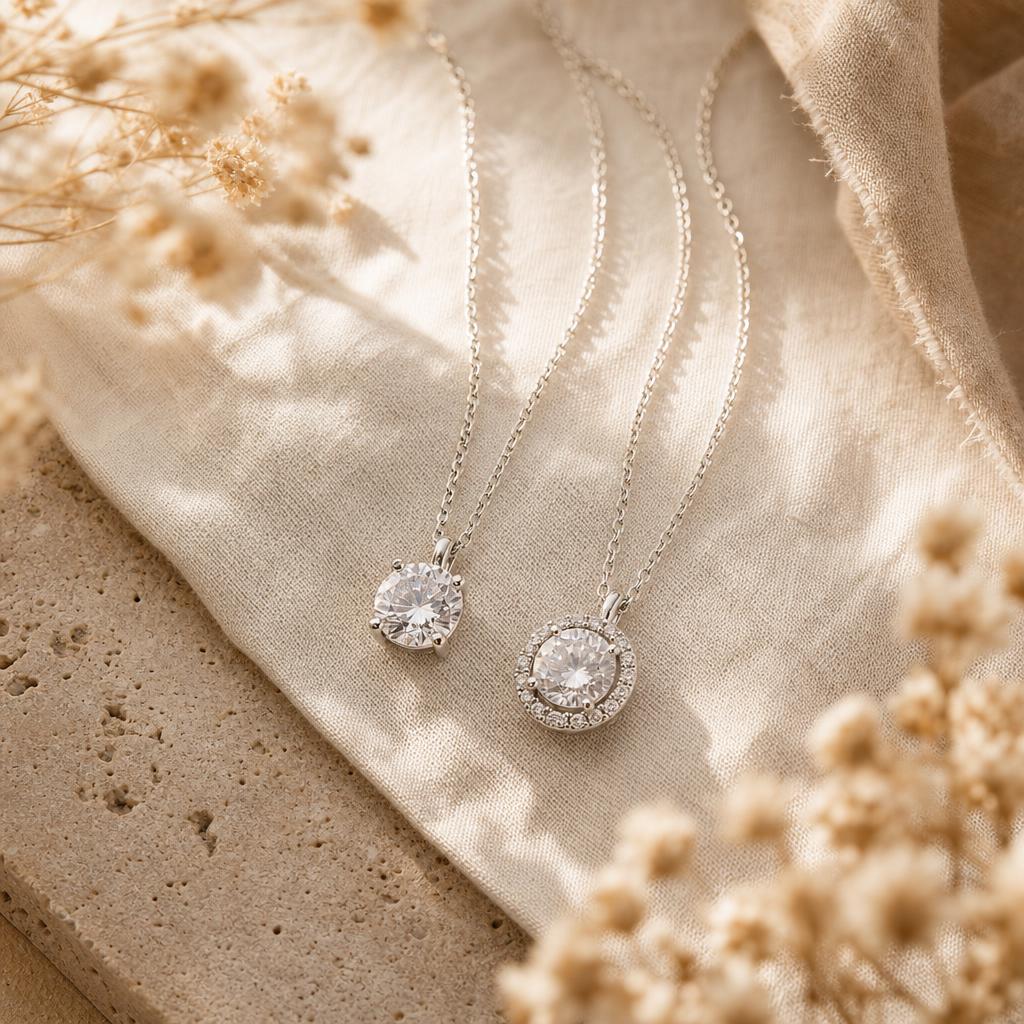
Halo Pendant Necklace vs. Solitaire: Two Different Philosophies
Open a jewelry box with a solitaire pendant on one side and a halo pendant necklace on the other, and you're not looking at two versions of the same idea. You're looking at two different arguments about what a stone is supposed to do. One says the center stone should stand entirely on its own. The other says brilliance is a group effort. Neither is more correct — but one of them is more correct for you, and most women never actually stop to figure out which.
Before we get into why the setting you choose says more about your taste than the carat weight ever will, here's a spread of both philosophies in action — so you can see the difference instead of just reading about it.


The Solitaire Philosophy: What One Stone Says When It Stands Alone
A solitaire pendant makes one decision and commits to it completely: the stone doesn't need anything else around it to be worth looking at. No pavé border, no supporting cast, no visual scaffolding. Just a single cut stone, held by the fewest prongs the setting can get away with, floating (sometimes literally, in a floating-solitaire mount) against your collarbone.
That restraint is the entire point. A solitaire pendant necklace reads as confident rather than cautious — it isn't trying to look bigger than it is or dress up a smaller stone with extra sparkle around the edges. It's the jewelry equivalent of a woman who doesn't over-explain herself. The stone is the sentence. There's no footnote.
This is also why a solitaire tends to photograph and wear cleaner than people expect. With nothing competing for attention around the center stone, the eye goes exactly where it's supposed to — which is part of why bezel-set and 6-prong solitaire moissanite pieces have become the quiet favorite for women who want daily-wear sparkle that never looks like it's trying too hard.

The Aria Moissanite Necklace
A round-cut moissanite set in a sleek bezel — the most secure, lowest-maintenance version of the solitaire argument. No prongs to snag, no halo to catch on a sweater.
Shop The Aria Necklace →The Halo Pendant Necklace Philosophy: Why Surrounding the Center Stone Changes the Whole Statement
This setting is making a completely different argument. Instead of asking one stone to do all the work, it surrounds the center cut with a ring of smaller accent stones — which does two things at once. Optically, it makes the center stone read larger and denser with light than its actual carat weight would suggest, because your eye registers the halo and the stone as one continuous shape. And structurally, it gives the piece more presence from a distance, which is exactly why halo settings tend to be the ones people notice first across a room.
The trade-off is intentional, not accidental. A halo necklace is louder by design — it wants to be seen, not just admired up close. That's not a flaw; it's a different job than the one a solitaire is doing. If a solitaire is a confident sentence, a halo is a fuller paragraph: more detail, more dimension, more reasons to look twice.
Worth knowing: A cushion-shaped halo, like the one framing a round center stone, reads slightly softer and more vintage than a perfectly round halo — worth considering if you already know your general aesthetic leans classic rather than modern.

The Élodie Necklace
A classic round halo pendant, refined down to its most essential form — the kind of halo necklace that reads elegant rather than ornate.
Shop The Élodie Necklace →Which One Actually Fits Your Neckline — and Your Personality
The styling logic is simpler than most guides make it sound. A solitaire pendant sits close and small against the skin, which makes it genuinely versatile — it layers underneath other pieces, works with a plunging neckline or a crewneck sweater equally well, and never competes with an outfit that's already making its own statement. If you tend to dress in a way that's deliberate but not loud, a solitaire pendant necklace is going to feel like an extension of that instinct rather than a departure from it.
A halo setting wants a little more room to do its job. It reads best against a bare neckline — a V-neck, a scoop, an off-the-shoulder top — where nothing crowds the extra dimension it's built to create. If your everyday style already includes a bit more texture and detail — a patterned blouse, a statement sleeve, a bolder lip — a halo won't feel like it's fighting for attention. It'll feel like it belongs.
Neither choice is about how "important" the moment is. A pendant necklace doesn't need an occasion to justify itself, and treating a halo as reserved for special events or a solitaire as the only "everyday" option is a rule nobody actually enforces except the jewelry store markup that wants you to buy more than one category of piece to feel complete. A well-made silver pendant necklace in either setting is durable enough, and versatile enough, to just live in your daily rotation.
Can You Own Both? The Case for Not Choosing at All
Here's the part most comparison guides skip: you don't actually have to pick a side. A solitaire and a halo necklace solve different problems, which means they're not really competing for the same slot in your jewelry box — one is your quiet, everyday layering piece, and the other is your reach-for-it-when-you-want-to-be-noticed piece. Owning one of each isn't indecision. It's just accurate self-knowledge: most women are not the same version of themselves every day, and their necklaces shouldn't have to pretend otherwise.
If you're building toward that pair deliberately, start with whichever setting matches how you dress on an average Tuesday, then add the other for the days that call for something different. That's a more useful rule than any "which one is more elegant" debate — elegance, in either setting, was never really in question. Gemiros necklaces are set in 925 sterling silver with simulated diamonds and moissanite that pass diamond testers and hold their shine with normal wear — the only real variable left is which philosophy matches the day you're having.
Quick Takeaways
- A solitaire pendant lets one stone stand alone — confident, minimal, and easy to layer under other pieces.
- A halo pendant necklace surrounds the center stone with accent stones, making it read larger and more dimensional from a distance.
- Solitaires suit closer necklines and quieter everyday styling; halos suit bare necklines and a bit more visual detail elsewhere in the outfit.
- Neither setting is more "special occasion" than the other — both hold up as daily wear.
- You don't have to choose permanently. Many women keep one of each for different days.
Frequently Asked Questions
What does a solitaire pendant actually symbolize?
Traditionally, a solitaire represents clarity and confidence — a single stone that doesn't need embellishment to make its point. In everyday styling terms, it's come to represent a more minimal, understated approach to sparkle rather than a maximalist one.
Does a halo setting actually make the center stone look bigger?
Yes — this is one of the few jewelry claims that's genuinely mechanical rather than marketing. Surrounding a center stone with smaller accent stones extends the visual footprint of the sparkle, so your eye reads the halo and the center stone as one larger shape rather than two separate elements.
Are pendant necklaces with a single stone still in style, or is that trend fading?
Solitaire pendants have stayed consistently relevant precisely because they're not trend-dependent — a single, well-cut stone on a fine chain doesn't date the way more elaborate designs sometimes do. It's a wardrobe basic, not a seasonal statement.
What's the real difference between a solitaire pendant and a hidden halo pendant?
A visible halo surrounds the center stone with an obvious ring of smaller stones. A hidden halo tucks that same ring of accent stones underneath the center stone, so from the front it reads almost like a solitaire — but with a subtle boost in perceived size and sparkle from certain angles. It's a middle option for anyone who wants a little more brilliance without a fully halo-forward look.
What chain length works best for a halo or solitaire pendant necklace?
A 16–18 inch chain is the most versatile choice for either setting — it sits at or just below the collarbone, which is exactly where you want the eye to land whether the pendant is a quiet solitaire or a more dimensional halo. Shorter chains push the pendant higher and make it read as bolder; longer chains soften the statement.
The honest answer to "which setting is better" is that it depends entirely on which version of your own taste you're trying to reflect on a given day — and refusing to pretend one setting is objectively superior to the other is, itself, the more intelligent way to shop.


