

How Much Jewelry Is Too Much? A Full-Look Rule for Rings, Necklaces and Earrings
There is no jewelry police, and no one is counting. But every woman who has caught her reflection on the way out the door and felt something was slightly off knows the question is real: how much jewelry is too much? The answer is less about a number than about who is doing the talking, you or the pile.
Most advice on this topic was written for one piece at a time. A necklace guide tells you how long to go. An earring guide tells you which pair suits your face. Nobody talks about the moment all three categories, plus a ring stack, meet in one outfit. Here is a way to decide, and a few pieces that show it working.


Stop counting pieces. Count what your eye lands on.
The most repeated answer online is a number: three pieces, no more. It sounds tidy, and it collapses the second you try to apply it. Is a stack of three thin bands three pieces or one? Are two small studs one pair or two items? A number can't tell you, because what actually reads as "too much" is competition, not quantity.
The better question is how many things are asking for attention at once. A whole stack of thin bands can read as a single quiet gesture. One oversized stone next to another oversized stone reads as a fight, even though it is only two pieces. Count focal points, not items.
The full-look rule: one star, two supporting players, everything else quiet
This is the framework we come back to whenever the ring, the necklace and the earrings all have to work together.
- Choose one star. One category leads. It is the piece you would be happiest to have noticed, and it gets the most visual weight: the biggest stone, the most sparkle, the boldest shape.
- Give it two supporting players. The other two categories stay in the background. They echo the star's shape or metal, but at half the volume.
- Keep everything else quiet. Anything beyond those three should disappear at arm's length: thin bands, tiny studs, a fine chain you forget you are wearing.
That is the whole rule. It also explains why coordinating a ring, necklace and earrings without overdoing it feels easy for some women and impossible for others. The ones who make it look effortless are not wearing less. They are letting only one piece speak up.
Worth knowing: Sparkle is the easiest thing to overspend. A brilliant, hidden-halo ring already throws light in every direction. If it is your star, the earrings can be small and clean, and the necklace can be a single fine solitaire.
Three star setups that work every time
The ring is the star
This is the setup for a woman who talks with her hands. The ring gets the stone, the stack or the halo, and everything above it goes minimal: small studs, a slim pendant on a short chain. Nothing near the face competes with what is happening at the fingertips.

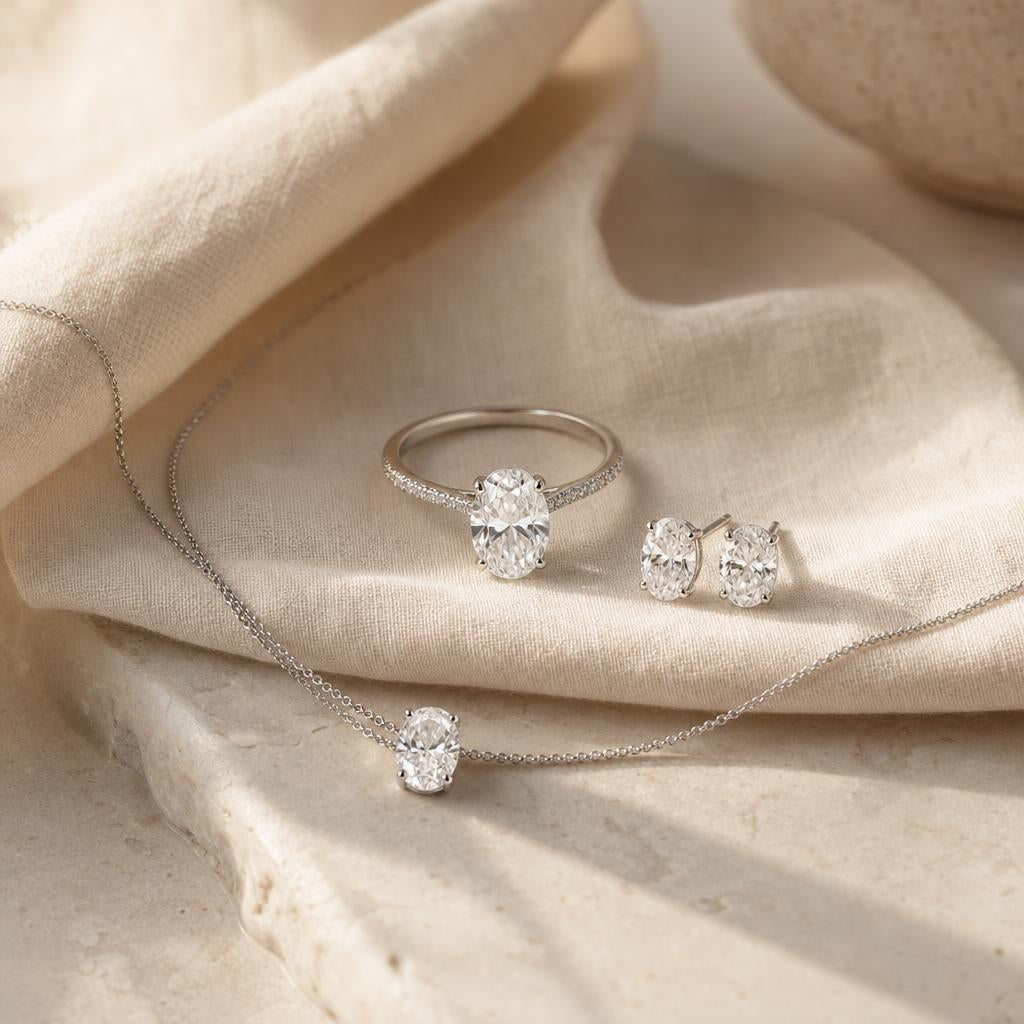
The Ophelia Ring
An oval center stone with a hidden halo and pavé band. It reads as a $15,000 or higher ring, which is exactly why the rest of the look can stay quiet around it.
Shop The Ophelia Ring →The necklace is the star
When the neckline is doing the work, a scoop, a V or an open collar, let the pendant lead and quiet the hands. The pendant's length should follow the neckline, which is the whole point of choosing a necklace for a V-neck. Earrings drop to small studs or huggies, and the ring is a single band or a solitaire.

The Meridian Moissanite Necklace
A marquise-cut moissanite solitaire. Its elongated shape draws the eye down the neckline, so it works as a lead piece with nothing else asking for attention.
Shop The Meridian Necklace →The earrings are the star
Hair up, collar open, a face-framing evening: this is when the earrings take the lead. A bigger stone or a halo goes in the ears, the neck stays bare or nearly so, and the ring is understated. If you love the idea of an earring you can wear for years, our guide to building a minimalist earring signature look shows how to keep the rest of the ear simple.

The Éclat Moissanite Stud Earrings
Six-prong round moissanite solitaire studs. Close to the ear, high on light, and clear enough to lead a look without needing a supporting cast.
Shop The Éclat Studs →Three quick checks before you leave the house
The removal test. Take one piece off. If the look improves, that piece was the extra. If it feels unfinished, put it back. The whole test takes ten seconds and is more reliable than any rule.
The zone check. Ears, neck, hands. If all three zones are loud, you have three stars. Turn two of them down.
The metal check. Mixed metals are not the problem, they are part of a modern look. Uncoordinated ones are. Pick a dominant tone, then let one deliberate accent break it. Our guide to mixing metals across every piece covers how to make that look intentional.
✦ Pro tip: Photograph yourself in a mirror once. A phone camera flattens the look and shows you what a stranger sees first. Whatever your eye lands on in the photo is your star. If two things fight for it, dim one.
How the answer shifts with the occasion
At work. Keep the star small and the supporting pieces smaller. A bezel pendant, studs and one ring is a complete, polished look that never distracts from what you are saying. Save the second and third sparkling pieces for after five.
At dinner or a party. This is where the star earns its keep. Add volume to one category only: a halo ring, a longer pendant or a bigger earring. Because the room is dimmer, light does the work that size would do in the daytime.
On a weekend. Fine, forgettable pieces win. The pair of studs you never remove, a chain that sits flat, a single band. A weekend look is where a full stack of layers can quietly come together, because every layer is light enough to stay out of the way.
When more is exactly right
None of this is an argument for wearing less. Plenty of the best-dressed women you know layer heavily, and it works because the layers share a logic: the same metal, the same size of stone, the same mood. A gold-toned stack of fine chains with fine studs and a slim stack of bands is a full look and a quiet one. The rules for wearing jewelry that hold up are the ones about hierarchy, not restraint.
It also depends on the day. A dinner or a wedding can carry more sparkle than a Tuesday meeting. If you want a systematic way to see what you really reach for, a jewelry wardrobe audit will show you which pieces earn the star spot and which just sit in the box.

The Aria Moissanite Necklace
A round brilliant moissanite in a bezel setting. Fine enough to sit under a statement ring or larger earrings without competing, bright enough to hold its own alone.
Shop The Aria Necklace →Quick Takeaways
- Count focal points, not pieces. A thin stack can be one gesture; two big stones are already a competition.
- Choose one star category, give it two quiet supporting players, and keep the rest fine enough to disappear.
- Run the removal test, the zone check and the metal check before you leave.
- Layering heavily is fine when every layer shares a logic.
Frequently asked questions
What is the rule of 3 in jewelry wearing?
It is a shorthand that suggests wearing no more than three visible pieces at once. It works as a starting point, but it treats a stack of bands and a single pendant as the same thing. The full-look rule above, one star and two supporting players, keeps the spirit of it while accounting for visual weight.
Can I wear a ring stack, a necklace and earrings on the same day?
Yes. The only condition is that they do not all lead. Let one category carry the sparkle and scale the others down to fine, close-fitting pieces.
Is it bad to never take off jewelry?
Not in itself, but everyday pieces last longer with basic habits: take them off for swimming, workouts and cleaning, and wipe them down regularly. Sterling silver keeps its finish best when it is not constantly exposed to lotions, perfume and water.
Does it look like too much if my pieces are all sparkly?
Sparkle multiplies. Three brilliant pieces can read as a chandelier. Choose one to be brilliant, and choose clean, simple shapes for the others so the eye has one place to land.
The best test of whether a look works is not what a rulebook says, but whether you walk out the door feeling like the smartest person in the room about your own style. Choose the star, quiet the rest, and wear all of it like you meant it.


