

Moissanite Jewelry Sets: How to Coordinate a Ring, Necklace and Earrings Without Overdoing It
There's a moment every woman with a moissanite ring eventually reaches: she loves how it catches light on her hand, and she starts wondering what that same brilliance would look like at her ears, at her collarbone. The question isn't whether she can build a full moissanite jewelry set — it's whether coordinating every piece reads as put-together, or as trying too hard.
The honest answer is that coordinated moissanite, done with a little restraint, reads as intentional rather than matchy. Overdone happens when every piece is identical instead of related. Here's how to tell the difference, and which pieces make it easy to get right.


Matching vs. Coordinated: The Difference That Actually Matters
"Matching" and "coordinated" get used interchangeably, and that's where most jewelry stacks go wrong. Matching means identical — the same cut, the same setting, the same size, repeated three times. Coordinated means related — the same stone, the same metal tone, a shared design language, expressed differently at each point on the body. One reads as a boxed department-store gift set. The other reads like she thought about it.
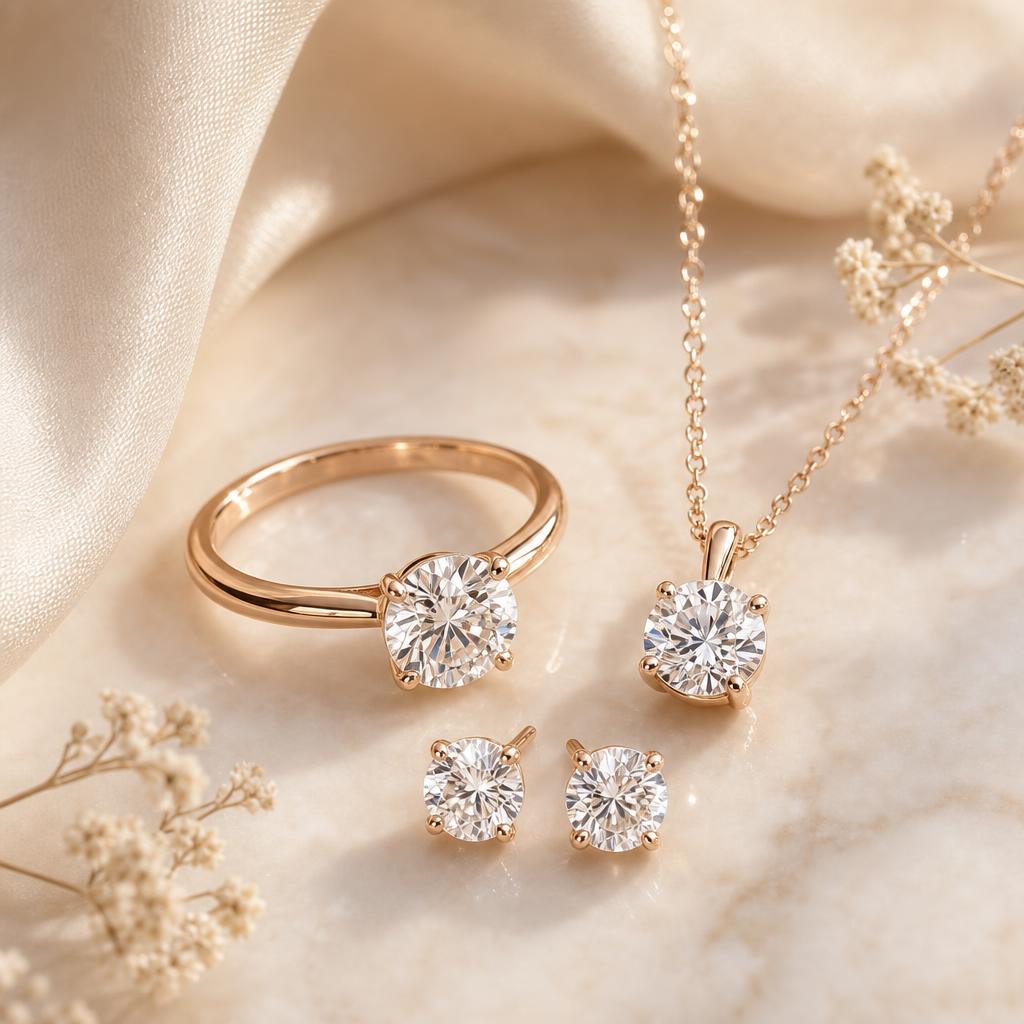
The Éclat line is a useful example of why this works. The ring, necklace, and stud earrings all share a round-cut moissanite in a six-prong solitaire setting — but each piece is scaled and shaped for where it sits. The ring carries the most visual weight because a hand can hold it. The necklace sits smaller, since a pendant on a chain has room to move and catch light on its own. The earrings are smaller still, framing the face rather than competing with it. Worn together, they don't look like three of the same thing — they look like one clear idea, applied with judgment.
The Case for Building a Moissanite Jewelry Set
There's a real argument for treating moissanite as a set rather than a series of one-off purchases. Stone quality is consistent — the same fire and brilliance she already trusts in her ring shows up identically in the necklace and earrings, so nothing looks like a downgrade next to the piece she wears daily. Buying with a plan also means fewer mismatched metals sitting in the same jewelry box, and it means every future purchase has a clear place to go instead of becoming its own isolated decision.
It also solves a problem she's probably already run into: the awkward gap between a ring that photographs beautifully alone and a neckline or earlobe that's been left bare by comparison. A coordinated set built around one consistent stone and setting style closes that gap without requiring three separate research projects.
Worth knowing: Moissanite isn't a diamond substitute that requires a disclaimer — it's a distinct gemstone that outperforms a mined diamond on fire (the flashes of rainbow color you see as it moves) while being indistinguishable from a diamond to the naked eye. It passes diamond testers. Building a coordinated set doesn't mean building a set of compromises.
Where Coordinated Tips Into Overdone
The line gets crossed when every piece is the exact same cut, size, and setting, worn all at once, with nothing left to contrast against. A round solitaire ring, a round solitaire necklace at the exact same carat weight, and round solitaire studs that mirror it precisely can start to look like a boxed gift set rather than a personal collection — polished, but a little impersonal. The fix isn't to abandon the coordinated approach. It's to let one piece anchor the look while the others echo it rather than repeat it exactly.
A halo setting next to a plain solitaire does this well. The Marchesa Moissanite Ring wraps a round-cut center stone in a cushion-shaped halo — same stone family as the Éclat pieces, a genuinely different silhouette. Worn on one hand while the Éclat necklace and earrings carry the cleaner solitaire look, the set reads as curated rather than uniform. That single point of contrast is often all it takes.

The Vivara Moissanite Huggie Hoop Earrings
A second earring option worth having in rotation. The huggie hoop silhouette wears differently than a stud — closer to the ear, more movement — so the same moissanite brilliance reads as everyday rather than a repeat of the earrings she wore yesterday.
Shop The Vivara Hoops →How Many Pieces to Actually Wear at Once
There's a simple styling framework worth knowing before assembling a matching jewelry set: let one category lead, and let the others support it. If the ring is the statement — a larger center stone, a halo, extra pavé — keep the necklace and earrings quieter, smaller stones in a simpler setting. If the necklace is doing the talking, a pendant with real presence, let the ring and earrings recede into something more minimal. Trying to make all three pieces equally loud at the same time is usually what tips a coordinated look into overdone, more than the stone choice ever is.
This is also where a second necklace option earns its place. Not every day calls for the same pendant.

The Lume Moissanite Necklace
A round-cut moissanite set in a minimal four-prong mount, designed to let the stone float on the chain rather than sit inside a heavier frame. A quieter option for days when the ring and earrings are already doing enough work.
Shop The Lume Necklace →Building the Set in an Order That Actually Makes Sense
Start with the ring, since it's the piece worn most consistently and the one that sets the tone for everything after it. From there, the earrings are the next logical addition — they're worn nearly as often as the ring and, unlike a necklace, don't compete with necklines or layered chains. The necklace can come last, chosen once she knows whether she wants it to match the ring's energy exactly or sit as the quieter, more minimal note in the set.
There's no requirement to buy all three at once, and there's no rule that says a matching jewelry set has to be purchased as a single transaction. Building it over a few months — a birthday earring upgrade here, a necklace added for a milestone there — often produces a more considered result than buying everything in one sitting.
Quick Takeaways
- Coordinated beats matching — same stone and metal tone, different scale and setting for each piece.
- One point of contrast (a halo next to a solitaire, for example) keeps a set from reading as a boxed gift rather than a personal collection.
- Let one category lead each day — statement ring with quiet earrings, or the reverse — rather than making every piece equally loud.
- Build the set in order: ring first, earrings next, necklace last, once you know what role it should play.
Frequently Asked Questions
Is moissanite a fake diamond?
No. Moissanite is its own gemstone, not a diamond stand-in — it's grown from silicon carbide and prized for having more fire than a mined diamond, meaning it throws more visible color as it catches light. It's indistinguishable from a diamond to the naked eye and passes diamond testers, which is exactly why it holds up across an entire coordinated set rather than just one ring.
What is the 2:1:1 rule in jewelry?
It's a loose styling guideline for building a set without overdoing it: roughly two supporting pieces (like stud earrings and a ring) for every one statement piece (a necklace or a bolder ring). It's not a strict formula, but it's a useful gut-check when a coordinated set starts to feel like too much at once — it usually means every piece is trying to be the statement instead of just one.
Can you wear earrings and a necklace at the same time?
Yes, and most days they should be worn together rather than treated as an either-or choice. The pairing works best when they don't fight for the same amount of attention — a smaller, quieter necklace under a more detailed earring, or the reverse, keeps the two from visually canceling each other out.
Is a moissanite jewelry set worth buying?
For anyone who already wears their moissanite ring daily, yes — the value case gets stronger with each piece, since the stone quality and setting language are already proven on the ring before the necklace or earrings are added. It also means a single, consistent standard for sparkle across everything worn at once, instead of one impressive piece surrounded by pieces that read as lesser by comparison.
A coordinated moissanite set isn't about matching for the sake of matching — it's about making sure every piece she puts on says the same thing about her taste. Start with the ring she already loves, add with intention rather than urgency, and let one piece lead the room instead of asking all three to shout at once.


