

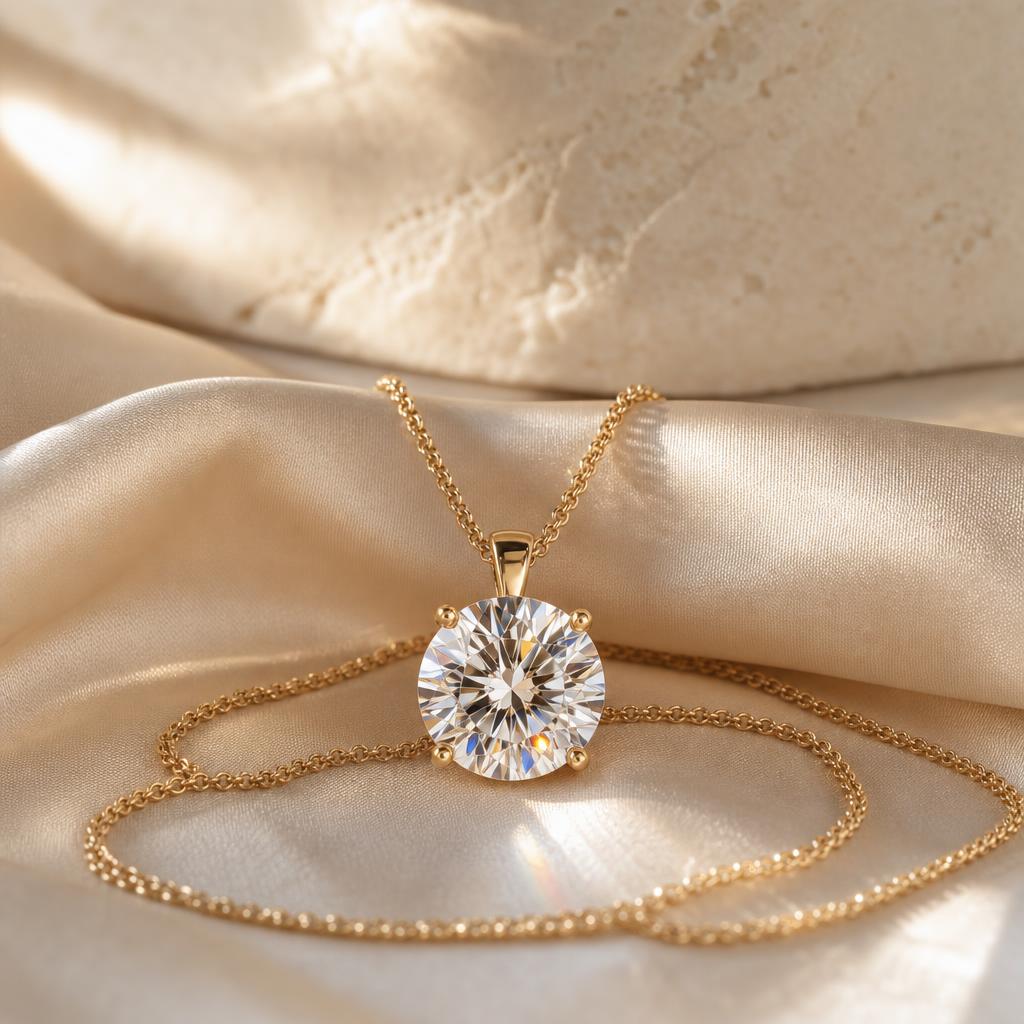
Moissanite vs. Diamond Necklaces: Same Fire, Different Story
Somewhere along the way, "moissanite" became a word women feel they have to defend. It shouldn't be. Moissanite is not a compromise, a placeholder, or a polite word for something lesser — it is its own gemstone, with its own brilliance, and it happens to outshine a diamond in the one category that actually matters at a glance: fire.
If you've been comparing moissanite and diamond necklaces and feeling like you need a geology degree to make the decision, here's the short version: they're different stones with different strengths, and once you know what each one is actually doing under light, the choice gets a lot easier.


What Moissanite Actually Is
Start with the chemistry, because it clears up almost every misconception in one sentence: a diamond is pure carbon, and moissanite is silicon carbide. They are not the same mineral wearing different names — they are two entirely different gemstones that happen to share a category, the way two singers can share a genre without sounding alike. Moissanite was first identified in fragments of a meteorite, which is a genuinely good story to have on hand the next time someone asks where the stone in your necklace came from. Nearly every moissanite necklace sold today is grown in a lab under controlled conditions, which is precisely why the clarity is so consistent — no inclusions to grade around, no waiting on what the earth happened to produce.
None of this makes moissanite a stand-in for a diamond. It's a mineral with its own optical fingerprint, and once you see what that fingerprint actually does under light, you'll understand why so many women stop thinking of it as the "other" option.
The Fire Difference: Why Moissanite Reads Brighter
Sparkle isn't one thing — jewelers break it into brilliance (the white light bouncing back at you) and fire (the flashes of color that scatter as the stone moves). This is where moissanite actually pulls ahead. Its refractive index is higher than a diamond's, which means it bends and splits light more aggressively. The result is more color-play: rainbow flashes under sunlight, under restaurant lighting, under the exact conditions where a diamond would settle into a quieter white sparkle. A diamond is composed and cool. Moissanite is animated. Which one reads as more expensive depends entirely on what you're comparing it to — but under direct light, most people clock the moissanite necklace first.
Worth knowing: The extra fire is also why moissanite passes a standard diamond tester. Testers measure thermal conductivity, and moissanite conducts heat in a way that reads in the same range diamonds do — a side effect of the chemistry, not a trick. It isn't performing as a diamond. It's simply a stone that happens to satisfy the same test.

The Lume Moissanite Necklace
A four-prong solitaire set in an illusion mount, so the stone appears to float against your collarbone with nothing visibly holding it there — every angle of light gets to reach the stone.
Shop The Lume Moissanite Necklace →Durability: What Actually Happens With Daily Wear
Diamonds sit at a 10 on the Mohs hardness scale — the hardest natural material there is. Moissanite sits at 9.25, which sounds like a meaningful gap until you remember what the scale is actually measuring: scratch resistance against other minerals, most of which never come near your neck. In practical terms, 9.25 is more than durable enough for a necklace worn every day, showered in, and forgotten about until someone compliments it. It won't cloud, dull, or lose its fire with wear. The Gemiros base metal is 925 sterling silver, nickel-free and hypoallergenic, so the part of the necklace actually touching your skin isn't the weak link either — that's usually where "will this hold up" concerns actually originate, and it's the part most comparison guides skip.
The Real Cost Difference
This is the part of the conversation people tend to soften, so we won't. A mined diamond's price is inflated by scarcity that's largely manufactured — controlled supply chains, decades of marketing that convinced an entire culture that three months' salary was a reasonable unit of measurement for love. Moissanite was never priced against that story. It's priced against what it actually costs to produce a stone this bright, this consistent, this durable. That's the entire gap. A moissanite necklace for women who've done the math isn't a cheaper version of the "real" thing — it's what happens when you stop paying for the myth and start paying for the stone.
| Comparison | Diamond | Moissanite |
|---|---|---|
| Composition | Pure carbon | Silicon carbide |
| Hardness (Mohs) | 10 | 9.25 |
| Sparkle style | White brilliance | Rainbow fire, higher refraction |
| Origin today | Mined or lab-grown | Almost always lab-grown |
| Passes a diamond tester | Yes | Yes |
| Price driver | Scarcity, tradition, markup | Production cost only |
Which Necklace Style Actually Shows Off That Fire
Setting matters as much as the stone. A moissanite pendant hanging from a fine chain lets the stone move with you, catching light from a dozen different angles over the course of a day — which is exactly why solitaire pendants outsell almost every other silhouette in this category. A single well-cut solitaire, set high off the chain rather than buried in a heavy mounting, will often out-sparkle a necklace with three times the stones simply because nothing is blocking the light from reaching it.
Fuller silhouettes work on the same principle, just scaled up. More stones set in a continuous line means more surface area catching fire at once, which is why a heavier design can read as more dramatic even when each individual stone is fairly modest.

The Faith Moissanite Necklace
A small moissanite-set cross in sterling silver — quieter than a solitaire, but the same fire when it catches the light.
Shop The Faith Moissanite Necklace →If you've been drawn to the continuous sparkle of a moissanite tennis necklace, that's the exact effect described above at work — a straight line of stones doing collectively what one larger solitaire does alone. If you gravitate instead toward something with more symbolic weight, a cross or celestial pendant carries the same fire in a smaller, quieter package — worth considering if you want the sparkle without the necklace announcing itself first.
Sterling Silver, and Why the Setting Metal Matters
The stone gets all the attention, but the metal decides how the necklace actually lives on your body. Gemiros sets every design in 925 sterling silver — a metal chosen for a reason beyond aesthetics. It won't discolor skin, it holds a polish for years with minimal care, and it doesn't carry the premium markup of solid gold while looking any less finished. Whether you choose a solitaire pendant or a fuller moissanite chain, sterling silver is the metal quietly doing the daily work underneath the sparkle. If you're weighing metal options across your wider jewelry collection, it's worth understanding the karat differences before you commit — the short version is that the number changes durability and color far more than it changes how "real" anything looks.
✦ Pro tip: If you're building toward a layered look, choose one moissanite piece as your anchor — a solitaire pendant or the North Star silhouette both work — and let simpler chains do the supporting work around it. Competing focal points is the fastest way to make a genuinely beautiful necklace look busy.
That layering instinct is worth developing generally, not just around moissanite pieces — how you sequence pendant and chain, and how many necklaces actually work together before it starts looking accidental, changes the whole effect. It's also worth knowing what actually happens to sterling silver over time before you buy, since most of what people assume about tarnish turns out to be wrong.
Quick Takeaways
- Diamond and moissanite are chemically different gemstones — moissanite isn't a "version" of a diamond, it's silicon carbide with its own optical properties.
- Moissanite has a higher refractive index, which means more visible fire and color-play than a diamond under the same light.
- At 9.25 on the Mohs scale, moissanite is more than durable enough for daily wear and passes standard diamond testers.
- The price gap reflects manufactured scarcity in the diamond market, not a quality gap in the stone.
- Setting matters: solitaire pendants and tennis-style silhouettes both maximize how much light reaches the stone.
Frequently Asked Questions
Is moissanite a real diamond?
No — and it isn't trying to be. Moissanite is silicon carbide, a distinct gemstone with its own chemical structure. It isn't a lesser stand-in; it's a different mineral that happens to sparkle even more under direct light, and it passes diamond testers because of how it conducts heat, not because it's imitating anything.
Are moissanite necklaces worth it?
Yes, on the terms that actually matter: brilliance, fire, and daily durability. A moissanite necklace holds its sparkle for years of regular wear, and because the price isn't inflated by the same scarcity narrative that drives diamond pricing, you're paying for the stone itself rather than the story around it.
What's the downside of moissanite?
Its fire is more colorful than a diamond's — under certain lighting, moissanite throws more rainbow flashes rather than pure white light. Whether that reads as a downside is really a style preference; plenty of women choose moissanite specifically because they prefer the livelier sparkle.
How should I decide what to spend on a moissanite necklace?
Let the setting guide the decision more than the carat size. A well-cut solitaire set high off the chain will out-sparkle a larger stone buried in a heavy mount, so prioritize a setting that lets light reach the stone from every angle before you prioritize size.
What should I look for in moissanite quality?
Cut matters most — a precise round brilliant or six-prong solitaire cut will maximize fire far more than clarity grading does, since lab-grown moissanite is already consistently clear. After cut, look at the setting metal: 925 sterling silver that's nickel-free and hypoallergenic will keep the necklace comfortable through years of everyday wear.
The comparison was never really diamond versus moissanite — it was tradition versus what you've actually figured out for yourself. Once you understand what's happening chemically and optically, the necklace stops being a compromise and starts being a decision you can defend without a second thought.


