

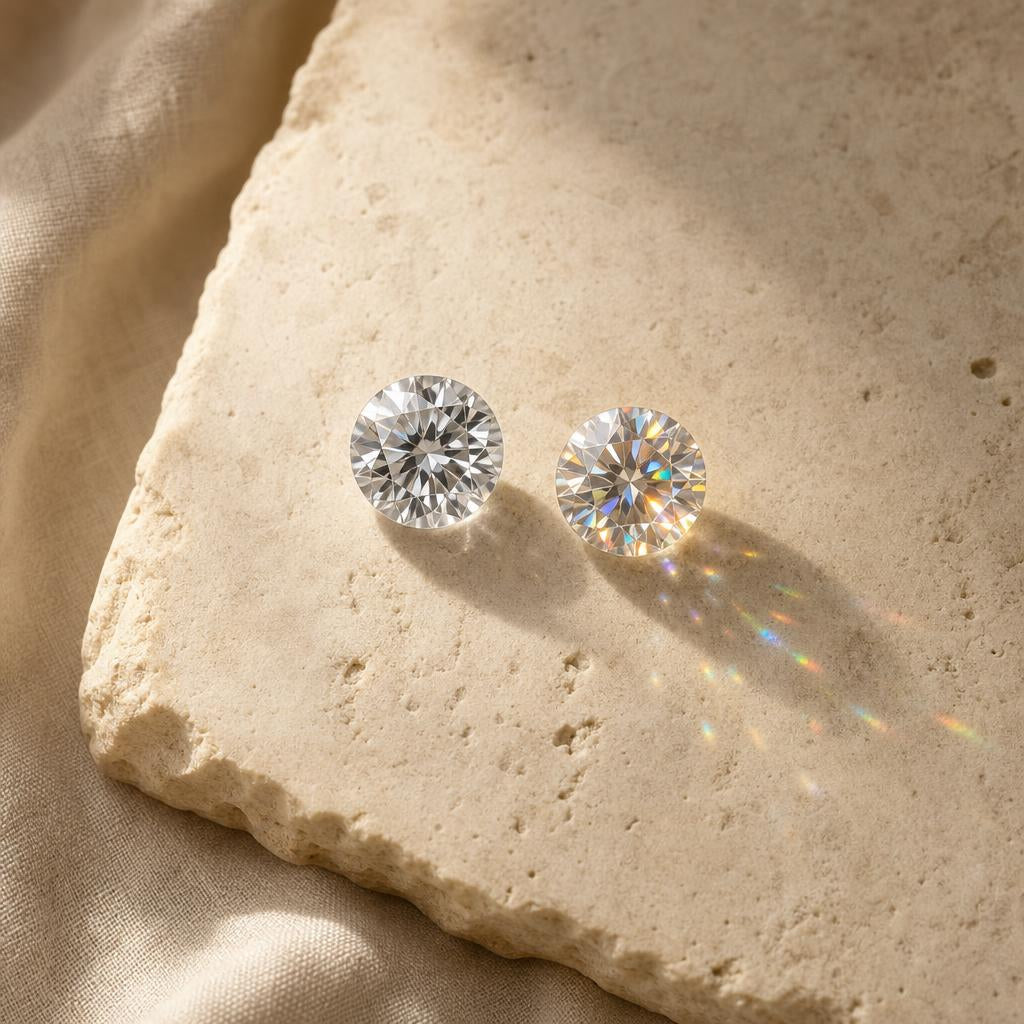
Moissanite vs. Diamond, Side by Side: What the Difference Actually Looks Like
Put a moissanite next to a diamond and the first thing you'll notice is how little separates them at a glance — and how much separates them everywhere else. One throws more color. One costs a fraction of the other. One requires a mining supply chain; the other doesn't. If you've been circling the moissanite vs diamond question without a straight answer, here's the side-by-side comparison, without the sales pitch.
Before we get into refractive indexes and price charts, it helps to see what the difference actually looks like on a hand — not in a lab, in real light, in a ring you'd actually wear every day.


What Moissanite and Diamond Actually Are
Start with the basics, because most of the confusion traces back here. A diamond — mined or lab-grown — is pure carbon, crystallized under extreme heat and pressure. Moissanite is silicon carbide, a completely different mineral that was first identified in a meteor crater before scientists learned to grow it in a lab. It isn't a stand-in for a diamond. It's its own stone, with its own optical fingerprint, and that fingerprint is precisely why it photographs the way it does.
That distinction matters because it explains everything else on this list. Moissanite isn't trying to be a diamond and falling short — it's a different gemstone that happens to rival a diamond's brilliance while outperforming it in a few specific, measurable ways. Once you understand that, the rest of the comparison gets a lot more interesting.
The Sparkle Difference: Fire vs. Brilliance
This is where moissanite actually pulls ahead. Diamond has a refractive index of roughly 2.42; moissanite sits higher, around 2.65–2.69. In plain terms, moissanite bends light more aggressively, which means more of it comes back at you as visible sparkle. Diamond returns a controlled mix of white brilliance with restrained flashes of color. Moissanite returns noticeably more "fire" — the rainbow flashes you see when a stone catches direct light.
Step outside with both stones and the effect becomes obvious. In sunlight, moissanite throws a visibly more colorful, almost disco-ball sparkle, while a diamond keeps its sparkle whiter and more restrained. Neither is objectively better — it's a genuine style preference, not a quality gap. Some women want the quieter, crisper flash of a diamond-style stone. Others want the stone that gets noticed from across the room. Gemiros' Signature Simulated Diamonds are cut to sit closer to that classic white brilliance, which is worth knowing if you've already decided which effect you prefer.

The Victoire Moissanite Ring
A 3ct radiant-cut center flanked by two pear-cut side stones, 4ct total — more facets means more surfaces catching and throwing light, which is exactly where moissanite's extra fire shows up most.
Shop The Victoire Moissanite Ring →Hardness and Everyday Durability
On the Mohs scale, diamond sits at a perfect 10 — the hardest known natural material. Moissanite comes in at 9.25 to 9.5, which sounds like a meaningful gap until you consider what it actually means for daily wear: moissanite is still harder than sapphire, harder than an emerald, and more than durable enough to be worn every single day without babying it. The gap between a 10 and a 9.25 shows up in laboratory scratch tests, not in the real life of a ring that gets worn to the gym, to the sink, and everywhere in between.
Worth knowing: Hardness measures resistance to scratching, not resistance to chipping or cracking. A stone's setting — how deep the prongs sit, how protected the girdle is — often matters more for everyday durability than the half-point difference in Mohs hardness.
Does Moissanite Pass a Diamond Tester?
Yes — and this is the detail most first-time buyers don't expect. Standard diamond testers work by measuring thermal conductivity, and moissanite conducts heat almost identically to a diamond. A basic thermal tester pen will read moissanite as a diamond, full stop. It takes a dual thermal-and-electrical tester, the kind most everyday jewelers don't carry, to separate the two reliably.
This isn't a loophole or a workaround — it's simply how the physics plays out. Moissanite is indistinguishable from a diamond to a standard tester, and to the eye of anyone who isn't specifically trained to spot double refraction under a loupe. If the fear driving your search was "will people be able to tell," the honest answer is: not with the tools most people actually have access to.
Price, Side by Side: What You're Actually Paying For
Here's where the comparison stops being close. A one-carat natural diamond typically runs $3,000 to $6,000 or more, depending on cut, color, and clarity — and that's before the markup that comes with a traditional jewelry store's overhead. A comparable moissanite costs a small fraction of that. You're not paying for scarcity engineered by a supply chain; you're paying for a stone that was grown to spec and set well.
Put it in real terms: a ring styled like the Ophelia — a 4ct-plus oval hidden halo — reads as the kind of piece that could easily run $15,000 or higher through a traditional retailer. Gemiros' entire moissanite collection sits under $200. That's not a discount on the same thing. It's a different way of thinking about what a ring's price is actually supposed to reflect.

The Carrée Moissanite Ring
A four-claw princess-cut solitaire with a pavé half-band — sharp, architectural lines that show off moissanite's fire without a single halo stone competing for attention.
Shop The Carrée Moissanite Ring →Can You Actually Tell Them Apart?
In everyday indoor lighting, at conversation distance, no. Moissanite and a well-cut simulated diamond both read as convincing, high-quality sparkle to the naked eye — that's the entire point of the stone. The differences that do exist (the extra fire, the very slight softness on the hardness scale) show up under close, deliberate examination: a jeweler's loupe, direct sunlight, side-by-side comparison under a single light source. They don't show up across a dinner table.
That's not a loophole to exploit. It's simply what the physics and the optics actually support — a ring that reads as expensive, considered, and finished, whether the person looking at it knows the technical difference or not.
Quick Takeaways
- Diamond and moissanite are chemically different stones — carbon vs. silicon carbide — not a "real" version and a copy
- Moissanite has a higher refractive index, so it throws more colorful fire; diamond keeps a whiter, more restrained sparkle
- Diamond rates a 10 on the Mohs scale, moissanite a 9.25–9.5 — both are more than durable enough for daily wear
- Moissanite passes a standard thermal diamond tester because it conducts heat almost identically to a diamond
- A one-carat natural diamond runs $3,000+; a comparable moissanite is a fraction of that cost
- To the naked eye, in normal light, most people cannot tell the two apart
Frequently Asked Questions
Will moissanite pass a diamond tester?
Yes. Standard thermal diamond testers measure how quickly heat moves through a stone, and moissanite conducts heat almost as well as a diamond does. A basic tester reads it as a diamond. Only a dual thermal-and-electrical multi-tester — equipment most jewelers don't keep on hand — can reliably separate the two.
Can a jeweler tell the difference between moissanite and a diamond?
A trained jeweler can, using a loupe to check for moissanite's double refraction — a subtle doubling of the back facet lines that diamonds don't show. Without that specific check, or under normal viewing conditions, even a jeweler is unlikely to spot it on sight.
Is moissanite cheaper than a diamond?
Significantly. A one-carat natural diamond typically costs $3,000 to $6,000 or more depending on cut, color, and clarity. A comparable moissanite runs a small fraction of that, and the price scales far more gradually as carat size increases.
Does moissanite look like a diamond?
Close enough that most people can't tell them apart in everyday light. Moissanite is near-colorless, cuts to the same kind of brilliance, and reads as convincing sparkle at conversation distance. The visible difference — more colorful fire, especially in direct sun — only shows up if you're looking for it.
Does moissanite sparkle more than a diamond in sunlight?
Yes, in a specific way. Moissanite's higher refractive index means it throws more colorful "fire" in direct sunlight, while a diamond keeps a whiter, more balanced brilliance. It's a difference in sparkle style, not sparkle quality — some buyers actively prefer moissanite's more colorful flash.
What is the actual downside of moissanite?
The most commonly cited one is that larger stones can show slightly more colorful fire than some buyers want in an everyday ring — a style preference, not a flaw. It also has minimal resale value compared to a natural diamond, though that's equally true of most jewelry bought at retail rather than wholesale.
Can you tell moissanite from a diamond just by looking at it?
Not reliably, and not from a normal viewing distance. Both stones read as convincing, high-quality sparkle to the naked eye in everyday light. The differences that do exist only become visible under a loupe or in direct, deliberate side-by-side comparison.
The honest version of this comparison isn't "diamond good, moissanite consolation prize." It's two different stones, with two different sparkle personalities and two very different price tags, that both do exactly what a ring is supposed to do: catch the light and hold it. Once you've seen them side by side, the choice usually stops being about which one is "real" — and starts being about which sparkle you actually want to wear.


