

Is a Simulated Diamond a Real Diamond? Natural vs. Lab-Grown vs. Simulated, Explained
Somewhere between the jewelry counter and the internet rabbit hole, three words got tangled together: natural, lab-grown, and simulated. They get used like synonyms. They are not. And if you're trying to buy a ring with real confidence instead of a vague sense that you might be missing something, the difference is worth five minutes of your attention.
Here's the short version before we go long: two of those three terms describe an actual diamond. One does not — and that's not a downgrade, it's a different, entirely defensible category. Below is what each term actually means, where the confusion comes from, and why the distinction matters more for your peace of mind than your budget.


The Three Terms, Actually Defined
A natural diamond formed underground over a billion or so years and was mined out of the earth. A lab-grown diamond is chemically, physically, and optically identical carbon — grown in weeks instead of eons, using heat and pressure that mimic the earth's own process. Gemologically, both are diamonds. Full stop.
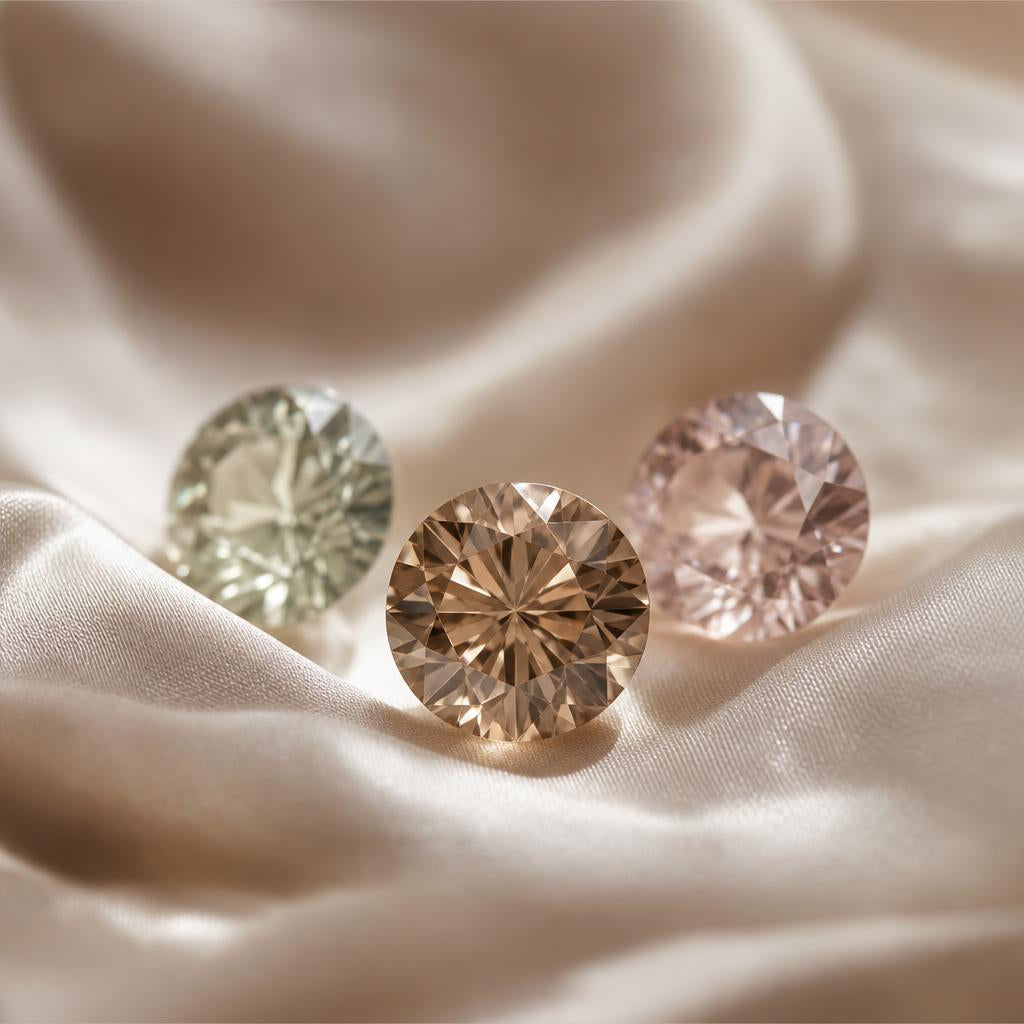
A simulated diamond is a different category entirely. It's a gemstone engineered to deliver the same visual experience — the brilliance, the fire, the way it catches a room — without being carbon at all. Moissanite (silicon carbide) and cubic zirconia are the two simulants doing most of the work in modern jewelry, and they're the reason a demi-fine ring can sit next to a piece that reads as significantly more expensive and make the room do a double take.
Worth knowing: "Simulated" is not a grading term or a euphemism — it's the accurate, industry-standard word for a stone built to replicate a diamond's optical performance using different material science. It's a category, not a compromise.
Laid side by side, the practical differences come down to composition, hardness, and how each stone is graded — not how impressive it looks on your hand.
| Type | Composition | Hardness (Mohs) | Graded Like a Diamond? |
|---|---|---|---|
| Natural diamond | Crystallized carbon | 10 | Yes |
| Lab-grown diamond | Crystallized carbon | 10 | Yes |
| Moissanite | Silicon carbide | ~9.25 | No — own grading standards |
| Cubic zirconia | Zirconium dioxide | ~8–8.5 | No — own grading standards |
Notice that moissanite and cubic zirconia sit in their own row, not underneath diamond as a lesser version of it. They're a parallel category with their own rules — which is exactly why they can't be graded on the same scale a jeweler would use for a mined or lab-grown stone.
Is a Simulated Diamond a Real Diamond?
No — and this is the one place the internet tends to get squeamish instead of just answering the question. A simulated diamond is not carbon, so gemologically it isn't classified as a diamond of any kind, mined or lab-grown. What it is: a stone with its own hardness rating, its own light behavior, and its own reason for existing — namely, giving you the look the diamond industry has spent a century pricing like scarcity is a virtue, without asking you to finance that scarcity yourself.
The confusion usually starts because people assume "not a diamond" must mean "lesser." It doesn't. A well-cut moissanite in a properly set piece is indistinguishable from a diamond to the naked eye — including, for what it's worth, your jeweler's. That's not a hedge. That's the actual, testable claim.
Simulated Diamond vs. Lab Diamond: What Actually Changes
This is the comparison that trips up the most shoppers, because both options are marketed as "diamond alternatives" even though only one of them is technically a diamond. A lab diamond costs less than a mined stone but still prices like a diamond, because it is one — same 10 on the Mohs hardness scale, same certification pathways, same long-term investment logic. A simulated diamond skips that pricing structure entirely, because it was never trying to compete on the diamond industry's terms in the first place.
Here's the part that actually matters day to day: for a ring you're going to wear constantly — stacked, worn to the gym, worn on a plane — the visual payoff of a well-set simulant rivals a lab diamond's, at a fraction of the commitment. You're not buying a smaller version of the same thing. You're buying a different thing that happens to look extraordinary on your hand.

The Astrid Ring
A 3-carat asscher-cut simulated diamond with architectural side stones — the kind of scale that usually comes with a five-figure quote attached. Set in 925 sterling silver.
Shop The Astrid →Where Moissanite Fits: Simulated Diamond vs. Moissanite
Moissanite is a simulated diamond — specifically, it's the simulant with the strongest case for daily wear. Where cubic zirconia sits around 8 to 8.5 on the Mohs hardness scale and can dull with years of contact, moissanite comes in at roughly 9.25, second only to diamond itself. It also has a higher refractive index than a mined stone, which means more fire — some people find it flashier than a diamond, not less impressive.
This is the material logic behind why Gemiros builds on moissanite and CZ rather than treating "simulated" as one interchangeable bucket. The stone in your ring isn't a stand-in for something better. It was chosen because it holds up.
Will It Pass a Diamond Tester?
Standard diamond testers measure thermal conductivity, and cubic zirconia fails that test outright — it simply doesn't conduct heat the way carbon does. Moissanite is the exception that surprises people: because silicon carbide also conducts heat efficiently, moissanite can register as "diamond" on a basic thermal tester. Only the dual thermal-and-electrical testers gemologists use professionally can reliably separate the two.
The takeaway for anyone buying with confidence: a well-made simulated diamond isn't hoping nobody looks closely. It's genuinely built to hold up under normal scrutiny — including diamond testers, including your jeweler's eye, including the friend who swears she can always tell.
Quick Takeaways
- Natural and lab-grown diamonds are both carbon — the only difference is where and how they formed.
- A simulated diamond (moissanite or cubic zirconia) is a different material engineered to match a diamond's look, not a lesser diamond.
- Moissanite passes basic thermal diamond testers; cubic zirconia does not — only dual testers reliably tell simulants apart from diamonds.
- "Simulated" describes the material category, not the quality of what's on your hand.
Why This Distinction Is Actually Good News
Once you stop hearing "simulated" as a synonym for "settling," the whole category opens up. You're not choosing a lab diamond because it's the closest thing you can afford to a mined stone. You're not choosing a simulated diamond because you couldn't swing a lab-grown one. You're choosing the material that gets you the look you actually want, at the price and durability profile that makes sense for how you actually live — stacked, traveled with, worn every single day without a second thought.
That's the real value of knowing these three terms cold: it turns a purchase built on uncertainty into one built on information. You end up smarter for having asked the question in the first place — and that's a very different feeling from hoping nobody asks you first.
It also changes how you shop long-term. Once "simulated" stops sounding like a warning label, you stop treating every ring purchase as a one-time, high-stakes decision and start treating it the way you'd treat any other piece of your wardrobe: something you can have more than one of, in more than one style, without the guilt or the years-long saving-up ritual that mined diamonds have quietly trained shoppers to expect. A stack of simulated diamond pieces, chosen deliberately, tells a more interesting story on your hand than a single stone you spent a decade waiting to justify.

The Morgan Ring
A brilliant 3-carat princess-cut simulated diamond with a pavé band — clean lines, serious sparkle, zero pretense. Set in 925 sterling silver.
Shop The Morgan →What This Actually Means When You're Shopping
Once the vocabulary is sorted, the buying decision gets a lot simpler — but a few practical questions still matter. First: ask what the center stone actually is before you ask anything else. Listings that say "diamond alternative" without naming the material are worth a second look; a straightforward listing will tell you outright whether you're looking at moissanite, cubic zirconia, or something else.
Second: pay attention to the setting, not just the stone. A 925 sterling silver band with rhodium or gold plating does the quiet work of making a simulated diamond look intentional rather than incidental — a great stone in a flimsy setting still reads as an afterthought. The stone gets the credit, but the setting is doing a lot of the actual heavy lifting.
Third: think about how you actually live with jewelry, not how you imagine you might. If a ring is going to get worn on flights, at the gym, in the pool, and to bed most nights, hardness and setting security matter more than whichever term is printed on the listing. That's the entire case for building a piece around a stone that's engineered for exactly that kind of life, rather than one that's simply inherited a reputation for being precious.
Frequently Asked Questions
Are simulated diamonds lab-grown?
Not in the way "lab-grown diamond" is typically used. A lab-grown diamond is real carbon grown in a controlled environment. A simulated diamond, like moissanite or cubic zirconia, is manufactured too, but from an entirely different material — it's engineered to look like a diamond, not to be one.
Do simulated diamonds look like real diamonds?
Yes — to the naked eye, a well-cut simulated diamond in a properly set piece is indistinguishable from a mined or lab-grown diamond. The differences show up in lab testing and long-term hardness, not in how it reads across a dinner table.
Do simulated diamonds pass a diamond tester?
It depends on the stone. Moissanite conducts heat efficiently enough to register as "diamond" on a basic thermal tester — only the dual thermal-and-electrical testers gemologists use professionally can reliably tell the two apart. Cubic zirconia, by contrast, fails a standard tester outright.
How long do simulated diamonds actually last?
Moissanite, worn daily, holds up for years without clouding or losing brilliance — it's nearly as hard as a diamond. Cubic zirconia is softer and can show wear sooner, which is one reason Gemiros builds its collection around 925 sterling silver settings designed for the stones inside them.
The next time someone uses "natural," "lab-grown," and "simulated" interchangeably, you'll know exactly where the line actually sits — and exactly which side of it makes sense for the ring you're about to wear every day.


