

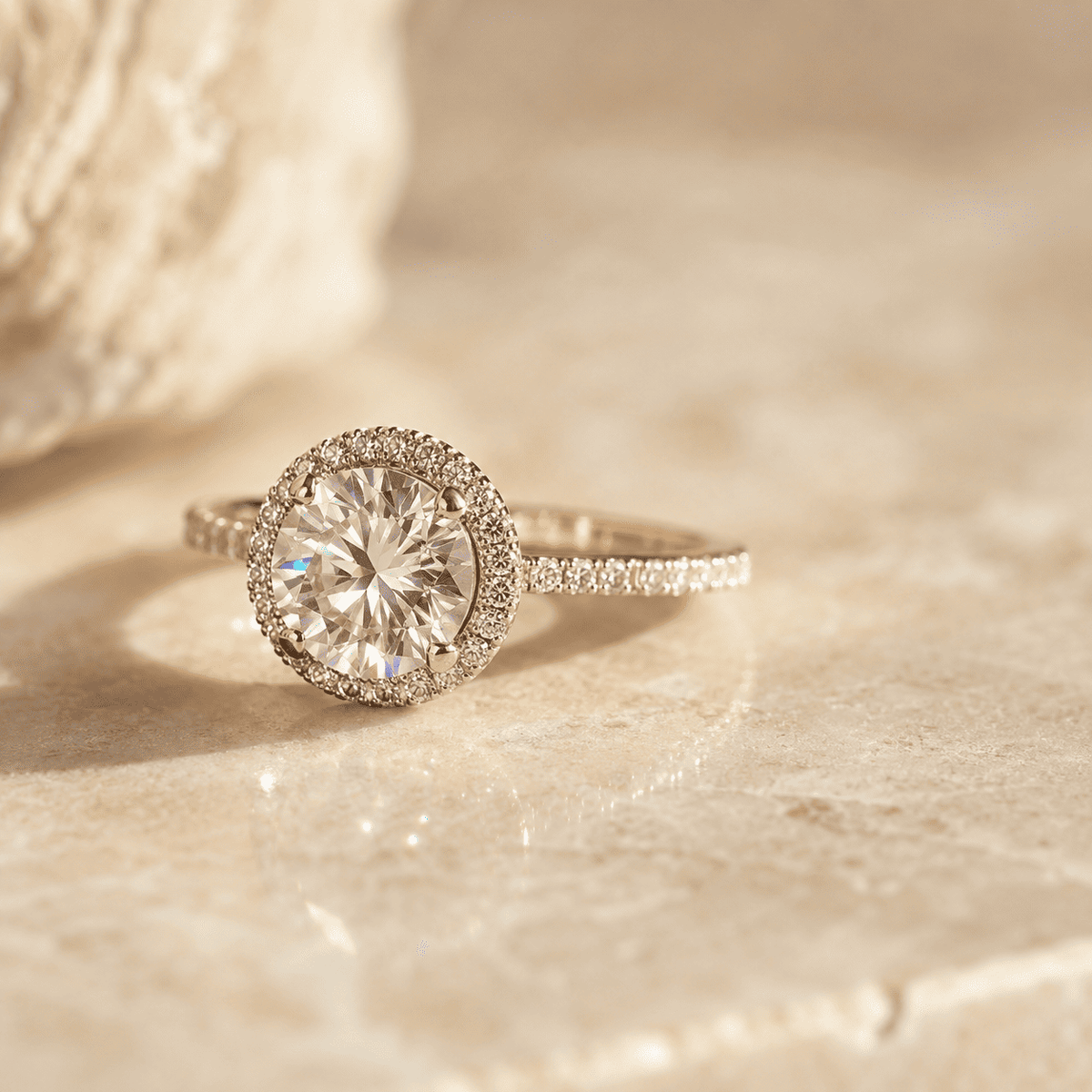
Is a Simulated Diamond Ring Worth Buying? Honest Answers for First-Time Shoppers
You've seen the rings. You've done the comparison tabs. And now you're asking the question that most people are too embarrassed to type out loud: is a simulated diamond ring actually worth buying — or is it just a fancy way of saying "fake"? Here are the honest answers.
Simulated diamonds have been available for decades, but the category has changed dramatically in the last few years. The materials have improved, the craftsmanship has caught up, and the reasons people buy them have quietly shifted. Whether you're considering one as a travel ring, an engagement ring alternative, or simply a beautiful piece you actually want to wear, this guide will tell you what you need to know — without the sales pitch.


First: what exactly is a simulated diamond?
A simulated diamond is any stone designed to visually replicate the look of a natural diamond. Unlike lab-grown diamonds, which are chemically identical to mined diamonds, simulated diamonds are a different material entirely — typically cubic zirconia (CZ) or moissanite — cut, polished, and set to look as diamond-like as possible.
The key difference is one of chemistry, not appearance. A natural diamond is carbon. A high-quality simulated diamond is either silicon carbide (moissanite) or zirconium dioxide (CZ). Both are hard, brilliantly clear, and cut to fire light the way a diamond does — but neither is a diamond, and no quality brand will tell you otherwise.
Worth knowing: "Simulated diamond" is the honest trade term. If a listing calls a CZ or moissanite a "diamond" outright, that's a red flag. A good brand will be transparent about what you're buying.
How do they actually look in real life?
This is the question that matters most, and the honest answer is: very good — often indistinguishably so to the untrained eye, and sometimes even to people who know what they're looking for.
Modern CZ has a refractive index between 2.15 and 2.18, compared to a diamond's 2.42. In practice, this means CZ throws slightly more colourful light — sometimes called "rainbow fire" — whereas a diamond produces more white light with subtle colour flashes. Unless you're comparing them side by side in bright daylight, most people simply see: sparkle.
Moissanite is closer still. With a refractive index of 2.65 — actually higher than a diamond — it disperses light with extraordinary intensity. The trade-off is that moissanite has a characteristic double-refraction effect that a trained eye can spot in strong directional light. Whether that matters to you is entirely personal. What both stones do beautifully is photograph. On camera — especially in the warm, diffuse light of everyday photos — a high-quality simulated diamond ring is genuinely difficult to distinguish from a natural diamond ring costing twenty times as much.
✦ The natural light test: If you want to know how a ring will look in real life, hold it near a window in daylight. High-quality CZ and moissanite both perform beautifully in natural light — the conditions where most people actually notice their rings.
Will a simulated diamond ring hold up over time?
This is where honest answers require a little nuance, because longevity depends on which stone and how it's worn.
Moissanite rates 9.25 on the Mohs hardness scale, making it the second-hardest gemstone commercially available. It will not scratch under normal wear. It doesn't tarnish, cloud, or yellow. A moissanite ring worn daily can look the same in ten years as it did on day one — provided the setting holds.
Cubic zirconia rates 8–8.5 on the Mohs scale — harder than most gemstones but softer than moissanite or diamond. With daily wear, CZ will accumulate micro-abrasions over time, gradually dulling its brilliance. The timeline varies considerably by lifestyle: someone who removes their ring for cleaning, cooking, and the gym might see no visible change for years; someone who never takes it off might notice cloudiness within 18 months.
The honest verdict: moissanite is the better choice for everyday long-term wear. CZ is an excellent choice for jewellery worn on rotation, for travel, for pregnancy rings, or for anyone who wants a beautiful piece without the expectation of lifetime daily wear.

The Astrid Ring
An Art Deco statement piece featuring a 3-carat asscher-cut simulated diamond with deeply layered step cuts that produce clean, geometric flashes of light — a different kind of brilliance from the conventional round brilliant. For the wearer who prefers structured drama over classic sparkle.
Shop The Astrid Ring →What does quality actually look like in this category?
Not all simulated diamond rings are equal, and knowing what separates a quality piece from a poor one makes the difference between a great purchase and a disappointing one.
The factors that matter most:
- Stone cut: The quality of the cut determines how well the stone disperses light. A poorly cut CZ will look flat and glassy; a well-cut one will look alive with movement. Look for descriptions that specify ideal or excellent cut grades.
- Clarity: High-quality simulated diamonds are eye-clean — free of any visible inclusions. Cloudiness or internal flaws visible to the naked eye indicate poor-quality material.
- Setting construction: This is often where cheaper pieces fail. Thin lightweight bands, uneven prong placement, and plating that wears through quickly are signs of poor construction. The stone might be fine; the setting undermines everything.
- Metal quality: Rhodium-plated sterling silver gives a bright white finish that reads as platinum. Gold-plated options offer warmth. In both cases, plating depth matters — thicker plating lasts longer and maintains its colour through wear.
- Weight and feel: A quality ring has heft. It should feel substantial on the hand — not paper-thin or plasticky in the hand.
Worth knowing: The best simulated diamond jewellery brands photograph their rings in real daylight — not just under heavily controlled studio lighting. If a brand only shows pieces under bright artificial light, they may be compensating for a stone that looks glassy in normal conditions.
Who should buy a simulated diamond ring?
The more useful question isn't "is a simulated diamond ring worth it in general?" — it's "is it worth it for how I intend to wear it?" Here are the situations where the answer is a clear yes.
If you travel regularly
The anxiety of wearing a significant engagement ring or fine jewellery abroad is real. A beautifully designed simulated diamond ring gives you the look you want on holiday — in photos, at dinner, at the beach — without the worry. If it gets lost, damaged, or stolen, it's a disappointment rather than a catastrophe.
If you're pregnant or your ring size fluctuates
Fingers change. Pregnancy, temperature, weight fluctuation, and medical conditions can all affect how a ring fits. A simulated diamond ring provides a comfortable, beautiful placeholder without the cost or emotional weight of resizing or simply not wearing your original ring.
If you want to try a style before committing
Wearing a ring shape for six months is the most reliable way to know how you actually feel about it day-to-day. If you've always worn round cuts but find yourself drawn to ovals, a simulated diamond oval ring is a low-stakes way to find out — before you invest in a fine piece.
If you simply want a beautiful ring that doesn't cost thousands
There's no rule that says beautiful jewellery must be expensive. A well-crafted simulated diamond ring looks stunning on the hand, photographs beautifully, and brings genuine pleasure to wear. The only person who needs to be satisfied with your reason for wearing it is you.

The Beatrice Ring
A round brilliant simulated diamond elevated by an intricately pavé-set vintage-style band — one of those rings that gets noticed in person before anyone knows what it's made from. The kind of piece that makes the "is it real?" question feel somewhat beside the point.
Shop The Beatrice Ring →What are the real limitations?
Being honest means acknowledging the downsides alongside the upsides.
CZ dulls with daily wear over time. It's not a question of whether but when. How long depends on how you wear and care for it — but it's worth knowing before you buy.
Side-by-side comparison is telling. Place a high-quality simulated diamond next to a natural diamond of similar size and cut in bright daylight, and someone with experience will tell them apart. In almost every other context — evening lighting, photos, across a table — they won't.
Resale value is negligible. Natural diamonds hold some resale value (though less than is commonly assumed); simulated diamonds hold essentially none. If you're thinking of jewellery as an investment, this isn't the category. If you're thinking of jewellery as something you actually wear, this point is entirely irrelevant.
Not everyone wants to explain. Some wearers are completely comfortable saying their ring is a simulated diamond; others would rather not have the conversation. That's personal — but it's worth considering if you're buying something for everyday wear in social situations where the question might arise.
Quick Takeaways
- Simulated diamonds are a different material from natural diamonds — not a fake version, but a different product designed to look the same.
- Moissanite is the more durable choice for daily wear; CZ is excellent for travel, rotation, or pregnancy rings.
- Quality varies enormously — stone cut, clarity, setting construction, and metal quality all determine how a ring actually looks and lasts.
- The strongest case for buying: travel, size fluctuation, style testing, or wanting a beautiful ring without the fine jewellery price tag.
- The realistic limitations: CZ dulls with heavy daily wear over time; simulated diamonds have negligible resale value; a trained eye can spot the difference in direct comparison.
Frequently asked questions
Can you tell the difference between a simulated diamond and a real one?
In most everyday situations, no. In direct sunlight, side-by-side with a natural diamond, or under a jeweller's loupe — yes, a trained eye can tell. The light behaviour is slightly different: CZ throws more rainbow fire, moissanite has a distinctive double-refraction effect. Day-to-day, these differences are rarely apparent.
Will a simulated diamond ring tarnish or turn green?
The stone itself will not tarnish. The metal setting might — particularly with lower-quality plating. High-quality rhodium-plated sterling silver resists tarnishing well but may eventually need re-plating with very heavy daily wear. Keeping rings clean and dry extends the life of the plating significantly.
Is it wrong to wear a simulated diamond ring as an engagement ring?
Not at all. More couples are making intentional decisions about what they spend on a ring, and many choose simulated diamonds for perfectly sound reasons — whether that's financial, practical, or ethical. What the ring means is between you and your partner; the material it's made from is a separate question entirely.
How do I clean a simulated diamond ring?
Warm water, a drop of mild dish soap, and a soft toothbrush. Rinse thoroughly and pat dry. Avoid harsh chemicals, ultrasonic cleaners (which can loosen settings over time), and steam cleaners. Regular gentle cleaning every couple of weeks keeps the stone performing at its best.
What's the difference between moissanite and cubic zirconia?
Moissanite (silicon carbide) is harder, more durable, and more expensive than cubic zirconia (zirconium dioxide). Moissanite has a higher refractive index and holds its brilliance indefinitely with normal care. CZ is more affordable, available in a wider range of styles, and looks beautiful — but will dull with very heavy daily wear over months to years. For occasional wear, the difference matters less. For a ring worn every day without exception, moissanite is the more resilient long-term choice.
So, is a simulated diamond ring worth buying? For the right purpose and with the right expectations — yes, genuinely. The category has matured to the point where quality is real, the look is beautiful, and the reasons to own one are entirely legitimate. The answer depends less on the stone itself and more on what you're actually looking for: if you want something that looks stunning, wears well in its intended context, and doesn't require a significant financial commitment, a well-crafted simulated diamond ring delivers on all three.


