

Does Moissanite Actually Pass a Diamond Tester? Here's What's Really Happening
You're standing at the kitchen counter, phone flashlight on, watching your partner press a cheap diamond tester against the stone on your finger. It beeps. The light turns green. And for a second, you brace for the conversation you didn't ask to have.
Here's the part nobody tells you before you buy: that beep doesn't mean what most people think it means. Before you spiral into a debate about what's "real," it's worth understanding exactly what a diamond tester is actually measuring — and why moissanite handles that test better than almost anything else on the market.


What a Diamond Tester Actually Measures
A standard diamond tester — the kind sold at kiosks and jewelry counters for the price of a nice dinner — doesn't scan for "diamond." It measures thermal conductivity: how quickly heat moves through a stone when the probe touches it. Diamond conducts heat exceptionally well, so a fast thermal reading has long been treated as a stand-in for "this is a diamond."
The problem is that thermal conductivity isn't unique to diamond. Moissanite conducts heat almost as efficiently, which means a basic pen-style tester reads it the same way it reads a mined stone. The tester isn't wrong, exactly — it's just answering a narrower question than most people assume it's asking.
So, Does Moissanite Actually Pass a Diamond Tester?
Yes. Cleanly, consistently, and for a reason that has nothing to do with quality. A well-cut moissanite center stone passes a standard thermal diamond tester because the science it relies on can't tell the two materials apart. Only a dual tester that also checks electrical conductivity — a tool most people have never seen outside a jewelry store back office — can reliably separate the two, because diamond doesn't conduct electricity and moissanite does.
In practice, that means the kitchen-counter test everyone's afraid of isn't the gotcha moment it feels like. It's confirmation. Indistinguishable from a diamond on the one test most people actually own, and priced nowhere near what a diamond costs — that's not a technicality, that's the entire point.

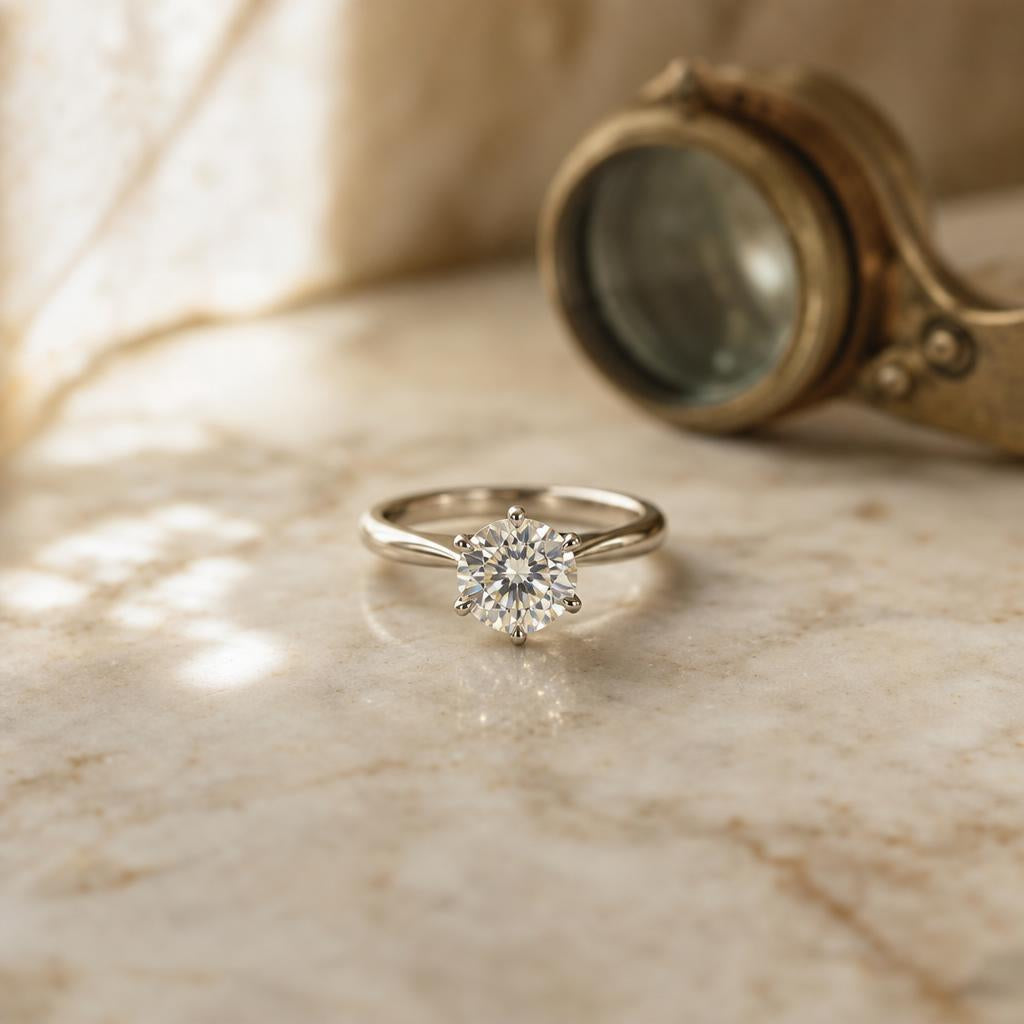
The Éclat Moissanite Ring
A round-cut moissanite center stone in a six-prong mount, available from 1 to 5 carats. Built for full-attention presence, not quiet hedging.
Shop The Éclat Ring →What About Sterling Silver — Does It Tarnish?
This is where the real durability question usually hides, and it's a fair one. The moissanite stone itself won't tarnish under any normal circumstance — it's chemically stable and doesn't oxidize with air, water, or daily wear. What can dull over time is the metal setting underneath it, and that comes down to the metal, not the stone. Gemiros rings are set in 925 sterling silver with rhodium, 18k gold, or rose gold plating specifically because that combination resists the discoloration that lower-grade alloys are prone to — a distinction worth understanding if you've read up on whether sterling silver actually tarnishes.
A quick wipe with a soft cloth after wear keeps both the metal and the stone looking the way they did on day one. That's maintenance, not damage control.
Will It Scratch or Cloud Over With Daily Wear?
Moissanite sits at 9.25 on the Mohs hardness scale — second only to diamond, and harder than sapphire, topaz, or anything you'll realistically knock it against in a normal week. Keys, countertops, and casual bumps don't touch it. The only things that reliably scratch moissanite are diamond and other moissanite, which is why jewelers recommend storing pieces separately rather than tossed together in one drawer.
Cloudiness is almost always a surface issue, not a stone issue — lotion, soap residue, and everyday oils building up a thin film that a warm-water soak and a soft toothbrush clear right off. It's the same reason moissanite's fire looks different from a mined diamond's in the first place: the two materials bend and disperse light differently, which is part of why some buyers actually prefer how moissanite sparkles compared to a diamond rather than treating it as a lesser version of one.

The Eterna Moissanite Ring
Twenty round-cut moissanite stones set in a full eternity band — two carats of brilliance built for a ring you never plan on taking off.
Shop The Eterna Ring →Can You Tell Moissanite From a Diamond by Eye?
Not reliably, and not from a normal social distance. The one visual tell trained gemologists look for is double refraction — moissanite splits light into two beams, which can make the edges of a facet look faintly doubled under a jeweler's loupe held inches from your eye. Nobody is doing that across a dinner table. At arm's length, in the lighting most compliments actually happen in, the difference disappears.
That's the quiet confidence built into every piece in the solitaire moissanite rings Gemiros carries: the ring isn't performing for a loupe. It's performing for the life you actually wear it in.

The Carrée Moissanite Ring
A princess-cut moissanite center stone in a clean four-claw mount with a slim pavé half-band. Structured, precise, and unfussy.
Shop The Carrée Ring →Moissanite vs. Our Signature Simulated Diamond — Which One Actually Fits You?
Gemiros carries both, and the choice comes down to how the stone throws light, not which one is "more real." Our Signature Simulated Diamond is cut to mirror a diamond's classic white-light brilliance as closely as possible. Moissanite carries noticeably more fire — that rainbow-flecked sparkle some women actively seek out precisely because it reads as distinctive rather than default. Neither is a compromise. If you've already weighed moissanite against lab-grown diamonds for a travel piece, the same logic applies here: pick the sparkle you actually want to look down and see.
Worth knowing: A diamond tester reading "positive" on moissanite isn't a loophole — it's physics. Thermal testers were built decades before moissanite jewelry existed, and they've never been recalibrated to separate the two. That's not a gap in your ring. It's a gap in a thirty-year-old tool.
The Bottom Line
A moissanite ring passing a standard diamond tester isn't a trick, a workaround, or a fact you need to manage in conversation. It's simply what happens when a genuinely hard, genuinely brilliant lab-created gemstone is tested with a tool designed to measure heat, not history. Every Gemiros moissanite ring is set in 925 sterling silver, nickel-free and built for daily wear, backed by a one-year warranty — because the goal was never to get away with something. It was to build a ring that holds up to exactly this kind of scrutiny.
Quick Takeaways
- Standard diamond testers measure thermal conductivity — and moissanite conducts heat almost identically to diamond, so it passes.
- Only a dual electrical/thermal tester can reliably tell the two apart, and most people will never encounter one outside a jewelry store.
- The stone itself won't tarnish, scratch under normal wear, or cloud permanently — any dullness is surface buildup, not damage.
- At 9.25 on the Mohs scale, moissanite is the second-hardest gemstone used in fine jewelry, right behind diamond.
- Visually, the two are nearly impossible to tell apart outside a jeweler's loupe held inches from the stone.
Frequently Asked Questions
Can a jeweler tell if a diamond is actually moissanite?
A jeweler using a proper dual tester or a loupe trained on double refraction can identify moissanite in seconds. A basic thermal pen tester — the kind most people own — cannot. That's the distinction that matters here, not whether the stone is somehow lesser.
What's the actual downside of moissanite?
The honest one: moissanite throws more rainbow-colored fire than a diamond, especially in direct sunlight. For buyers who want the whitest, most muted sparkle possible, that's worth knowing going in. It isn't a flaw — it's a different kind of brilliance, and plenty of women prefer it.
How can I test my moissanite ring at home?
A basic thermal diamond tester will read it as positive, which confirms nothing beyond what the tool is built to measure. A magnifying loupe held close to the stone, looking for the faint doubling of facet edges, is the more telling home test — though even that takes a trained eye to interpret with confidence.
Is moissanite the same thing as a lab-grown diamond?
No. A lab-grown diamond is pure carbon, chemically identical to a mined diamond. Moissanite is silicon carbide — a distinct gemstone in its own right, not a diamond grown differently. Both are lab-created; only one is technically a diamond.
How long does a moissanite ring actually last?
Indefinitely, under normal wear. The stone doesn't fade, cloud, or lose brilliance with age — it's simply too hard and too chemically stable to degrade the way softer simulants can. Worn daily for years, a well-set moissanite ring looks the same as the day it arrived.
Whatever brought you here — a beeping tester at the kitchen counter, a nosy question from a friend, or plain curiosity before you buy — the answer holds up the same way the ring does. Nothing about wearing moissanite requires an explanation.


