

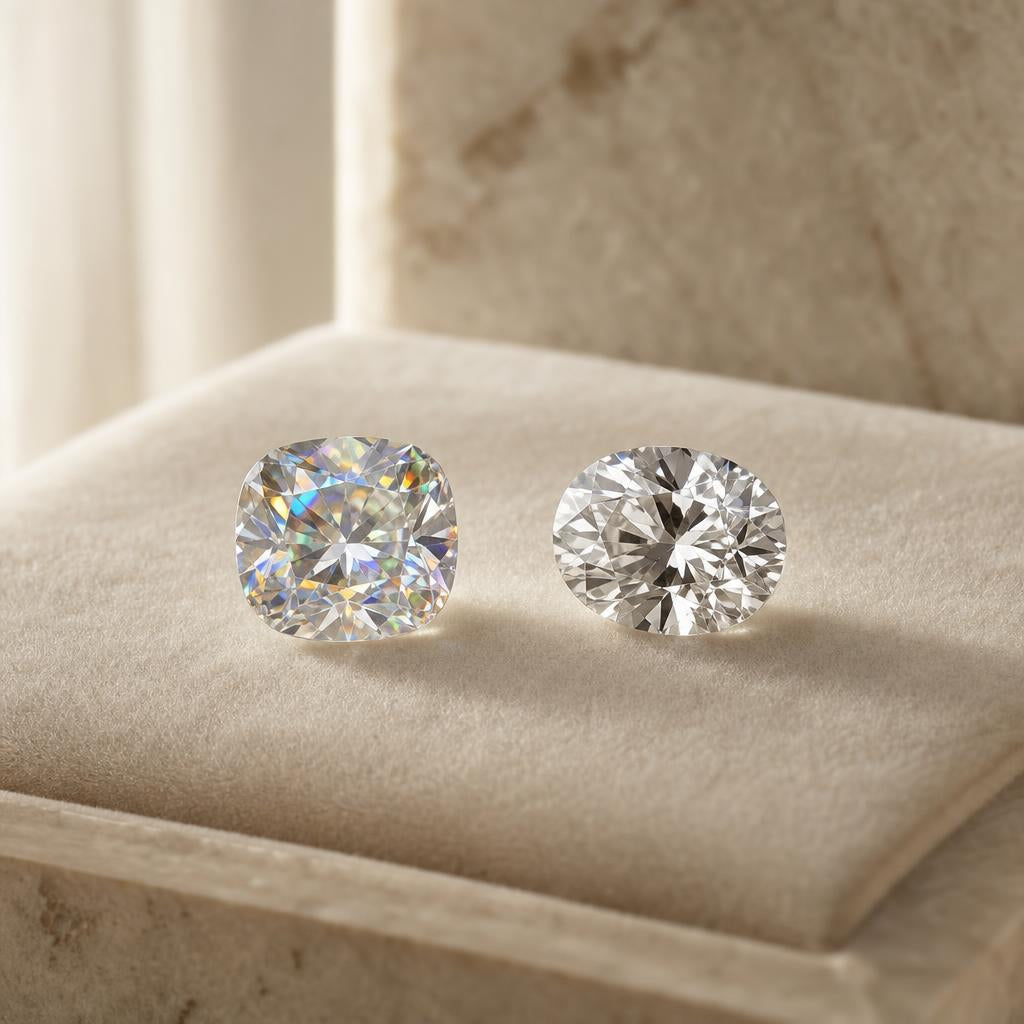
Moissanite vs. Diamond: How to Choose the Right Stone for Your Ring
Two stones. Two completely different ways of catching light. And exactly one right answer — for you, specifically, once you know what you're actually choosing between.
At Gemiros, every ring is set with one of two center stones: moissanite, or our Signature Simulated Diamond. Both are 925 sterling silver, both are built to be worn every day, and both are designed to make a jeweler look twice. But they are not the same stone, and the difference matters more than most buying guides let on. Here's the real comparison — moissanite vs. diamond sparkle, durability, and everything in between — so you can pick the one that actually fits you.


What Moissanite Actually Is
Moissanite is its own gemstone — not a diamond, not trying to be one. It's silicon carbide, grown in a lab under carefully controlled conditions, and it was first identified in the 1890s inside a meteor crater before scientists learned to create it consistently on purpose. What that origin gives it is a genuinely different optical personality: a higher refractive index than diamond, which means more light bends and splits as it passes through the stone. The result is fire — flashes of color, not just white light — and it's the reason a well-cut moissanite can look, in certain angles, even more animated than a mined diamond.
It's also hard. At 9.25–9.5 on the Mohs scale, moissanite sits just below diamond and comfortably above nearly everything else you'd wear against it daily — countertops, gym equipment, the inside of a coat pocket. This is not a delicate stone. It's built for a ring that leaves the house.
So is moissanite a diamond? No. It's its own gemstone, with its own chemistry and its own following of buyers who choose it outright, not as a stand-in for anything else.
What Our Signature Simulated Diamond Actually Is
What is a simulated diamond, exactly? The Signature Simulated Diamond is Gemiros' other center stone, and it's built for a different job: replicating the classic white brilliance people picture when they think "diamond." Where moissanite throws rainbow fire, the Signature Simulated Diamond reflects a balanced, crisp white sparkle — the traditional look, engineered to hold up under real light and real wear, not just studio photography. It's the stone behind the Ophelia and the Maxima, and it's the reason both rings read as effortlessly as they do next to anything in a jewelry store case.
Both stones are set the same way at Gemiros: 925 sterling silver base, rhodium or gold plating, nickel-free construction. The choice between them isn't a hierarchy. It's a question of which kind of sparkle you actually want on your hand.
Moissanite vs. Diamond: The Real Differences
The difference between moissanite and diamond comes down to two things: composition and light. Set side by side, the differences are visible but not dramatic. A mined or lab-grown diamond reflects light in a fairly restrained, white-dominant way — that's what gives diamonds their reputation for looking "clean." Moissanite reflects more aggressively and more colorfully; in direct sun, you'll catch genuine flashes of blue, gold, and green inside the stone. The Signature Simulated Diamond was built to sit closer to that classic diamond behavior, which is why it's the center stone on rings like Ophelia and Maxima, styles designed around the traditional halo-and-solitaire silhouette.
Neither stone is a compromise. Moissanite isn't a diamond, and it doesn't need to be — it's a legitimate gemstone with its own fire, its own hardness, and its own following of buyers who prefer it outright. The Signature Simulated Diamond isn't trying to be moissanite either. Each does its own job extremely well.

Marchesa Moissanite Ring
A round-cut moissanite center stone set inside a cushion-shaped halo, so the fire of the center stone gets a soft, vintage-leaning frame. Available in 1, 2, or 3 carats.
Shop Marchesa Moissanite Ring →Which One Actually Looks More Like a Mined Diamond?
If the goal is a stone that reads, at a glance, exactly like the mined diamond in your mental picture — the Signature Simulated Diamond gets you there. It's engineered for that specific resemblance: white light, balanced brilliance, no rainbow flash to explain to anyone. If the goal is maximum sparkle and you don't mind — or actively love — a stone that looks unmistakably alive with color, moissanite is the more dramatic choice, and it photographs beautifully because of it.
Either way, the fear that actually drives most of this research isn't really "which one sparkles more." It's "will people be able to tell." The honest answer: no. Both stones are indistinguishable from a mined diamond to the naked eye, and both pass standard diamond testers. No one will know — including your jeweler — unless you tell them.

Kensington Ring
A 3-carat emerald-cut center stone in a hidden halo setting — architectural, elongating, and built entirely around that classic white brilliance.
Shop Kensington Ring →Durability, Daily Wear, and the Diamond Tester Question
This is where a lot of buyers get stuck, so let's settle it directly. Standard handheld diamond testers work by reading thermal conductivity — how fast heat moves through a stone — and moissanite conducts heat at nearly the same rate as a diamond. That means moissanite passes a basic diamond tester. The Signature Simulated Diamond is built to hold up under the same scrutiny. Neither stone will out you at a jeweler's counter, at a wedding, or in a work meeting where someone leans in for a closer look.
On hardness, moissanite's 9.25–9.5 Mohs rating means it resists scratching from nearly everything you'll encounter in ordinary life — sand, keys, countertops. The sterling silver setting underneath either stone is the part that benefits most from normal care: keep it dry when you can, store it separately from other pieces, and it'll still look new years in.
Worth knowing: Moissanite's fire comes from a higher refractive index than diamond — that's the science behind the rainbow flash. It's not a flaw or a tell. It's the entire reason some buyers choose moissanite over anything else.
Moissanite vs. Cubic Zirconia: Not the Same Conversation
It's worth separating moissanite from cubic zirconia, because the two get lumped together constantly and they shouldn't be. Cubic zirconia is softer, loses its shine faster with everyday wear, and simply isn't in the same durability class. Moissanite's hardness and heat resistance put it much closer to diamond territory — which is exactly why Gemiros builds an entire collection around it instead of treating it as a budget filler. When you're comparing moissanite to a "diamond," you're comparing two genuinely serious stones. When you're comparing it to cubic zirconia, you're comparing two very different tiers of gemstone entirely.
So, Which Should You Actually Choose?
Choose moissanite if you want maximum fire — visible, colorful, unmistakably alive sparkle that catches attention in direct light and photographs beautifully. Choose the Signature Simulated Diamond if you want the classic, traditional diamond look: white brilliance, quiet confidence, the exact silhouette people expect when they picture an engagement or statement ring. There's no wrong choice here, only the one that matches how you actually want your ring to feel on your hand — and your finger doesn't know or care which one costs a fraction of what the other implies.
Quick Takeaways
- Moissanite is its own gemstone (silicon carbide) — not a diamond, and not trying to be one.
- Moissanite throws more colorful "fire"; the Signature Simulated Diamond reflects classic white brilliance.
- Both pass standard diamond testers and are indistinguishable from a mined diamond to the naked eye.
- Moissanite rates 9.25–9.5 on the Mohs scale — durable enough for daily wear.
- Moissanite and cubic zirconia are not the same tier of stone — moissanite is significantly harder and more durable.
- Neither stone is a compromise. Each is built for a different kind of sparkle.
Frequently Asked Questions
Moissanite or simulated diamond — which is actually better?
Neither is objectively better; they're built for different looks. Moissanite gives you more visible fire and color. The Signature Simulated Diamond gives you the classic white brilliance people associate with a traditional diamond. Choose based on which sparkle you actually want, not which one sounds more impressive.
Does moissanite pass a diamond tester?
Yes. Standard diamond testers measure thermal conductivity, and moissanite conducts heat at nearly the same rate as a diamond, so it reads as a pass on a basic handheld tester.
Can a jeweler tell if my ring is moissanite just by looking?
Not at a glance. Moissanite is indistinguishable from a diamond to the naked eye, and it passes standard diamond testers. No one will know unless you tell them — including your jeweler.
Is moissanite a lab-grown diamond?
No. A lab-grown diamond is chemically identical to a mined diamond — pure carbon, grown under pressure instead of underground. Moissanite is silicon carbide, a completely different mineral with its own hardness, refractive index, and sparkle profile.
What's the actual downside of moissanite?
The only real trade-off is the sparkle style itself — moissanite's colorful fire reads differently than a diamond's white brilliance, and if you specifically want that traditional white sparkle, our Signature Simulated Diamond is the better match. It isn't a downside so much as a different look.
Is a simulated diamond worth buying?
If what you're actually after is the look, the durability, and the daily-wear confidence of a diamond ring — yes. Both moissanite and the Signature Simulated Diamond are indistinguishable from a mined diamond to the eye, pass diamond testers, and are built into a nickel-free, 925 sterling silver setting designed for everyday wear.
Whichever stone you choose, you're not settling for a version of something else. You're choosing exactly the sparkle you want, on your terms, without paying for a markup that never had anything to do with how the ring actually looks on your hand.


