

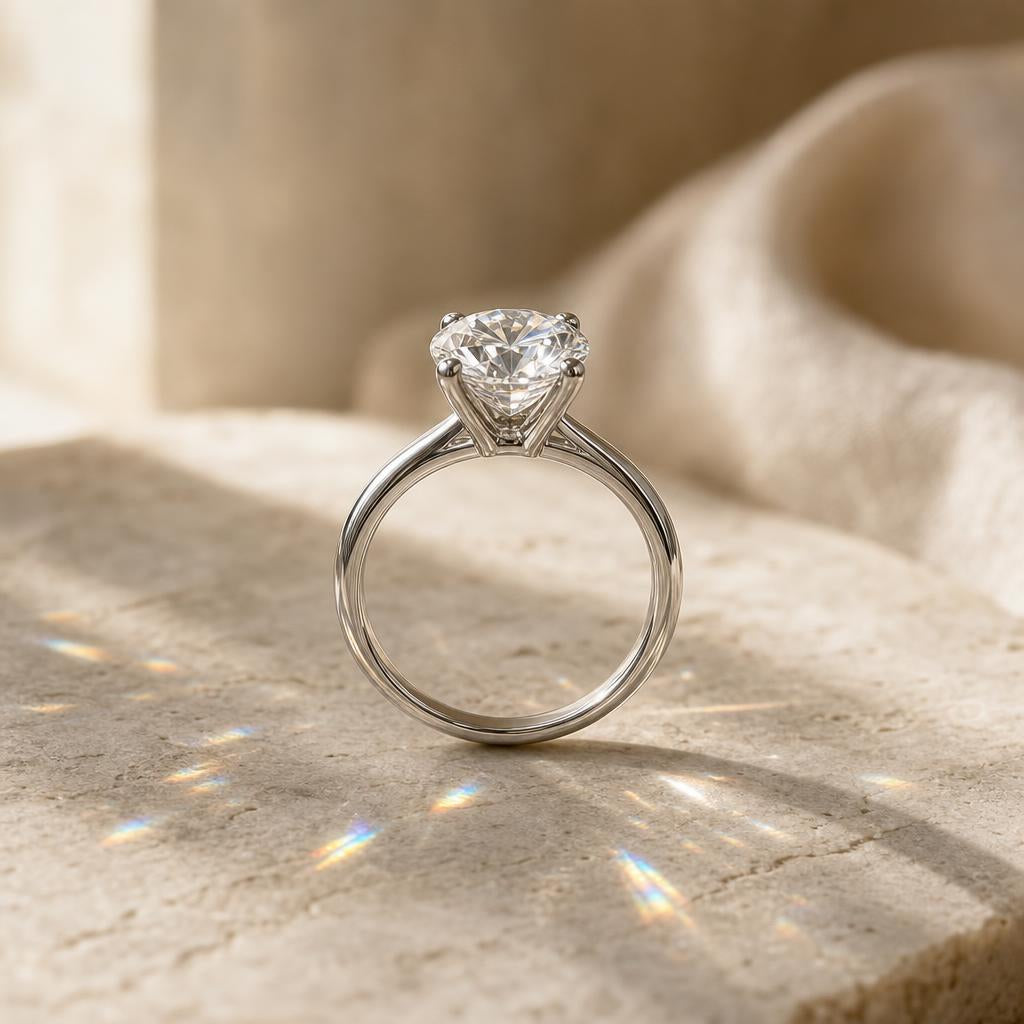
Affordable Moissanite Engagement Rings Aren't a Compromise — They're a Choice
Somewhere along the way, choosing moissanite got quietly filed under "settling." It isn't. It's a decision about what you actually want on your hand — how it throws light, how hard it is, how much of your money stays yours — made by someone who read the specifications instead of the marketing.
A moissanite engagement ring is not a smaller version of something else. It is a different stone, with its own optical behavior, its own hardness rating, and its own reasons for existing. What follows is what's actually true about it, and how to choose one that suits your hand rather than someone else's rulebook.


What Moissanite Actually Is
Moissanite is silicon carbide. It was first identified in 1893 by the French chemist Henri Moissan, who found microscopic crystals of it inside a meteorite crater in Arizona and initially mistook them for diamonds. Natural moissanite is vanishingly rare — far rarer than diamond — so every stone used in jewelry today is created in a laboratory under controlled heat and pressure.
That laboratory origin is the part people trip over. It sounds like a shortcut. It isn't — it is the only reason the stone exists in wearable sizes at all, and the same reason lab-grown diamonds exist: the chemistry is understood, and there is no good argument for excavating a mountainside to obtain something that can be grown correctly.
Worth knowing: Moissanite is not a diamond and does not pretend to be one. It is its own gemstone species, with a refractive index of 2.65–2.69 — higher than diamond's 2.42. It is the only widely available stone that out-sparkles a diamond on the specification sheet rather than beneath it.
The Compromise Story, and Where It Came From
The idea that a ring must cost some fixed multiple of someone's salary is not a tradition. It is a mid-century advertising campaign that worked so well it started passing for common sense. Before that campaign, no such rule existed anywhere. It was invented to sell a specific product at a specific margin, and it has been quietly taxing engagements ever since.
Once you see the rule for what it is, the word "compromise" stops making sense. A compromise means giving something up. So the honest question is: what exactly is being given up? Not the look — moissanite is indistinguishable from a diamond to the naked eye, and it reads as a serious ring across a dinner table, in daylight, and in every photograph you will take of it. Not the durability, as we'll get to shortly. Not the ethics, which are cleaner by any measure.
What's given up is the receipt. Some women arrive here through the numbers and some arrive through the aesthetics; if you want the financial picture laid out plainly, the real cost breakdown of a mined diamond ring versus a simulated one does the arithmetic without the sales pitch. Either route lands in the same place. This is a choice, and it holds up under scrutiny.
Moissanite Sparkle vs Diamond: Fire, Brilliance, and What You Actually See
Jewelers separate a stone's sparkle into two distinct behaviors. Brilliance is white light bouncing straight back at you. Fire — technically dispersion — is white light being split into its spectrum, which is what produces those flashes of red, blue and green you catch out of the corner of your eye.
Moissanite has roughly 2.4 times the dispersion of diamond. In practice that means it throws more colored light, more often, and does it in conditions where a diamond stays comparatively quiet. Under low restaurant lighting, on an overcast afternoon, in the flat glare of an office — it keeps working. Seen moissanite vs diamond side by side under the same lamp, this is the difference people notice first, long before anything else registers.
This is a difference in character, not a defect. Some people prefer the cooler, whiter, more restrained return of a diamond. Others want the ring visible from across a room. Neither is more correct — but knowing which one you are before you buy matters, because it is the most noticeable difference between the two stones in daily wear.
✦ Pro tip: Larger stones show fire more dramatically than small ones, because there is more facet area doing the splitting. If you love the rainbow flash, size up. If you'd rather it stayed subtle, a smaller stone in a step cut — an emerald cut, say — will read much quieter on the hand.

The Éclat Moissanite Ring
A six-prong round-cut solitaire on a plain polished band — no pavé, no halo, nothing competing with the stone. Offered in 1, 2, 3 and 5 carat sizes, so you decide exactly how loudly it speaks.
Shop The Éclat →Durability: What 9.25 on the Mohs Scale Actually Means
The Mohs scale measures scratch resistance. Diamond sits at 10. Moissanite sits at 9.25. Sapphire — the stone jewelers have recommended for hard daily wear for over a century — sits at 9.
The scale is not linear, so the gap between 9.25 and 10 is wider than it looks — and also academic. Almost nothing in ordinary life is hard enough to scratch a 9.25 stone. Household dust contains quartz at 7. Steel is around 4.5. The realistic threats here are precisely the realistic threats to a diamond ring: a hard knock against a stone countertop, or a prong that loosens without anyone noticing.
It also does not cloud, does not absorb oils permanently, and does not lose its optical properties over time. A moissanite ring gets dull for exactly one reason — the same reason every ring gets dull — a film of soap, lotion and skin oil on the underside of the stone, where light enters. That's a five-minute problem, and our guide to cleaning a moissanite ring safely at home covers the method properly.
| Property | Moissanite | Diamond |
|---|---|---|
| Composition | Silicon carbide | Carbon |
| Mohs hardness | 9.25 | 10 |
| Refractive index | 2.65–2.69 | 2.42 |
| Dispersion (fire) | 0.104 | 0.044 |
| Origin | Lab-created | Mined or lab-grown |
| Sparkle character | Colorful, high-contrast | Cooler, whiter |
What Affordable Moissanite Engagement Rings Actually Buy You
Here is the part that gets underrated. When the stone stops being the limiting factor, the whole decision shifts to design — and that is a far better conversation to be having.
With a mined stone, budget usually dictates shape. You take whichever cut delivers the most visual weight per dollar, which is a large part of why so many rings end up looking like each other. Remove that pressure and you can choose a shape because it suits your hand, your work, and your temperament. That is the actual return on affordable moissanite engagement rings: not a cheaper version of the same ring, but a wider set of options and a decision made on aesthetic grounds rather than financial ones.
Round
The most light-efficient cut ever engineered, and the reason it has never fallen out of favor. A round brilliant returns more light to the eye than any other shape, which makes it the most emphatic showcase for this stone's fire.
Oval
An elongated silhouette that visually lengthens the finger and reads slightly larger than a round stone of the same carat weight, because more of its surface faces upward. If you have shorter fingers, or simply want maximum apparent size, this is the shape that delivers it.
Emerald and Asscher
Step cuts, meaning long parallel facets rather than a mosaic of triangles. They produce broad flashes of light instead of scattered sparkle — an architectural, deliberately restrained look. They are also the most forgiving shapes if you find high-fire stones a little theatrical.
Three-Stone and Halo
Two different ways of adding presence. A halo rings the center stone with smaller accents so the whole setting reads larger; a three-stone design flanks it with two companions instead. If you're weighing whether extra stones suit you, our breakdown of what carat weight actually means is worth reading first — the number on a listing is a weight, not a size, and the two diverge more than most listings admit.

The Reine Moissanite Ring
Three round-cut stones held in tall double-claw prongs, with a small accent stone bezel-set beneath each one — visible only in profile, which is exactly the kind of detail worth paying attention to.
Shop The Reine →What to Check Before You Buy
Not every moissanite ring is built to the same standard, and the stone is only half of what you're buying. The setting is the other half, and it is the half that fails first when a maker cuts corners.
- What the band is actually made of. A well-made ring sits in solid 925 sterling silver, not a base metal wearing a thin coat of something better. If a listing won't state the metal outright, the silence is the answer. Here's what the 925 stamp actually guarantees.
- Whether it's nickel-free. Nickel is the most common cause of contact irritation in jewelry. A ring you intend to wear every day should be hypoallergenic as a baseline, not as an upgrade.
- The plating. Rhodium and 18k gold plating over sterling silver are both durable finishes when applied properly. Ask which one, and how thick.
- The prong work. Look at the setting in profile, not just from above. Prongs should be evenly spaced and sit flush against the stone. Uneven prongs are the clearest single sign of a rushed build.
- Sizing before you order. Not every maker carries half sizes, so measure properly rather than guessing between two numbers and hoping.

The Eternelle Moissanite Ring
A full eternity band of scallop-set round moissanites with pavé accents running along both shoulders. It works as a stand-alone statement, or as the piece that finishes a stack.
Shop The Eternelle →The Question Nobody Says Out Loud
It's this: will anyone be able to tell?
In ordinary life, no. Not a friend, not a colleague, not a relative with opinions. The stone reads as serious because it behaves like one — bright, clear, hard, set in real metal. The difference lives at the level of a loupe and controlled lighting, which is not a situation your hand encounters over dinner.
And there is a second, better answer underneath the first. The women buying these rings are not, on the whole, hoping to be mistaken for someone who spent more. They are perfectly comfortable saying exactly what the stone is. That comfort is the actual product — and it is a large part of why so many women are choosing stones like these now, without a trace of apology.
Quick Takeaways
- Moissanite is silicon carbide — its own gemstone species, not a stand-in for another one.
- It has a higher refractive index and roughly 2.4× the fire of diamond, so it throws more colored light in more conditions.
- At 9.25 on the Mohs scale it is harder than sapphire and built for daily wear.
- It doesn't cloud, yellow or lose its sparkle — it only needs the underside of the stone kept clean.
- Removing the price pressure means choosing a shape and setting because it suits your hand, not your budget.
- Check the metal, the plating, the prong work and the sizing before you order. The setting fails long before the stone does.
Frequently Asked Questions
What is the downside of moissanite?
Two, and both are worth knowing before you buy. It has no meaningful resale market, so it is a piece to wear rather than an asset to hold. And in very bright direct light, large stones throw enough colored fire that the effect reads as more theatrical than a diamond would. Whether that second one is a downside or the entire appeal is a matter of taste.
Can someone tell my ring is moissanite?
Not by looking at it in any normal setting. Identification requires magnification, controlled lighting and someone who knows what they're looking for. The practical answer is that nobody at dinner, at work or at a wedding is going to identify the stone on your hand — and most women who wear one are happy enough to say what it is anyway.
Does moissanite sparkle in direct sunlight?
Considerably. Compare a diamond vs moissanite in sunlight and the second stone throws noticeably more colored flash, because its dispersion is more than double. Larger stones show this most dramatically. If you want the effect dialed down, choose a smaller stone or a step cut.
Does moissanite get cloudy over time?
No. Silicon carbide is chemically stable — it doesn't yellow, cloud or degrade, and at 9.25 on the Mohs scale essentially nothing in daily life scratches it. Any dullness that appears is surface residue on the underside of the stone, and it comes off with warm water, a drop of dish soap and a soft brush.
Will moissanite pass a diamond tester?
On a standard thermal tester, yes — moissanite conducts heat closely enough to diamond that the tester reads it as one. Dual testers that also measure electrical conductivity can distinguish the two. Worth knowing which instrument you're being shown, because most retail counters use the thermal kind.
Is moissanite a lab grown diamond?
No — different material entirely. A lab-grown diamond is carbon, chemically identical to a mined diamond. Moissanite is silicon carbide, a separate gemstone species with its own optical signature. Both are created in a lab, which is where the confusion starts, but they look and behave differently. Our side-by-side of moissanite and lab diamonds covers where they diverge.
Can I shower with a moissanite ring?
The stone is unaffected by water. The reason to take it off is soap — shampoo and body wash leave a film on the underside of the stone that dulls the sparkle within days, and repeated buildup around the prongs is a nuisance to clear. Water won't hurt it. Soap will make it look like it did.
Do wealthy people wear moissanite?
Frequently — often as a travel piece while the insured ring stays in a safe, and increasingly as the everyday ring outright. When money isn't the constraint, the decision comes down to what someone wants to wear and how much they'd rather not worry about it. That calculation lands here more often than the industry likes to acknowledge.
The rule that a ring must cost a fortune to count was written by people selling fortunes' worth of rings. You are allowed to decline it. What goes on your hand should be chosen for how it catches the light and how it wears through a decade of ordinary days — and on both counts, this stone earns its place without anyone's permission.


