

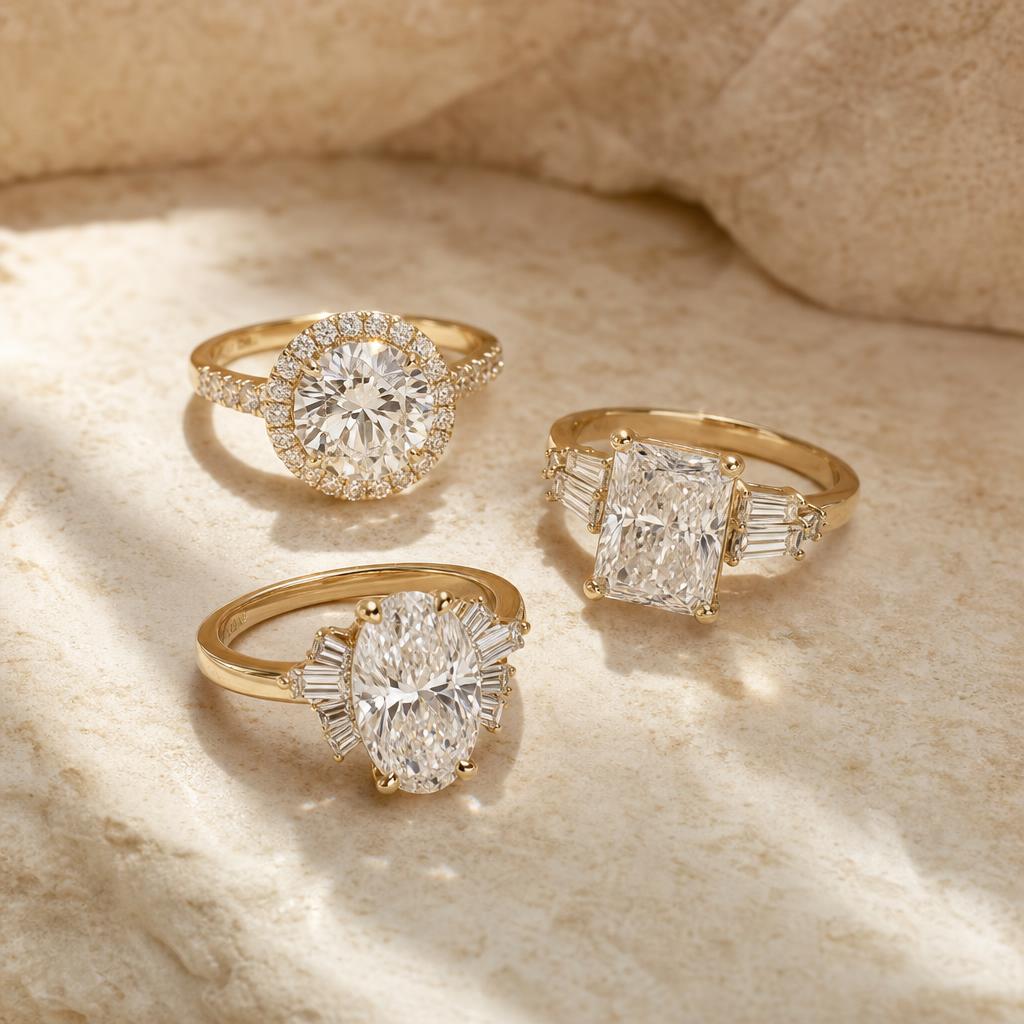
Why More Women Are Choosing Simulated Diamonds — and Not Apologising for It
There's a shift happening — quiet, confident, and long overdue. More women are buying simulated diamond rings not as a budget workaround, but as a deliberate, informed choice. And increasingly, they're not explaining themselves to anyone.
If you've been curious about simulated diamonds — or if you already own one and find yourself editing your answers when people ask — this piece is for you. Because the conversation around these stones is changing, and it's worth understanding why.


The quiet revolution in how women shop for rings
A few years ago, buying a simulated diamond ring meant something specific to most people: it meant you couldn't afford the real thing. The stone was a stand-in. A placeholder. Something you'd trade up from eventually.
That framing is dissolving — and the women buying these rings are the ones dissolving it. Not with grand statements, but with straightforward purchasing decisions that reflect what they actually want. A ring that looks genuinely beautiful. A purchase that doesn't require three months of savings or a conversation about the household budget. A stone that can go to Italy without anxiety.
What changed isn't just the quality of the stones (though that changed significantly — more on that shortly). What changed is who's buying them and why. The buyer profile for a simulated diamond ring today isn't someone making do. It's someone making a choice.
What simulated diamonds actually are — briefly
A simulated diamond is any stone engineered to look like a diamond: similar optical properties, similar sparkle, similar cut — but a different physical composition. Cubic zirconia and moissanite are the two most common. Moissanite, in particular, has a refractive index that actually exceeds a mined diamond's, which means it can appear even more brilliant under certain lighting conditions.
Simulated diamonds are not lab-grown diamonds. Lab-grown stones are chemically identical to mined ones; simulated stones are not. Both are valid choices — they just solve different problems. A simulated diamond excels at delivering visual impact at a fraction of the cost. A 3-carat simulated diamond stone in a sterling silver setting under $200 is not a compromise dressed up nicely. It is exactly what it looks like: a beautiful ring.
Worth knowing: The Gemiros collection uses precision-cut simulated diamond stones set in 925 sterling silver with rhodium or 18k gold plating. Nickel-free. As featured in Vogue, PopSugar, and Refinery29.
Why more women are choosing them — the real reasons
When you ask women who own and wear simulated diamond rings why they bought them, the answers are more interesting than "I wanted to save money." That's part of it, yes. But it's rarely the whole picture.
Financial intelligence, not financial limitation
Spending significant money on a mined diamond ring is a choice — a legitimate one, for the right person. But so is deciding that the money would do more work elsewhere. A woman who allocates her budget deliberately — toward travel, a down payment, building something — isn't compromising. She's prioritising. A simulated diamond ring can be part of that calculation without requiring her to explain herself at every dinner party.
The travel argument is unanswerable
Every woman who's ever nervously stuffed a ring into a hotel safe, refused to swim in the sea, or second-guessed wearing her engagement ring to a busy market knows this feeling: real jewellery creates anxiety when it travels. The answer, increasingly, is to wear something beautiful that you're not afraid to lose. A well-made simulated diamond ring on holiday is a genuinely better experience than an insured mined diamond ring sitting in a hotel safe.
The ethical dimension has shifted
Concerns about the sourcing of mined diamonds — environmental impact, supply chain transparency — have become harder to dismiss. Lab-grown and simulated stones sidestep these issues entirely. For buyers who care about where their things come from, that matters. It doesn't have to be the primary reason. But it no longer has to be an afterthought, either.
Daily wear without daily anxiety
A ring you wear every day takes a beating. Soap, lotion, gym sessions, dishes, gardening, typing. The more beautiful and expensive the ring, the more psychological weight it carries during all of those activities. A simulated diamond ring that looks stunning and costs a fraction of a mined stone gives you something genuinely valuable: the freedom to actually wear it.

The Duchess Ring
A cushion-cut simulated diamond set in a spectacular double halo — because one halo was never going to be enough. The Duchess is for the woman who knows exactly how much sparkle she wants.
Shop The Duchess Ring →The quality conversation
Simulated diamond stones look dramatically different from their equivalents twenty years ago. The manufacturing precision has improved to the point where the gap between a well-cut simulated diamond and a mined stone — in terms of how they present to the naked eye — is not visible to most people. Not jewellers. Not friends examining your hand. Not even you, most of the time.
The cut quality, the colour consistency, and the brilliance of modern simulated stones have improved because the technology to produce them has improved. What was once a recognisably flat or lifeless look is now, in a precision-cut stone, a genuinely brilliant sparkle that catches light exactly as you'd want it to.
This is the factual case for simulated diamonds. The aesthetic case — the reason women are proud to wear them — is separate, and arguably more interesting.
The identity question
Jewellery has always been a signal. The question is what signal you want to send, and to whom.
For a certain type of woman — and if you've read this far, you may be her — the ring on her finger is a reflection of her actual values, not just her budget. She'd rather own five beautiful rings she rotates and enjoys than one ring so precious she's afraid to wear it anywhere. She'd rather spend the money she saved on experiences she can't return. She's not performing wealth she doesn't have, and she's not performing frugality she doesn't feel.
She chooses a simulated diamond ring because she wants to. And she's not apologising for it.
✦ A note on social approval: The most common question women ask before buying is some version of "Will people be able to tell?" The short answer is usually no. The longer answer is: does it matter? A ring that makes you feel good every time you look at it is doing its job, regardless of what it's made of.

The Evangeline Ring
A radiant-cut simulated diamond in a vintage-inspired setting with intricate pavé detailing — where old-world craft meets modern brilliance. For the woman who wants substance and beauty in equal measure.
Shop The Evangeline Ring →What to look for when you're ready to buy
Not all simulated diamond rings are created equally. If you're buying, these are the factors worth understanding before you spend anything.
- Stone type matters. Moissanite and cubic zirconia are both simulated diamonds, but they perform differently. Moissanite tends to hold its brilliance longer and handle daily wear better. CZ is typically less expensive but may cloud or scratch over time with heavy use.
- Setting quality matters as much as the stone. A high-quality stone in a poorly made setting will still look cheap. Look for 925 sterling silver as the base metal, with rhodium plating (which resists tarnishing) or 18k gold plating for colour options.
- Nickel-free is worth checking for. Nickel allergies are common and often undiagnosed — a ring worn daily on sensitive skin needs to be hypoallergenic. Look for nickel-free in the product specifications.
- Cut quality determines sparkle. A well-cut stone catches and returns light in a way a poorly cut one never will, regardless of size. Precision cutting takes craft and drives significant quality differences within the simulated stone category.
Quick Takeaways
- Simulated diamonds are engineered to look like diamonds — modern versions are visually indistinguishable from mined stones to the naked eye
- Women choosing them today are doing so deliberately — for financial intelligence, travel freedom, ethical reasons, and daily wear practicality
- The quality gap between simulated and mined stones has narrowed significantly over the past decade
- Stone type, setting quality, metal type, and cut precision all affect how a ring wears and looks over time
- The Gemiros collection: precision-cut simulated diamonds in 925 sterling silver, nickel-free, under $200
Frequently asked questions
Will people be able to tell my ring is a simulated diamond?
In almost all everyday situations: no. Modern precision-cut simulated diamonds — particularly moissanite — are visually indistinguishable from mined stones to the naked eye. A trained gemologist with testing equipment can identify them, but no one at a dinner party is going to hand you a refractometer.
Do simulated diamond rings hold up to daily wear?
Yes, with reasonable care. Moissanite is extremely hard (9.25 on the Mohs scale, close to diamond's 10) and handles everyday activities well. Sterling silver settings should be kept away from harsh chemicals and stored properly, and rhodium-plated finishes may need occasional re-plating after several years of heavy wear — though most wearers find this unnecessary for many years.
Is a simulated diamond ring worth buying, or will I regret not getting a real one?
This is the wrong framing. The right question is: what do you actually want from this ring, and which choice delivers it? If the ring is primarily for daily wear, travel, or self-expression — a simulated diamond ring is genuinely better suited to those purposes than a stone that creates anxiety every time it leaves the house. If the symbolic significance of a mined stone is important to you, that's also a valid reason to choose differently. Both are legitimate. The one to avoid is spending significantly out of perceived obligation.
Are simulated diamonds the same as lab-grown diamonds?
No. Lab-grown diamonds are chemically and physically identical to mined diamonds — they're real diamonds, just not formed underground. Simulated diamonds (moissanite, CZ) are different materials engineered to replicate the appearance of a diamond. Both are alternatives to mined stones, but they occupy different categories, different price points, and serve different purposes.
The conversation around simulated diamonds isn't going to stop evolving. But for the women already wearing them — on their commute, on holiday, at the dinner table, at the gym — the conversation already feels resolved. They chose the ring they wanted. It looks beautiful. They're wearing it. That's the whole story.
✦ ✦ ✦
Explore the Gemiros collection: browse all rings, or start with our guide to what simulated diamonds are and how they compare if you want to go deeper before you buy.


