

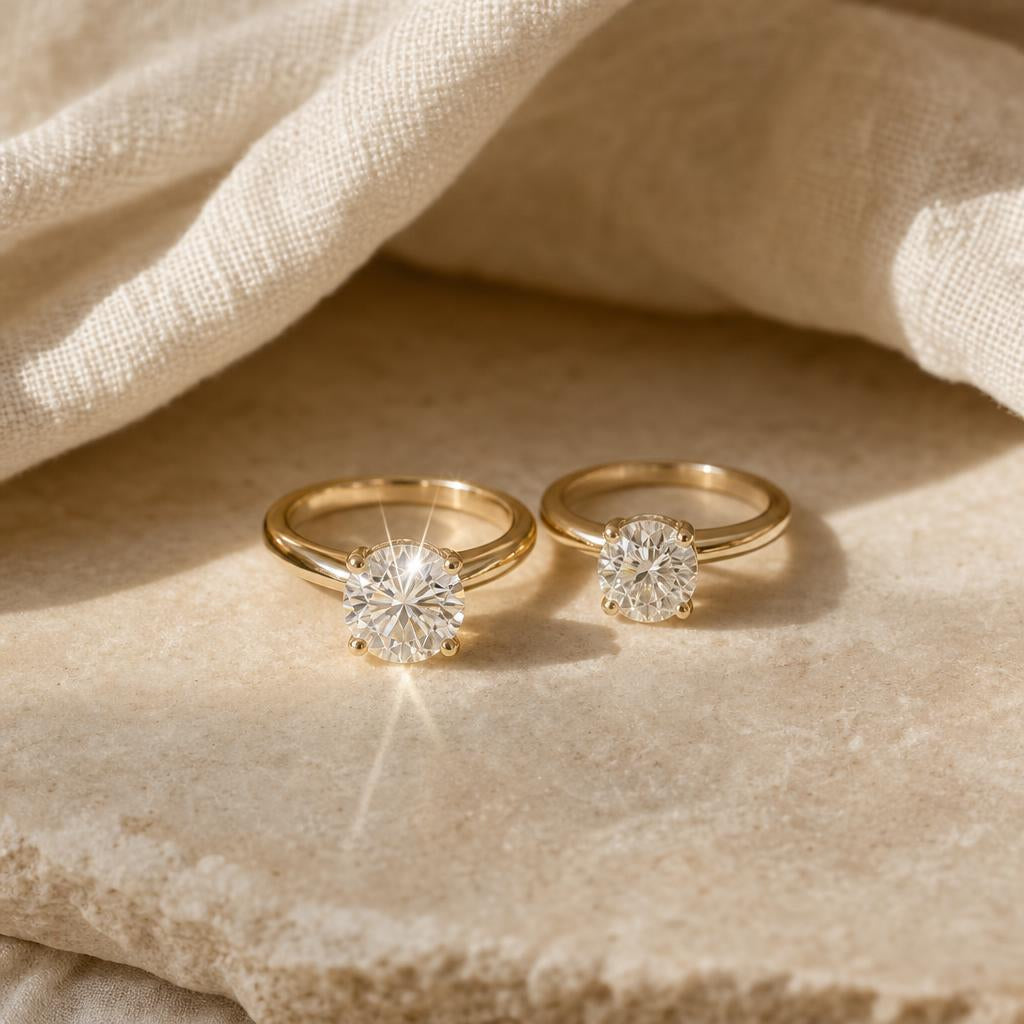
The Real Cost Breakdown: Mined Diamond Rings vs. Simulated Diamond Rings
Put a mined diamond ring and a simulated diamond ring side by side and, to most eyes, they're indistinguishable — the same brilliant white sparkle, the same clean lines, the same quiet shine under kitchen light. Yet one of them can cost many times more than the other. If you've ever wondered where that gap actually comes from, the honest answer has surprisingly little to do with beauty and almost everything to do with a supply chain most shoppers never see.
Before we break down exactly what you're paying for in each case, here's a look at a few simulated diamond styles that show how much range exists within a single, honest price category — no mystery markup required.


Where a Mined Diamond's Price Actually Comes From
A mined diamond doesn't arrive at a jewelry counter with a single price tag attached to it — it arrives with a long list of costs stacked on top of one another, most of which have nothing to do with how the stone looks on your hand. The process starts underground, sometimes hundreds of meters down, where heavy machinery, land rights, labor, and environmental remediation all factor into the cost of extracting a single rough stone. From there, the diamond is sorted, evaluated, and sold — often multiple times — through a wholesale pipeline of brokers, cutters, and polishers before it ever reaches a retailer.
Each stage in that chain adds its own margin. The cutter who transforms a rough stone into a brilliant-cut diamond charges for that expertise. The grading lab that certifies the stone's carat, cut, clarity, and color charges for that report. The wholesaler who moves it from the cutting house to the retail market takes a cut. And the retailer, finally, prices it to cover overhead, staff, insurance, and — yes — a healthy margin, because diamonds have been marketed for nearly a century as an emotional purchase people rarely negotiate hard on.
Worth knowing: None of these costs are really about the stone's beauty. A mined diamond and a lab-grown or simulated stone can be chemically or visually similar in appearance, but the mined stone carries the cost of geology, logistics, and a multi-decade marketing apparatus that a sterling silver ring set with a simulated stone simply never touches.
What You're Actually Paying For — Rarity, Not Just Sparkle
The traditional diamond industry built its entire pricing model around perceived rarity. Every mined diamond is geologically unique, which means the industry can frame each one as a singular, irreplaceable object — even though supply has never actually been as scarce as decades of advertising suggested. That framing is a large part of why two visually identical stones, one mined and one lab-grown or simulated, can carry such different price tags. You're not just paying for carbon arranged in a crystal lattice. You're paying for the story of where it came from, the paperwork that proves it, and the assumption that scarcity alone makes it worth more.
This isn't a criticism of anyone who chooses a mined diamond — for many people, that provenance and tradition genuinely matters, and it's a legitimate reason to spend more. But it's worth naming clearly, because it explains why the price difference between a mined and a simulated stone is so much larger than the visual difference between them.
Where a Simulated Diamond's Cost Comes From Instead
A simulated diamond — like the moissanite and cubic zirconia stones used across the Gemiros collection — skips almost the entire chain described above. There's no mining, no multi-party wholesale pipeline, and no certification report tied to geological rarity. The stones are manufactured to a consistent, replicable standard, which means the cost structure behind them is dramatically simpler and more transparent.
What actually drives the cost of a simulated diamond ring isn't the stone at all — it's the setting. A hidden halo with pavé accent stones takes more hours of hand-setting than a plain solitaire. A 4-prong setting is faster and less labor-intensive than a cathedral or a cluster of smaller stones. And the metal matters enormously: sterling silver, gold vermeil, and rose gold vermeil all carry different material costs, which is why you'll see price variation within the simulated diamond category itself, even between two rings with a nearly identical center stone.

The Ophelia Ring
An oval-cut center stone with a hidden halo and a pavé band — a good example of how setting complexity, not the stone itself, is what moves the needle on a simulated diamond ring's cost.
Shop The Ophelia Ring →The Setting and Metal Matter More Than the Stone
This is one of the most useful things to understand if you're comparing a mined diamond ring to a simulated one and trying to make sense of the numbers: with a mined diamond, the center stone usually accounts for the majority of the total cost. With a simulated diamond, the relationship flips. The stone itself is a relatively small, consistent input, and the total cost is shaped far more by craftsmanship — how many hours of hand-setting the design requires, how intricate the band is, and which metal it's built in.
That's also why two simulated diamond rings with the same carat-look center stone can land in genuinely different places. An asscher-cut ring with pavé side stones running down the shank requires meaningfully more setting work than a clean solitaire, and that labor is reflected honestly in the price — not inflated by a certification chain or a rarity narrative, just the actual time it takes to set each accent stone by hand.

The Astrid Ring
An architectural asscher-cut center stone with pavé side stones — the kind of detailed setting where labor, not the gem itself, explains most of the cost.
Shop The Astrid Ring →What You Genuinely Don't Get With a Simulated Diamond
An honest cost breakdown has to acknowledge the other side of this too. A simulated diamond ring is not a mined diamond ring with a discount — it's a different category of object, and there are real differences beyond price. Mined diamonds carry a graded certification report tied to an internationally recognized standard, which matters if resale value, insurance appraisal, or long-term investment framing is part of why you're buying. Simulated stones don't carry that same paper trail, because they were never priced or marketed as a store of value in the first place.
Mined diamonds are also the hardest natural substance on earth, which plays into their durability reputation, though in practice a well-set moissanite or cubic zirconia in a quality setting holds up extremely well to daily wear. The honest distinction isn't "better" versus "worse" — it's that a mined diamond's price includes a rarity and resale premium that a simulated stone's price simply doesn't, and won't ever try to.
✦ Pro tip: If part of your decision involves resale or long-term value, that's a legitimate reason to lean mined. If your priority is how the ring looks and wears every single day, a simulated stone gets you there for a fraction of the layered costs described above — without pretending to be something it isn't.
Side by Side, Without the Marketing Spin
Here's the comparison stripped down to what's actually driving the cost on each side, rather than what a sales pitch usually leads with.
| Cost Driver | Mined Diamond Ring | Simulated Diamond Ring |
|---|---|---|
| Sourcing | Mining, land rights, extraction labor | Manufactured to a consistent standard |
| Middle chain | Cutter, grading lab, multiple wholesalers | Minimal middle chain |
| What drives the final number | The center stone's rarity and grading | Setting complexity and metal choice |
| Certification | Graded report tied to global standards | No comparable rarity-based certification |
| Resale expectation | Retains some value, tied to grading | Not designed or priced as a resale asset |
| Visual appearance | Brilliant, natural fire | Comparable brilliance, especially in moissanite |
Once you see the drivers laid out this way, the price gap stops feeling mysterious. It isn't that one ring is "real" and the other is a lesser copy — it's that one price is built from geology, certification, and a rarity narrative, and the other is built almost entirely from craftsmanship. Neither is dishonest. They're just pricing completely different things.
How to Decide What Actually Matters to You
If you're standing between these two categories, the most useful question isn't "which one is more real" — it's "which parts of that price stack am I actually willing to pay for." If provenance, certification, and resale potential genuinely matter to you, that premium is doing real work. If what you actually want is the way a ring looks on your hand every day — the brilliance, the setting, the craftsmanship — a simulated diamond ring gets you there without asking you to fund a supply chain that has very little to do with how it sparkles.
It's also worth remembering that these aren't mutually exclusive categories forever. Plenty of women build a small collection that includes both — a mined diamond for the ring that carries emotional or ceremonial weight, and a rotation of simulated diamond pieces for the styles they want to wear more freely, without thinking twice about travel, daily wear, or trying a bold new setting before committing to it in a mined stone.
Quick Takeaways
- A mined diamond's price reflects mining, cutting, certification, and a multi-decade rarity narrative — not just how it looks.
- A simulated diamond's cost is driven almost entirely by setting complexity and metal choice, not the stone.
- Certification and resale value are genuine advantages of mined diamonds, not marketing fluff — they matter if those are priorities for you.
- Two simulated diamond rings with a similar center stone can cost differently based purely on hand-setting labor and metal.
- Neither category is "the real one" — they're pricing different things entirely.
Frequently Asked Questions
Is a simulated diamond just a cheaper, lower-quality version of a mined diamond?
No — it's a different category of stone with its own manufacturing standard, not a discounted version of a mined one. The lower cost reflects a simpler supply chain and the absence of a rarity premium, not lower craftsmanship in the setting itself.
Why do two simulated diamond rings with similar-looking stones cost different amounts?
Almost always because of the setting and metal, not the stone. A hidden halo with pavé accents takes more hand-setting time than a plain solitaire, and gold vermeil carries a different material cost than sterling silver.
Does a mined diamond actually hold its value better over time?
Certified mined diamonds do generally retain more resale value than simulated stones, largely because they're tied to an internationally recognized grading standard. Simulated stones were never priced or marketed as a resale asset, so this isn't really a fair like-for-like comparison — it's a different intention from the start.
Can you tell a simulated diamond apart from a mined one just by looking at it?
For most people, in everyday lighting, no — especially with moissanite, which has its own bright, fiery sparkle. Trained gemologists with specialized equipment can distinguish them, but the visual gap that would justify a dramatic price difference simply isn't there for the average viewer.
At the end of the day, the price difference between a mined and a simulated diamond ring isn't a mystery once you know what each number is actually paying for. One is priced around geology and scarcity. The other is priced around craftsmanship and honest materials. Knowing the difference doesn't tell you which one to choose — it just means you're choosing with your eyes open, instead of paying for a story you never asked to buy into.


