

Why Simulated Diamond Rings Look So Much Better Than They Used To — And What Changed
There's a phrase that used to apply to simulated diamond rings: "you can tell." You could tell because the stone was cloudy, or flat, or caught the light wrong. You could tell because the band turned your finger green within a week. You could tell because nothing about it looked considered. That era is over — and it ended more decisively than most people realise.
Simulated diamond rings have changed so substantially in the last several years that the old assumptions no longer apply. The stones are cut differently. The metals are treated differently. The manufacturing process itself has been rebuilt from the ground up. If you haven't looked closely at what's available today, you're operating on outdated information.


The stone quality revolution
The most significant shift has happened at the stone level. For a long time, the simulated diamond market was dominated by cubic zirconia produced at volume with minimal quality control. These stones had high refractive indices on paper, but in practice they scattered light unevenly, producing a "disco ball" flash rather than the complex interplay of brightness, fire and scintillation you see in a well-cut diamond.
Two things changed that. First, stone manufacturers started applying the same grading criteria to simulated diamonds that gemologists use for natural stones — specifically facet precision, table size, crown angle and culet alignment. A poorly aligned facet on a cubic zirconia scatters light the same way a poorly aligned facet on a mined diamond does. Getting the geometry right meant getting the light performance right. Second, moissanite — a silicon carbide compound first identified in meteorite craters — entered the mainstream market at accessible price points. Moissanite has a refractive index of 2.65, compared to 2.42 for diamond, which means it actually refracts more light, not less. A well-cut moissanite produces more fire than a comparable diamond; the question has shifted from "is this convincing?" to "which fire profile do I prefer?"
The result is that modern simulated diamond stones — whether moissanite, high-grade CZ or lab-grown simulants — are cut to tolerances that simply weren't commercially viable a decade ago. The stones are cleaner, the facets are more precise, and the light performance is measurably better.

The Beatrice Ring
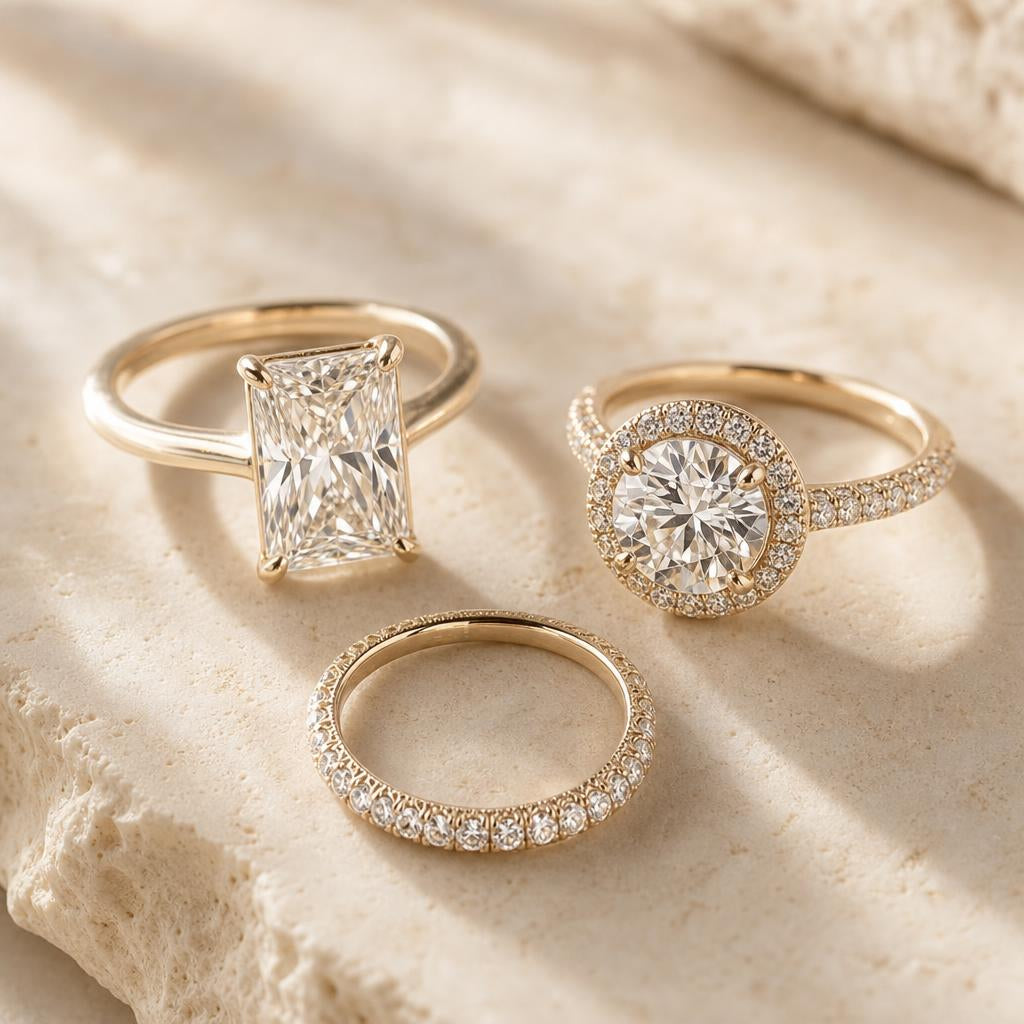
A classic round-cut stone is the right choice when you want a stone that performs in every light — from low candlelight to harsh office fluorescents. The Beatrice pairs it with an antique-style pavé band that adds texture without competing with the centre stone. The combination works because the stone quality carries the design.
Shop The Beatrice Ring →The settings revolution
Better stones were only half the equation. The settings that hold them have changed just as significantly.
Early simulated diamond rings often had settings that gave them away as much as the stones. Prongs were too thick, too blunt, or set unevenly — details that a trained eye would clock immediately. Plating was thin enough that gold or silver colour would start wearing through at friction points — the underside of the band, the inside of the shank — within weeks. The whole piece felt like it had been manufactured to a cost rather than to a standard.
Modern settings are cast, finished and quality-checked at a different level. Prong work is finer, which matters because prongs are one of the most visible indicators of quality — the way they hold a stone, how they catch the light themselves, whether they sit evenly around the girdle. Rhodium plating on white gold finishes and sterling silver pieces is now applied at a thickness that holds up to daily wear. Gold vermeil (a legal standard requiring a minimum gold thickness over sterling silver) has become a credible everyday choice rather than a novelty.
Worth knowing: Rhodium plating is the white finish you see on most "white gold" and sterling silver rings. When it's applied properly, it's both tarnish-resistant and hard-wearing. On quality-made rings it lasts 12–18 months of daily wear before it might need a refresh — and a replating costs very little.
There's also been a shift in how settings are designed for the stones they hold. A simulated diamond that refracts light differently from a natural diamond benefits from a setting geometry optimised for it — different girdle thickness, different prong placement, different head height. The best manufacturers have started designing their settings around the specific optical properties of the stones they use, rather than adapting a mined-diamond template.
The design revolution
Something less obvious but equally important has happened on the design side. When you're not constrained by a six-figure stone budget, you can spend more of your resources — financial and creative — on the setting itself.
Elaborate settings that would be prohibitively expensive in fine jewellery because of the labour involved in setting a high-value stone are economically viable in simulated diamond rings. Double halos, intricate milgrain detailing, pavé micro-settings along the shank, geometric Art Deco side stone arrangements — these designs exist in the simulated diamond market not as budget compromises but as the primary value proposition. You're buying the design, not just the stone.

The Evangeline Ring
A radiant-cut centre stone framed in detailed pavé work — the kind of setting that would add significantly to the cost of a mined diamond ring because of the labour involved. In a simulated diamond ring, that setting quality becomes the whole point. The Evangeline earns its place by the details you keep noticing.
Shop The Evangeline Ring →What "simulated diamond" actually means today
The terminology has historically been a source of confusion, and it's worth being clear about what these terms mean now.
A simulated diamond is any stone that visually resembles a diamond but has a different chemical composition. This is a broad category that includes cubic zirconia, moissanite, white sapphire, and various manufactured glass or crystal stones. The quality range within this category is enormous — from very inexpensive stones with poor light performance to near-flawless moissanites that outperform most natural diamonds in fire and brilliance.
A lab-grown diamond is chemically identical to a mined diamond — same crystal structure, same refractive index, same hardness. It's not a simulated diamond; it's a real diamond that was grown in a laboratory rather than extracted from the earth. Lab-grown diamonds have fallen significantly in price in recent years, but they're still a distinct category from simulated stones.
The distinction matters because when people say "simulated diamonds have gotten so much better," they're specifically talking about the manufacturing quality of stones like high-grade CZ and moissanite — not a change in their fundamental chemistry. The chemistry hasn't changed. What's changed is the precision with which those materials are now cut, polished, and set.
✦ How to judge a simulated diamond stone: Look for fire (coloured light dispersed when the stone moves), brilliance (white light reflected back through the table), and scintillation (the sparkle pattern when the stone moves). A well-made modern simulant should show all three clearly — not just a flat white sparkle.
What hasn't changed
Better doesn't mean the same as natural, and it's worth being honest about what's still different.
Moissanite is harder than cubic zirconia and more durable than most simulants, but it's still softer than diamond (9.25 on the Mohs scale versus 10). High-grade CZ, even well-cut, will accumulate fine surface scratches over years of daily wear that affect its light performance. Both benefit from regular cleaning to maintain their sparkle — oils, lotions and soap residue dull the surface of any stone, but they show up faster on CZ than on diamond or moissanite.
Metal finishes also still require more care than solid gold. Rhodium plating on sterling silver and gold-plated pieces needs to be treated as a wear surface, not a permanent coating — avoid hand sanitiser, bleach, and abrasive surfaces. The ring itself will outlast the plating; the plating is the maintenance variable.
None of this is hidden or controversial — it's just what it is. A simulated diamond ring is a different product from a mined or lab-grown diamond ring. It's priced accordingly, it wears accordingly, and for many buyers — particularly those who want a beautifully designed ring now rather than a plain ring that fits a diamond budget later — it's the better choice for their actual life.
What Actually Changed
- Stone cutting precision has improved significantly — facet geometry now drives real light performance
- Moissanite entered the mainstream at accessible prices, bringing diamond-level durability and exceptional fire
- Setting quality — prong work, plating thickness, overall finish — has risen to match the stones
- Design has evolved: complex settings are now designed for simulants, not adapted from mined diamond templates
- What hasn't changed: maintenance requirements, scratch susceptibility (especially CZ), and the fundamental material difference from natural diamond
Frequently asked questions
Can people tell a modern simulated diamond ring isn't a real diamond?
A gemologist with a loupe can distinguish moissanite from diamond by its characteristic doubling of facet reflections, and high-end CZ will test differently on a diamond tester. To the naked eye, at normal conversation distance, a well-cut modern simulant in a quality setting is indistinguishable from a diamond to anyone who isn't specifically looking. That includes most jewellers.
Which is better — moissanite or cubic zirconia?
For durability and long-term light performance, moissanite is significantly better. It's harder (9.25 vs 8.5 Mohs), more resistant to scratching, and holds its optical clarity better over years of daily wear. High-grade CZ is a good choice for rings worn occasionally or for travel — it's often used in travel rings precisely because replacing it if it's lost or damaged is inexpensive. For a daily-wear ring you want to keep looking its best, moissanite is the stronger choice.
Do simulated diamond rings still turn your finger green?
The green-finger effect comes from copper in the base metal reacting with skin chemistry and moisture. Quality simulated diamond rings are set in sterling silver (92.5% pure silver, no copper) or sterling silver with rhodium plating, or gold-plated sterling silver — none of which contain enough copper to cause discolouration. Very inexpensive fashion rings in brass or low-grade alloys can still do this. The material difference matters; the stone itself is irrelevant to the equation.
How long will a simulated diamond ring last?
The stone itself, if it's moissanite, will last indefinitely — it's nearly as hard as diamond and won't cloud or discolour. High-grade CZ worn daily will develop micro-scratches over several years that affect its sparkle, at which point the stone can be replaced or the ring retired. The metal setting, if properly cared for, will last just as long as any silver or gold-plated piece. Rhodium plating may need refreshing every 12–18 months of heavy daily wear, but the ring itself is not a consumable product.
The best argument for a modern simulated diamond ring isn't that it fools anyone — it's that fooling people was never the point. The point is a ring that looks genuinely beautiful, is well-made, and lets you spend your money on what the design actually looks like rather than what the stone's geological origin story is. That case has never been stronger than it is right now.


