

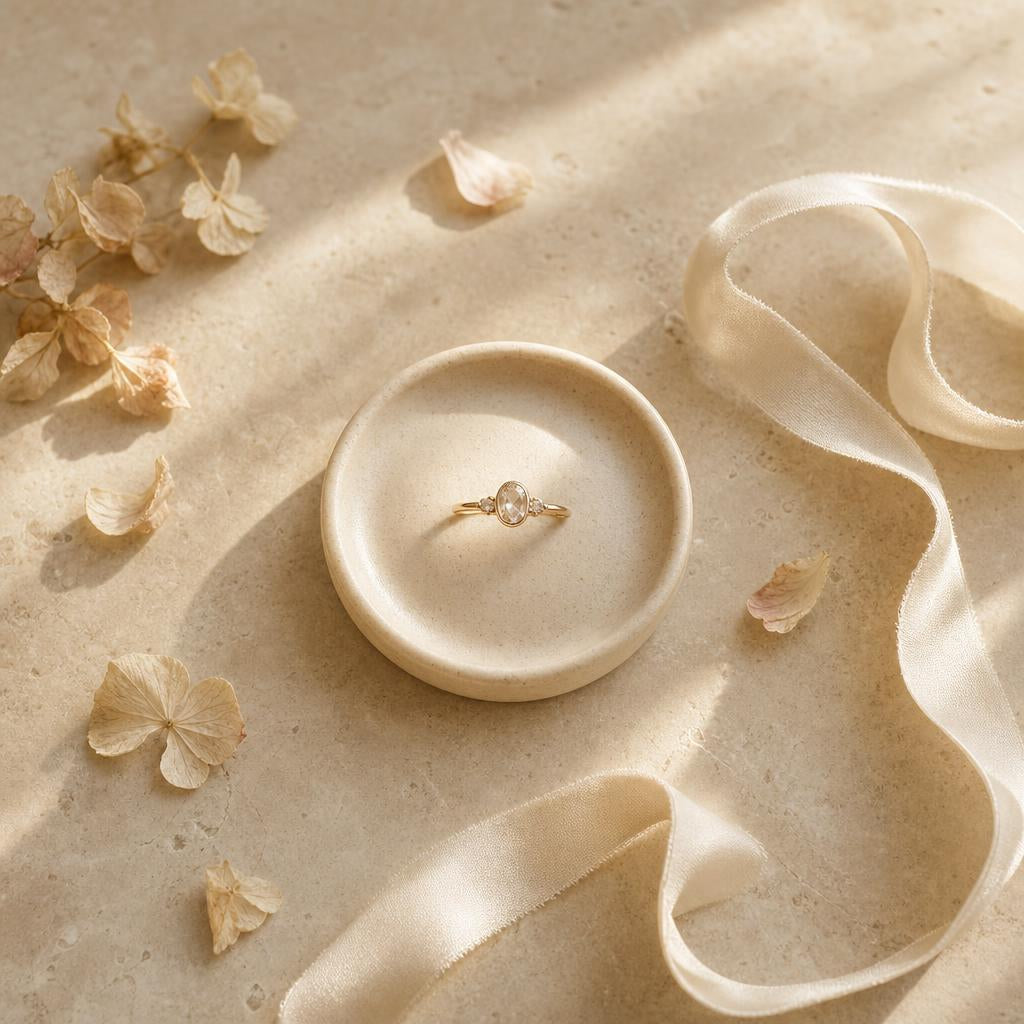
Ring Shopping With a Strict Budget Cap: How to Get the Most Ring for a Fixed Number
Every ring budget is really just a number you've decided not to cross — and the good news is that number doesn't have to shrink your options nearly as much as you'd think. With the right cut, the right setting, and a little bit of optical strategy, a fixed budget can still get you a ring that reads as considered, deliberate, and genuinely beautiful.
The trick isn't finding a "cheaper version" of the ring you already had in mind. It's understanding which design choices quietly do more work per dollar, so the number you've set stretches as far as it possibly can. Here's where we'd start.


Start With the Number, Not the Ring
Most ring shopping goes wrong in the same order: fall in love with a ring, then try to justify the number. Flip that sequence and the whole search gets easier. Decide what you're comfortable spending first, and let that number filter everything that comes after — the cut, the setting, the metal, even which retailer you shop with.
This isn't a consolation-prize approach. It's the same logic anyone building a wardrobe on a budget already understands: a handful of well-chosen, well-fitting pieces beats a closet full of compromises. Rings work the same way. One ring, chosen deliberately within a real number, will always look more intentional than a ring stretched for that quietly resents its own price tag.
Worth knowing: simulated diamond rings have changed enormously in the last few years. Better cuts, better settings, and finer plating mean a ring at a fixed, modest price point can now hold up to a much closer look than it could even a couple of years ago.
The Optical Tricks That Make a Ring Look Bigger Than the Number Says
If there's one lever that matters more than any other on a budget, it's the setting. The stone size is fixed once you've chosen it, but the setting around that stone is where a ring either reads as "modest" or "substantial" — and that's almost entirely a design decision, not a spending one.
A halo setting is the most direct version of this trick: a ring of smaller accent stones circles the center stone, adding perceived size and a wider footprint of sparkle without changing the center stone itself. A hidden halo takes it further — the halo sits underneath the center stone rather than around it, invisible from a straight-on view but catching the light the moment the hand tilts, so the ring seems to shimmer from angles a plain solitaire simply can't.

The Duchess Ring
A cushion-cut center stone with a hidden halo tucked beneath it — the kind of detail that makes a fixed-budget ring look considerably more elevated the moment it catches light.
Shop The Duchess Ring →Pavé settings do something similar in a smaller, quieter way. Instead of one large statement, tiny stones set closely along the band catch light continuously, so the whole ring reads as more luminous without a single feature carrying all the weight. It's a detail that costs relatively little in design terms but changes how the entire ring photographs and how it looks under different lighting — office fluorescents, restaurant candlelight, a sunny sidewalk.
Choosing a Cut That Works With Your Budget, Not Against It
Cut shape has a bigger effect on perceived size than most first-time buyers expect. Elongated shapes — oval, marquise, pear — create the illusion of greater size because more of the stone's surface area is visible from a top-down view, compared to a round or cushion cut of the same carat weight. If "looking bigger" matters more to you than a particular silhouette, an oval solitaire is one of the most efficient choices you can make.

The Odette Ring
A clean oval solitaire that leans on shape, not embellishment, to look bigger and brighter than its simplicity suggests — a genuinely smart pick for a fixed number.
Shop The Odette Ring →A true solitaire — one stone, minimal metalwork, no halo — is also one of the most budget-efficient choices there is, simply because it puts all of the visual attention on the stone and the cut, with nothing else competing for it. If you've been drawn to the halo-or-no-halo decision and keep landing on "no halo," a fixed budget is exactly the situation where that instinct pays off.
What a shape actually does for you
- Oval: elongates the finger and appears larger than its carat weight thanks to a larger visible surface area
- Cushion: softer, rounded corners with more brilliance than a strict emerald or asscher cut
- Round: the most classic silhouette, and often the most cost-efficient setting to source and produce well
- Pear or marquise: dramatic, elongating shapes that read as more unique without needing a larger stone
Metal Choices That Don't Change the Number
The band material is another place where a strict budget can still get you exactly what you want, because the differences between sterling silver, gold vermeil, and rose gold are almost entirely aesthetic rather than about durability or quality at this price point. All three, done well, are nickel-free and finished with rhodium or gold plating that holds up to daily wear far better than budget shoppers usually expect.
✦ Pro tip: if you're torn between two rings at the same price, let skin tone and your existing jewelry decide the metal, not the other way around. Cool undertones tend to favor sterling silver or white gold finishes; warm undertones usually lean toward gold vermeil or rose gold.
If you want the full breakdown of what separates these finishes — plating thickness, how they wear over years, which one actually tarnishes and which doesn't — it's worth reading a dedicated breakdown of gold vermeil, sterling silver, and gold-plated finishes before you commit either way. None of the three should push your number in either direction; they're a style decision, not a budget one.
One Ring Now, a Stack Later: Spreading the Spend Over Time
A strict budget doesn't have to mean one purchase and done. Some of the most satisfying collections we see are built deliberately over time — one solitaire or halo ring first, with a slim pavé band or two added later once the first piece has settled into daily rotation. It spreads the spend out, and it almost always looks more considered than buying everything at once.
A stacking band is also simply a smaller purchase in its own right, which makes it a genuinely useful starting point if your number this month is tighter than you'd like it to be for a full halo or solitaire ring. Start with one flush, unobtrusive band, and build from there once the budget resets.
Worth knowing: stacking bands are also one of the easiest ways to keep a ring wardrobe feeling fresh without buying a new "main" ring every time. Rotate which band sits next to your solitaire and the whole look changes.
If a stack is the direction you're leaning, it's worth reading through how to build a minimal ring stack from scratch before you buy your second piece — the order you add rings in matters more than most people expect.
What Not to Compromise On
A fixed number means making real choices, but a few things are worth protecting no matter how tight the budget gets:
- Nickel-free settings — this is a sensitivity issue, not a style one, and it's non-negotiable for daily wear
- Rhodium or gold plating over base metal — thin, low-quality plating wears through within months; better plating is the difference between a ring that still looks new at year two and one that doesn't
- A comfort-fit band — a ring you wear every day should never feel like something you're tolerating
- The right size — resizing costs more, in money and hassle, than getting it right the first time
Everything else — halo or no halo, round or oval, silver or rose gold — is genuinely a style call, and none of those choices should stretch a number you've already decided is firm.
Quick Takeaways
- Decide your number before you start browsing, not after you've fallen for a ring
- Halo and hidden halo settings add perceived size without changing the center stone
- Elongated cuts like oval and marquise look larger than their carat weight suggests
- Sterling silver, gold vermeil, and rose gold are style choices, not quality tiers, at this price point
- A stacking band is a smart, smaller starting point if this month's number is especially tight
- Never compromise on nickel-free settings, real plating, comfort fit, or accurate sizing
Frequently Asked Questions
Does a halo setting actually make a ring look like a bigger stone, or is that just marketing?
It's a genuine optical effect. A ring of smaller stones surrounding the center stone widens the visible sparkle and blurs the edge of where the "main" stone ends, so the eye reads the whole cluster as one larger area of brilliance.
Is it better to spend the full budget on one ring, or split it across a ring and a stacking band?
It depends on how you plan to wear it. If you want one ring that reads as complete on its own, put the full number toward that. If you're building toward a stacked look eventually, a smaller first purchase — like a solitaire — with a band added later often looks just as intentional and spreads the cost out.
Does the metal — silver, gold vermeil, or rose gold — affect how long a ring lasts?
At this price point, the difference is mostly aesthetic rather than a durability gap. What matters more for longevity is plating quality and whether the setting is nickel-free, regardless of which metal tone you choose.
What's the single best design choice for making a ring look more expensive on a fixed budget?
A hidden halo is usually the highest-impact choice, because it adds a layer of sparkle that's invisible head-on but catches light constantly during normal hand movement — without changing the center stone itself.
A strict number doesn't have to feel like a limitation once you know where the real value in a ring actually lives. Choose the setting and cut deliberately, protect the details that matter for daily wear, and the ring you land on will feel like exactly what you meant to buy — not what you settled for.


