

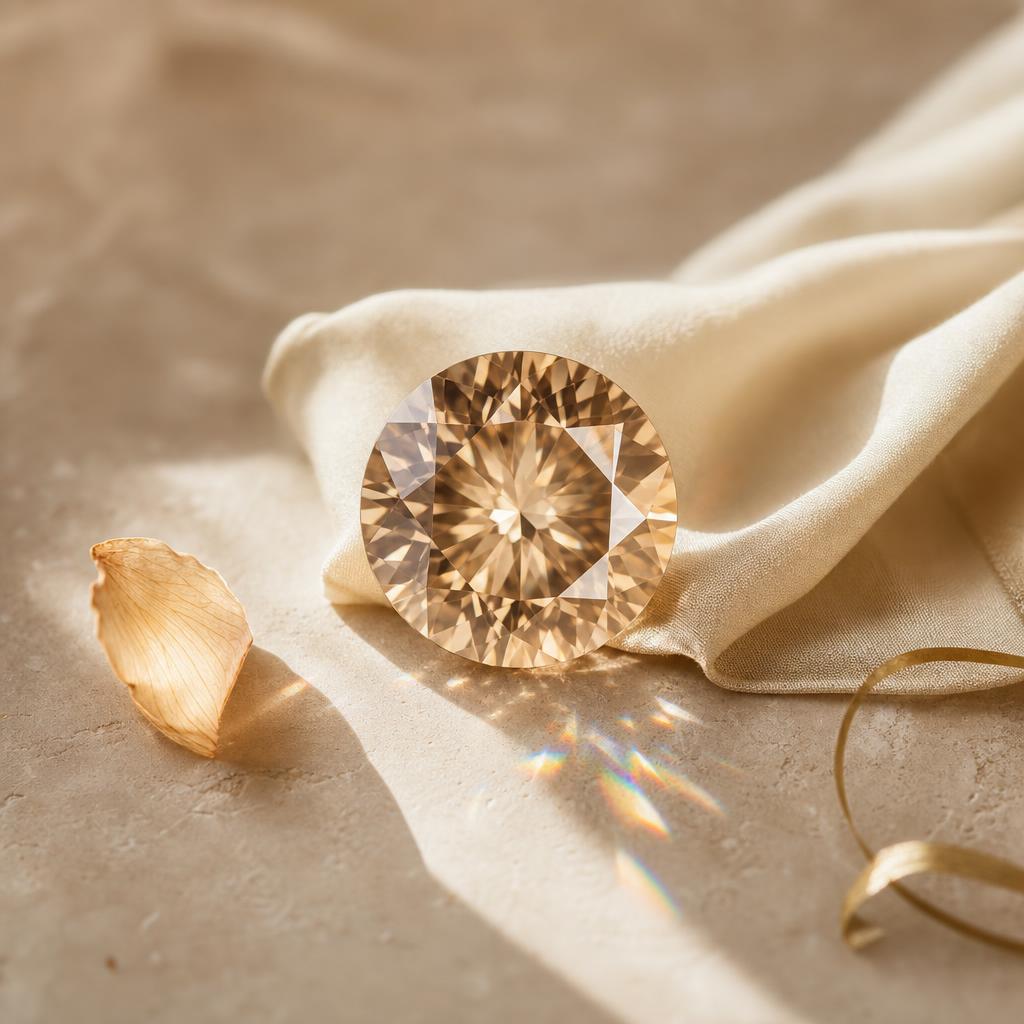
Moissanite vs Diamond: Is It a Real Gemstone or a Diamond Impostor?
Somewhere along the way, moissanite got saddled with a reputation it never earned. People hear the word and assume it means "fake diamond" — a stand-in, a compromise, something you settle for when the real thing is out of reach. It's time to correct the record, because the actual answer to moissanite vs diamond is more interesting than the myth.
Moissanite is not a diamond, and it was never trying to be one. It's its own gemstone, with its own origin story, its own chemistry, and — in more than a few ways — more fire than a diamond will ever throw. Before you decide what you think of it, here's what it actually is.


What Moissanite Actually Is
Moissanite is silicon carbide — a crystal structure that occurs so rarely in nature it was first identified in fragments of a meteorite, decades before anyone figured out how to grow it consistently in a lab. That's the whole story. It is not carbon pressed into a diamond lattice. It is not glass, plastic, or a coated stand-in dressed up to pass for something it isn't. It is a distinct mineral with its own name, its own crystal formation, and its own optical behavior, and it has been recognized by gemologists as exactly that since the 1990s.
So the honest answer to "is moissanite a real gemstone" is simple: yes. It's real in the same sense that sapphire, emerald, and every other stone in a jewelry case is real — a genuine mineral, cut and set the way any fine gem would be. What it isn't is a diamond. And that distinction matters less than you'd think, because a stone doesn't have to share a diamond's chemistry to earn a place on your hand.
Worth knowing: Every Gemiros moissanite ring is set in 925 sterling silver with rhodium or 18k gold plating — hypoallergenic, nickel-free, and built to be worn daily, not saved for occasions.
Moissanite vs Diamond: The Real Differences
Here's where the comparison actually gets interesting. Moissanite and diamond aren't different tiers of the same thing — they behave differently under light, wear differently over years, and come from entirely different processes.
| Property | Diamond | Moissanite |
|---|---|---|
| Composition | Pure carbon | Silicon carbide |
| Hardness (Mohs scale) | 10 | 9.25 |
| Sparkle | Bright white light | Rainbow-colored fire, higher refractive index |
| Origin | Mined or lab-grown | Discovered in a meteorite; grown in a lab today |
| Everyday durability | Excellent | Excellent — second only to diamond |
The hardness gap between a 10 and a 9.25 sounds significant until you realize what it actually means in practice: both stones shrug off scratches from everyday life — typing, dishes, gym days, all of it. Moissanite isn't the fragile alternative some people assume it is. It's the second-hardest gemstone used in fine jewelry, full stop.
The sparkle difference is the one people notice first, and it goes the opposite direction of what most assume. Moissanite has a higher refractive index than a diamond, which means it throws more color — flashes of rainbow fire instead of pure white light. Under direct sun or bright indoor lighting, it can genuinely out-sparkle a diamond of the same size. Some women prefer the classic white flash. Others prefer the fire. Neither preference makes the stone "less real."
Does Moissanite Pass a Diamond Tester?
Yes. Standard diamond testers measure thermal conductivity, and moissanite conducts heat at a rate close enough to diamond that basic testers read it as a match. Indistinguishable from a diamond, passes diamond testers, and — because the two stones look so similar under normal lighting — no one across the table is going to clock the difference either. That's not a workaround or a trick. It's just physics working in your favor.
✦ Pro tip: Only a specialized dual-probe tester, checking electrical conductivity alongside heat, can reliably separate moissanite from a diamond — and that's equipment your jeweler keeps in the back, not something anyone's pulling out at dinner.

The Élise Moissanite Ring
A 2.5-carat emerald-cut moissanite center, set atop a pavé-lined band for an extra ribbon of sparkle. Old-world elegance with today's proportions.
Shop The Élise →Is Moissanite a Lab-Grown Diamond?
No — and this is the mix-up that trips up even careful shoppers. Lab-grown diamonds are chemically identical to mined diamonds; they're pure carbon, grown under lab conditions instead of pulled from the earth, but structurally the same stone. Moissanite is a different mineral entirely. It was never a diamond in any form, lab-grown or otherwise, so comparing the two isn't a matter of degree — it's a matter of two separate materials that happen to look similar to the eye.
Can You Tell Moissanite From a Diamond by Eye?
In everyday settings — across a table, under office lighting, in a photo — no. The difference only becomes visible to a trained eye at close range, under strong light, usually above one carat, where moissanite's extra fire starts to read as more colorful rather than more brilliant. For the overwhelming majority of moments a ring actually gets seen, that distinction never surfaces. What people register is the shape, the setting, and the way it catches light — and moissanite delivers all three convincingly.
Moissanite or Signature Simulated Diamond: How to Choose
Gemiros carries both, and the honest difference comes down to the kind of sparkle you want, not which one is "better." Our Signature Simulated Diamond collection is built to mirror a diamond's classic white brilliance as closely as possible. Moissanite leans into its own identity — that extra fire, that rainbow flash, a stone that reads as unmistakably itself. Neither is a downgrade from the other. They're simply two different answers to the same question: what do you want people to see when the light hits your hand?

The Rivière Moissanite Ring
Five moissanites, 3.6 carats total, set in a soft graduated wave across the band — sparkle that moves every time your hand does.
Shop The Rivière →Why the "Impostor" Label Never Made Sense
Calling moissanite fake assumes a diamond is the only legitimate reference point a gemstone can be measured against — which is exactly the kind of outdated thinking that built the diamond industry's markup in the first place. Moissanite doesn't need to borrow a diamond's identity to justify its price. It has its own hardness rating, its own optical signature, its own history. Choosing it isn't a consolation prize. It's a decision made by someone who did the research and landed on the stone that actually suits her, not the one she was told to want.
Quick Takeaways
- Moissanite is a genuine gemstone made of silicon carbide — not a diamond, and not an imitation of one.
- It rates 9.25 on the Mohs hardness scale, second only to diamond, and holds up to daily wear.
- Its higher refractive index gives it more colorful "fire" than a diamond of the same size.
- It passes standard diamond testers because both stones conduct heat almost identically.
- It is not a lab-grown diamond — lab-grown diamonds are pure carbon; moissanite never was.
Frequently Asked Questions
Is moissanite a real gemstone, or is it fake?
It's real — a genuine mineral (silicon carbide) recognized and graded by gemologists, not a synthetic imitation. "Fake" would mean it's pretending to be something it's not; moissanite has always been marketed and sold as exactly what it is.
What's the actual difference between moissanite and a diamond?
Composition, mainly. Diamonds are pure carbon; moissanite is silicon carbide. That difference shows up in hardness (10 vs. 9.25), sparkle (moissanite throws more color), and origin — diamonds are mined or lab-grown, moissanite is grown in a lab from a structure first found in a meteorite.
Will moissanite pass a diamond tester?
Yes. Standard testers measure how quickly heat moves through a stone, and moissanite conducts heat at a rate close enough to diamond that basic testers read it as a match every time.
Can a jeweler tell the difference between moissanite and a diamond?
A trained eye can, usually with a loupe and strong light, by looking for the extra rainbow fire and subtle double-refraction moissanite produces. Without that equipment and training, most people — jewelers included — can't reliably tell the two apart at a glance.
Is moissanite the same as a lab-grown diamond?
No. Lab-grown diamonds are chemically identical to mined diamonds — pure carbon, just grown differently. Moissanite is a completely separate mineral, silicon carbide, and was never a diamond in any form.
What's the biggest downside of moissanite?
Mainly personal preference: its extra fire means more colorful flashes of light rather than a diamond's purely white sparkle, which some buyers love and others find less classic. Beyond that, it holds up to daily wear just as well as a diamond does.
The next time someone assumes moissanite is a lesser choice, you'll have the actual answer ready: it's not a diamond, it never claimed to be, and it doesn't need to be one to be worth wearing. Explore the full moissanite collection and find the cut that catches your light best.


