

Is Moissanite a Fake Diamond? What to Actually Look for Before You Buy
You've narrowed it down. You know you want moissanite — the sparkle is undeniable, the price makes sense, and you're done pretending the diamond markup is anything other than a tax on tradition. But somewhere between the browser tabs, a question keeps surfacing: is moissanite a fake diamond, and how do you actually know if the one you're about to buy is any good?
Here's the short version: no, it isn't fake — it's a distinct, lab-grown gemstone with its own chemistry and its own kind of brilliance. But "not fake" doesn't mean "not worth scrutinizing." Some moissanite rings are cut, set, and finished with real precision. Others are not. Before you buy, it helps to know exactly what separates the two — and to see a few styles that get it right.


Is Moissanite a Fake Diamond?
No. Moissanite is composed of silicon carbide — a naturally occurring mineral first identified in a meteor crater, and grown in laboratories ever since for use in fine jewelry. It was never manufactured to pass as something it isn't. It's its own gemstone, with its own name, its own crystal structure, and its own set of numbers on the Mohs hardness scale (9.25–9.5, just shy of a diamond's 10 — durable enough for daily wear, sized right for an engagement ring that actually gets worn). What it shares with a diamond is the visual outcome: indistinguishable to the naked eye, and it passes diamond testers. What it doesn't share is the price tag built on a century of manufactured scarcity.
The confusion usually starts with vocabulary. People search for "fake diamonds" or "diamond dupes" because that's the shorthand they've always had for anything that isn't mined — not because moissanite is actually pretending to be a diamond. It's closer to the truth to say moissanite is the smarter category entirely: a gemstone built to be seen, not one built to be excused.
What to Actually Look for Before You Buy
Not every moissanite ring is made the same way, and the difference rarely shows up in a product photo. It shows up in three places: the cut, the setting, and the metal underneath it.
Cut and Brilliance
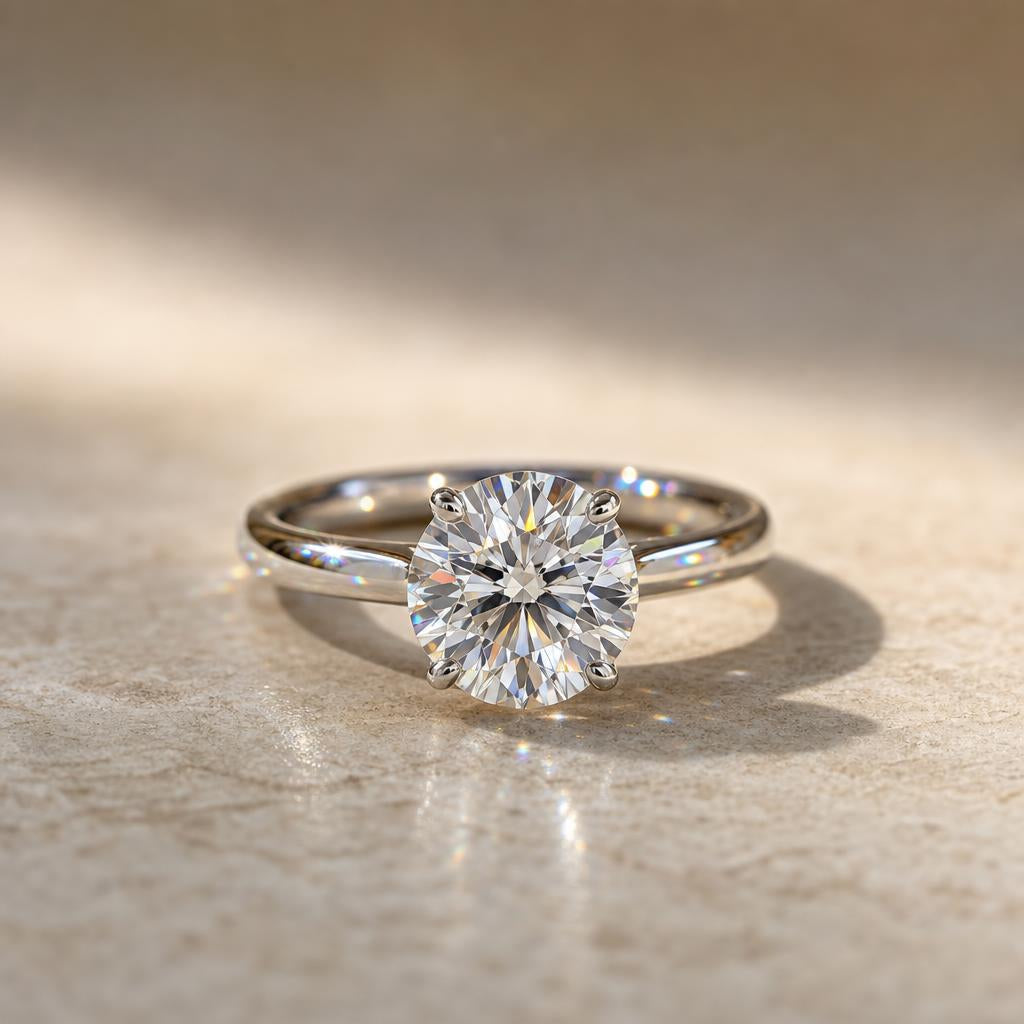
Moissanite has a higher refractive index than diamond, which means it throws more colorful, rainbow-toned light — what jewelers call "fire." A well-cut stone channels that fire evenly across every facet. A poorly cut one looks glassy in the center and washed out at the edges, no matter how large the carat count claims to be. Round and oval brilliant cuts, like the six-prong solitaire on the Éclat or the hidden-halo setting on the Aurore, are built specifically to maximize that light return — worth comparing against anything with a shape you can't quite place.
Setting and Prong Quality
A stone is only as secure as what's holding it. Loose prongs, thin metal, or a setting that looks soldered on as an afterthought are the fastest way for an otherwise beautiful ring to feel cheap within a year. Look for four or six substantial prongs on a solitaire, or a pavé band where the accent stones sit flush and even — not gapped, not crooked. The cushion-shaped halo on the Marchesa is a good reference point: every stone in that halo should catch light at the same angle, which only happens with careful, deliberate setting work.
Metal and Plating
925 sterling silver with rhodium or 18k gold plating is the standard for demi-fine moissanite jewelry, and there's nothing lesser about it — it's the same base metal used across fine costume-free jewelry lines at every price point above the mall kiosk tier. What matters is whether the plating is nickel-free (a real consideration for sensitive skin) and whether the brand is transparent about it upfront, rather than burying the material details three clicks deep on a product page.

Vivienne Moissanite Ring
A radiant-cut moissanite set on a smooth, polished band — no pavé, no halo, just clean architecture and a stone with nowhere to hide. A useful ring to study if you want to see cut quality with zero distractions.
Shop Vivienne →Moissanite vs. Cubic Zirconia — What's the Real Difference
These two get lumped together constantly, and they shouldn't be. Cubic zirconia is softer (roughly 8–8.5 on the Mohs scale, against moissanite's 9.25–9.5), which means it scratches and clouds with regular wear in a way moissanite simply doesn't. It also has a lower refractive index, so its sparkle reads flatter and more uniformly white — pretty, but without the colored fire that makes a well-cut moissanite ring genuinely hold its own next to a diamond. If you've been comparing moissanite vs cubic zirconia rings side by side and one just looks more "alive," that's not your imagination. It's physics.
What Moissanite Actually Looks Like in Sunlight
This is where moissanite tends to surprise people who've only seen it in photos. Step outside, and the stone's higher dispersion rate goes to work — diamond vs moissanite in sunlight isn't really a contest of which one is "better," it's a difference in character. A diamond gives you crisp, controlled white brilliance. A moissanite gives you a bolder, more prismatic flash, sometimes described as disco-ball-bright. Neither is a downgrade. It's simply a different kind of sparkle, and one that a lot of women end up preferring once they've seen it in person rather than under studio lighting.
Worth knowing: Because moissanite conducts heat almost identically to a diamond, a basic single-mode diamond tester will read it as a diamond. It takes a dual thermal-and-electrical tester — the kind most independent jewelers actually carry — to tell the two apart with confidence.
Does Moissanite Pass a Diamond Tester?
Yes. This is one of the more satisfying facts to know before you buy, especially if the fear sitting underneath your search is some version of "will anyone be able to tell?" A standard thermal diamond tester measures heat conductivity, and moissanite conducts heat almost exactly like a diamond does — close enough that it registers as a positive on the same basic tester a jeweler would use to check a mined stone. In the moissanite vs diamond test that actually matters to most people — the one at the jewelry counter, not the gemology lab — the stone holds up.
How Much Should a Moissanite Ring Actually Cost
This is where the category earns its reputation. Loose moissanite at large retailers is priced by the carat, and a full ring from an established moissanite house routinely climbs well into four figures before the setting is even factored in. Gemiros moissanite rings price out for a fraction of that: every design in the current collection is set in 925 sterling silver with rhodium or 18k gold plating, built to the same cut standards you'd pay several times more for elsewhere. That gap isn't a discount on quality. It's the actual cost of the stone and the setting, without a legacy markup layered on top for a name.

Victoire Moissanite Ring
A radiant-cut center stone flanked by two pear-cut side stones, four carats total — structured in the center, softened at the edges. A three-stone design for anyone who wants more story in the setting.
Shop Victoire →Quick Takeaways
- Moissanite is a real, lab-grown gemstone — not a diamond, and not a fake diamond either.
- Cut quality and prong security matter more than carat size for how a ring actually wears.
- 925 sterling silver with rhodium or 18k gold plating is the standard, transparent baseline — not a compromise.
- Moissanite passes a standard diamond tester due to near-identical heat conductivity.
- A well-made moissanite ring should cost a fraction of what a comparable diamond piece runs — not a fraction of the quality.
Frequently Asked Questions
Is moissanite considered a fake diamond?
No. Moissanite is a genuine gemstone made of silicon carbide, with its own chemical composition, hardness, and light performance. It was never created as a diamond substitute — it's a category of its own.
What's the downside of moissanite?
The main trade-off is optical, not structural: moissanite throws more colorful fire than a diamond, which some people notice more in bright, direct light. For most everyday wear, that reads as extra brilliance rather than a flaw — but it's worth knowing going in, especially if you're used to a diamond's cooler, whiter sparkle.
Does moissanite pass a diamond tester?
Yes, on a standard single-mode thermal tester. Moissanite's heat conductivity is close enough to a diamond's that it registers as a positive result on the same tester most jewelers use for a quick check.
How much should a moissanite engagement ring actually cost?
Larger retailers price moissanite rings well above the actual cost of the materials and craftsmanship once brand markup is factored in. Gemiros prices its moissanite collection to reflect the real cost of the stone and setting — the same 925 sterling silver base, without the legacy retail premium.
Is a moissanite engagement ring actually worth it?
If what you want is a ring that's indistinguishable from a diamond to the eye, durable enough for daily wear, and priced like the honest cost of materials rather than a manufactured scarcity story — yes. It's not a compromise version of an engagement ring. It's the version built for someone who did the math.
The question was never really "is moissanite a fake diamond." The real question is whether the specific ring in front of you was cut, set, and finished with care — and now you know exactly what to check before you commit. Bring that eye to whatever you're comparing, and the right ring stops being a gamble and starts being an easy, obvious call.


