

What a Moissanite Ring Actually Costs Per Carat of Look
Open three tabs for the same size moissanite ring and you'll get three different prices — sometimes by a factor of four. That's not a scam. It's a market with almost no shared vocabulary, where "1 carat" can describe a machine-cut promotional stone or a hand-graded, colorless, precision-faceted one, and the listing rarely tells you which. Once you know what actually moves the number, a moissanite ring's price stops looking random and starts looking like exactly what it is: one of the most transparent value equations in fine jewelry.
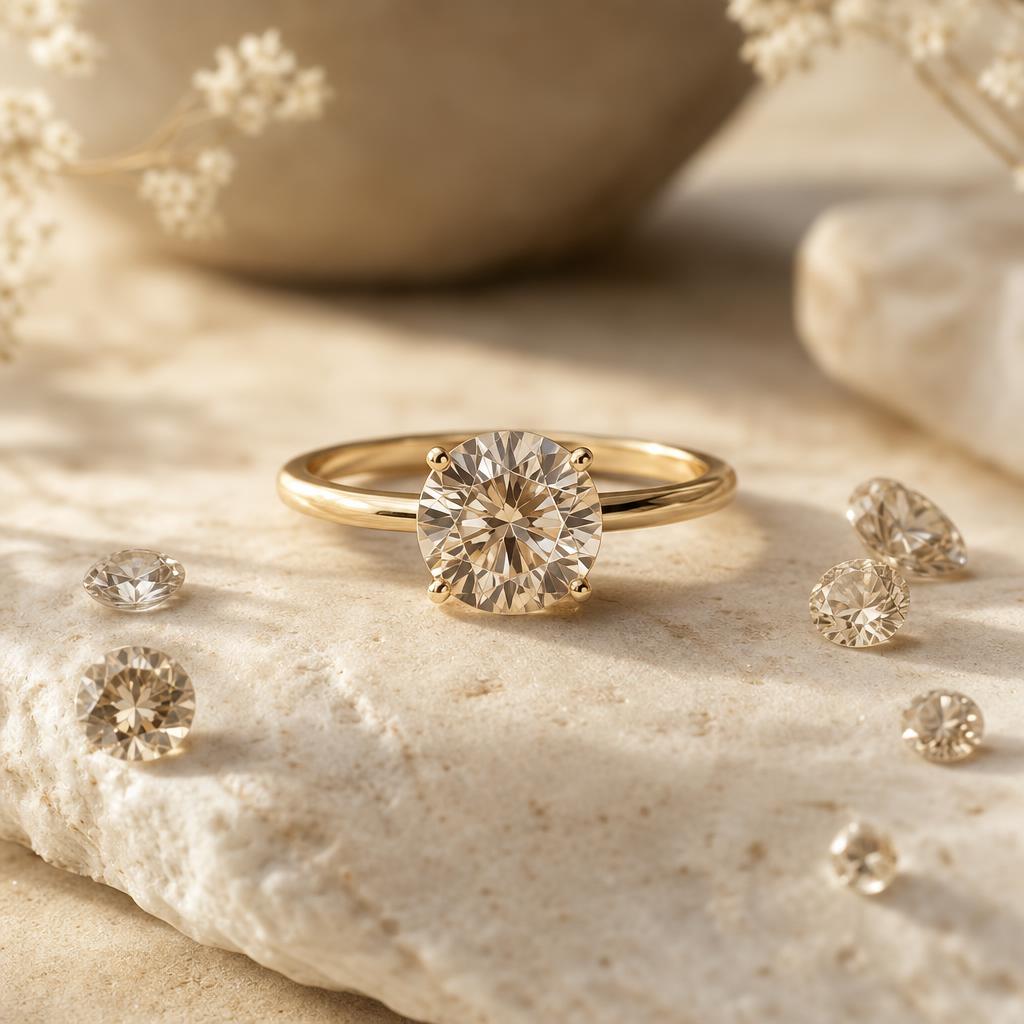
The short version — moissanite's price rises gently as the stone gets larger, instead of jumping the way a mined diamond's does. That single difference is the whole story of why moissanite has quietly become the default choice for women who've done the math. Before we get into how that scaling actually works, here's a spread from the Gemiros moissanite collection that shows the range — from a clean single-carat solitaire to a full four-carat presence — so you can see what "per carat of look" actually looks like.


What Actually Determines a Moissanite Ring's Price
Four things move the number on a moissanite ring, and only one of them is the carat weight everyone fixates on. The others matter just as much, and they're the reason two "identical" rings can land in completely different places.
- Center stone size. Bigger stones cost more — but as you'll see below, moissanite's curve is nothing like a diamond's.
- Cut precision. A well-proportioned cut throws more fire and brilliance from the same carat weight. Sloppy faceting is where the cheapest listings cut corners, and it's the difference a jeweler's loupe catches immediately.
- Metal and setting. Sterling silver with rhodium or gold plating costs meaningfully less to produce than solid 14k or 18k gold, and that gap shows up directly in the final number — with no difference in how the stone itself performs.
- Construction complexity. A plain four-prong solitaire is simpler to make than a hidden-halo, pavé-shouldered setting with dozens of accent stones. More labor, more price — reasonably.
Grading language matters here too. Not every "1 carat" is the same 1 carat. Colorless, high-clarity, precision-cut stones cost more to produce than budget-grade ones with visible inclusions or an off-white tint — which is exactly why moissanite ring price can vary so widely between two listings that both say "1 carat" on the label. The carat number alone tells you almost nothing about quality.
Moissanite vs. Diamond Price, Carat by Carat
Here's the part that actually changes how you shop: a diamond's price doesn't scale in a straight line with carat weight — it scales exponentially, because larger rough diamonds are dramatically rarer to find and cut without flaws. Moissanite, grown in a lab under controlled conditions, doesn't have that scarcity problem. Its price climbs in a gentle, predictable line instead of a steep curve.
| Center Stone Size | What Happens to a Mined Diamond's Price | What Happens to Moissanite's Price |
|---|---|---|
| 1 carat | Baseline | Baseline — already a fraction of the diamond figure |
| 2 carat | Roughly triples, not doubles | Increases modestly, well under double |
| 3 carat | Climbs sharply again — rarity premiums stack | Continues its gentle, near-linear climb |
| 4+ carat | Often reaches "by appointment only" territory | Still simply and predictably priced |
That widening gap is what keeps surprising first-time shoppers. It isn't a small discount at the low end that disappears as stones get bigger — it's the opposite. The larger the stone you want, the more dramatic the gap becomes, which is exactly backward from what most people assume walking in.

The Carrée Moissanite Ring
A sharp-edged princess-cut center stone in a four-claw mount with a slim pavé half-band — available at two stone sizes, so you can feel that gentle price curve for yourself between the 1 and 2 carat options.
Shop The Carrée →Why Moissanite Ring Price Doesn't Scale Like Diamond Price
It comes down to where each stone comes from. A mined diamond is a geological accident — carbon compressed for a billion years, then found, extracted, and cut by hand from rough that's frequently flawed or the wrong shape. Every carat you add multiplies the odds of finding a clean, well-proportioned stone that size, and the price reflects that compounding rarity.
Moissanite is grown in a lab under precisely controlled conditions, engineered from the start for size, clarity, and cut. There's no lottery involved in finding a flawless 3-carat rough. That's not a lesser process — it's simply a more rational one, and it's why the price behaves rationally too. This is also why the language around moissanite deserves more respect than it usually gets: it isn't a diamond understudy. It's a distinct gemstone with its own optical properties — moissanite actually has a higher refractive index than diamond, which is why well-cut moissanite can throw even more fire under direct light.
Worth knowing: Moissanite is indistinguishable from a diamond to the naked eye and passes standard diamond testers, because those testers check thermal conductivity — a property moissanite shares closely enough with diamond to register the same reading. No one is going to clock the difference across a dinner table, and your jeweler won't either without specialized equipment.
Is Moissanite Expensive? What You're Actually Paying For
Not compared to what it's replacing — but it isn't free, either, and understanding what you're paying for changes how you evaluate a listing. You're paying for the stone's size and cut quality, for the metal and setting construction, and — increasingly — for design. A plain four-prong solitaire will always cost less than an intricate hidden-halo, pavé-shouldered design at the same carat weight, because more goes into making it.
What you're generally not paying much of a premium for, with a well-made moissanite ring, is scarcity theater — the manufactured urgency and markup that mined diamonds carry simply because they're rare and marketed as symbolically irreplaceable. That's the whole premise how much are moissanite rings searches are usually circling: people have already sensed that a huge share of a traditional diamond's cost has nothing to do with how it looks on the hand, and they're right.

The Lumina Moissanite Ring
A round-cut center stone rising from a cathedral setting with a double-row pavé band, available across three stone sizes — a clean example of design complexity and carat size working together rather than against your budget.
Shop The Lumina →How to Read a Moissanite Ring Listing Without Getting Played
Once you understand the scaling logic, a few practical habits will save you from the two ways this market actually disappoints people — and neither of them is "the stone doesn't sparkle enough."
Ignore resale value as a factor
Moissanite, like nearly every gemstone sold at retail — including most mined diamonds — has minimal resale value. If a listing or seller is leaning on "investment" language, that's a sign to look elsewhere, not a reason to pay more. You're buying a ring to wear, not a commodity to trade.
Compare stone size in millimeters, not just carat
Cut proportions change how large a stone reads on the hand at the same carat weight. A well-proportioned oval or radiant can look noticeably bigger than a deep, poorly cut round at an identical carat weight. If a listing gives you millimeter dimensions alongside carat weight, use them — they're the more honest measurement.
Check what "moissanite price 1 carat" actually includes
A quoted per-carat figure sometimes means a loose, unmounted stone — not a finished ring with a metal band, prongs, and construction labor included. Confirm you're comparing finished-ring listings to finished-ring listings, not a bare stone to a complete piece. It's the single most common apples-to-oranges mistake in this category.
✦ Pro tip: If two listings quote the same carat weight and cut but wildly different numbers, the gap is almost always explained by clarity grade, cut precision, or metal — not by one seller being generous. Ask, don't assume.
Quick Takeaways
- Moissanite's price rises gently with carat size; a mined diamond's rises exponentially — the gap widens the bigger you go.
- Cut precision, clarity grade, metal choice, and setting complexity matter as much as carat weight.
- Moissanite passes diamond testers and is indistinguishable from a diamond to the naked eye — this isn't a compromise, it's a different, more rational way the price was built.
- Skip resale-value pitches, compare stone size in millimeters, and confirm whether a quoted price is for a loose stone or a finished ring.
Frequently Asked Questions
How much does a 1-carat moissanite ring actually cost?
It depends far more on cut quality, clarity grade, and metal than on the carat number alone — two "1 carat" listings can sit worlds apart in price for exactly those reasons. What stays consistent is the gap versus a comparable mined diamond, which starts wide and only grows as carat size increases.
Is moissanite more affordable than a diamond, carat for carat?
Yes, significantly — and increasingly so as the stone gets larger. A mined diamond's price climbs exponentially with size because of scarcity; moissanite's climbs in a gentle, near-linear line because it's lab-grown under controlled conditions.
Can a jeweler tell the difference between moissanite and a diamond?
Not by eye, and not with a standard diamond tester — moissanite's thermal conductivity is close enough to diamond's to register the same result. Distinguishing the two requires specialized equipment most jewelers don't keep on hand for a casual look.
Does a moissanite ring hold any resale value?
Realistically, very little — but the same is true of most retail jewelry, moissanite and mined diamonds alike. Buy it because you want to wear it, not as a store of value, and the math stops mattering.
Is moissanite considered a real gemstone, or just a diamond substitute?
Moissanite is its own gemstone with its own optical identity — including a higher refractive index than diamond, which is why it can throw even more fire under direct light. It isn't a lesser version of anything; it's a different stone that happens to solve the same problem a diamond does, more efficiently.
The honest takeaway is that a moissanite ring's price isn't a mystery once you know what's actually in it — cut quality, clarity, metal, and construction, moving in a straight, predictable line instead of an exponential one. That's not a discount you should feel sheepish about. It's what happens when the price of something finally tracks what it actually costs to make, instead of how rare a geological accident happened to be.


