

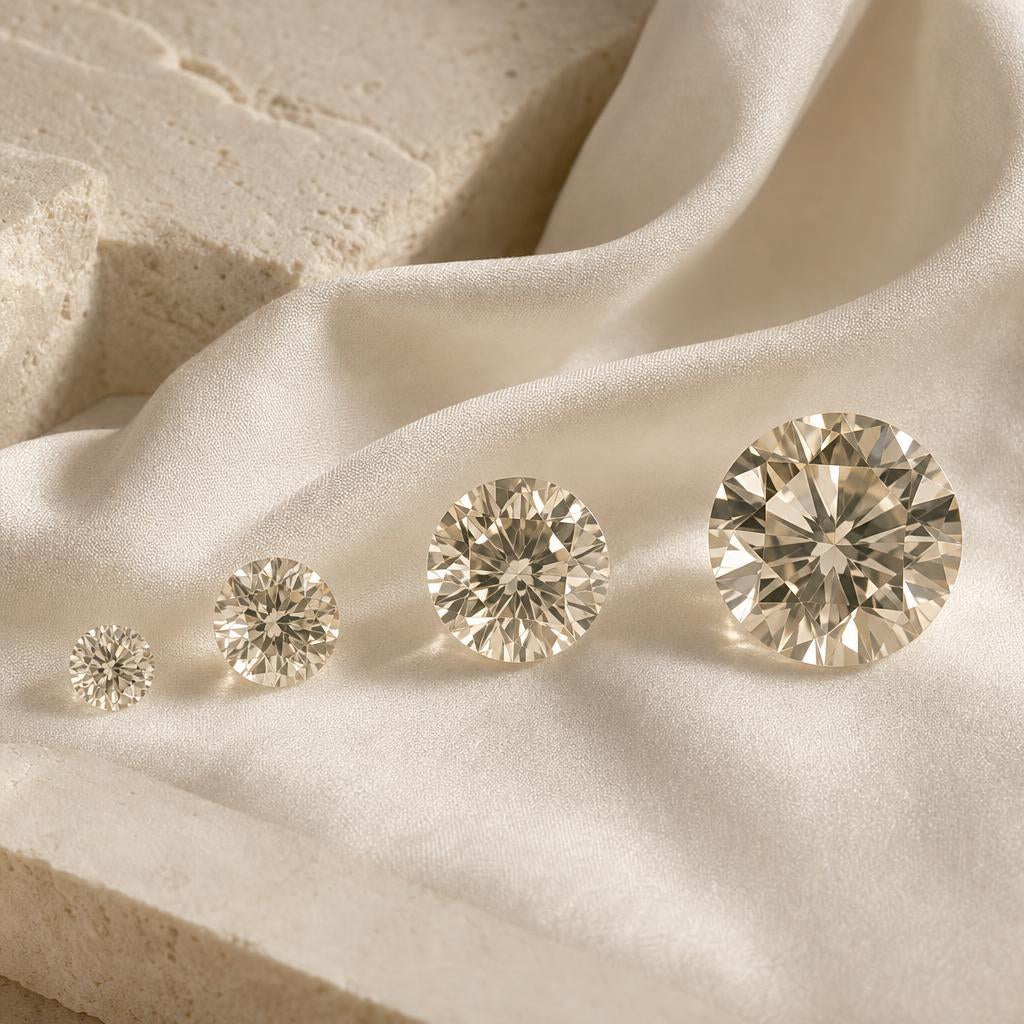
The Moissanite Size Chart: What a '3-Carat Look' Really Means
Somewhere between the jewelry counter and the internet, "carat" quietly stopped meaning weight and started meaning size. It's an easy mix-up — a well-cut stone photographs enormous, a poorly cut one photographs small, and the number on a receipt tells you almost nothing about either. The size on your finger and the number on the paperwork are two different conversations, and once you understand how they relate, you can shop for the look you actually want instead of guessing at a carat count.
That distinction matters even more with simulated diamonds, where the entire premise is choosing your look on purpose. Below is a practical moissanite size chart, an explanation of what carat weight actually controls, and which Gemiros styles deliver a substantial, self-assured look without the price tag attached to a mined stone of the same visual size.


Carat Weight Measures Mass, Not Size
A carat is a unit of weight — 0.2 grams, full stop. It says nothing about diameter, nothing about shape, and nothing about how a stone actually sits on a hand. Two stones can share an identical carat weight and look meaningfully different in person, because weight is distributed through depth as much as width. A shallow-cut stone spreads its mass outward, reading larger face-up. A deep-cut stone hides weight underneath the setting, reading smaller than its number suggests.
This is precisely why "carat" became shorthand for "big" in the first place, and precisely why that shorthand is a little misleading. The honest way to shop for size is by millimeter measurement — the actual footprint a stone occupies on your finger — not by the weight figure alone.
The Moissanite Size Chart: Carat Weight to Millimeter Size
Because moissanite is cut to the same proportions as a well-cut diamond, the general size-to-weight relationship carries over. Here's an approximate moissanite size chart across the most popular cuts, so you can picture the actual footprint before you commit to a number:
| Carat Weight | Round | Oval | Cushion |
|---|---|---|---|
| 1.0 ct | ≈6.5mm | ≈7.7 × 5.7mm | ≈5.8 × 5.8mm |
| 2.0 ct | ≈8.2mm | ≈9.7 × 7.2mm | ≈7.4 × 7.4mm |
| 3.0 ct | ≈9.4mm | ≈10.8 × 8.1mm | ≈8.4 × 8.4mm |
| 4.0 ct | ≈10.4mm | ≈11.9 × 8.9mm | ≈9.2 × 9.2mm |
Worth knowing: These are approximate, cut-dependent figures, not a fixed formula. A slightly shallower or deeper cut can shift the actual footprint by half a millimeter in either direction — which is why two "3-carat" stones can genuinely look like different sizes side by side.
Why Shape Changes the Look More Than the Number Does
Look at the chart again and notice something: an oval stone spreads noticeably wider than a round one at the exact same carat weight. That's not an accident of cut quality — it's geometry. Elongated shapes distribute the same mass across more surface area, so they read larger and cover more of the finger per carat than a round brilliant does.
This is the real mechanism behind a convincing "3-carat look," and it's also why an oval or cushion silhouette is often the smarter move for anyone chasing visual presence rather than a specific number. The Ophelia's oval hidden halo, for instance, is built around a 4ct+ center stone that reads with genuine finger coverage — the elongated cut and the halo of pavé stones both work in the same direction, adding perceived size without adding actual weight.

The Duchess Ring
A 3–4ct cushion center stone with a hidden halo underneath — the softer, rounded-corner cousin of the oval, with the same size-forward logic and a slightly more classic silhouette.
Shop The Duchess Ring →What Actually Makes a Large Stone Look Convincing
Millimeter size gets you most of the way there, but two more details finish the job. The first is cut quality — a well-faceted stone throws light evenly across its whole surface, so the eye reads "solid, substantial gem" rather than "large but glassy." The second is the setting itself, and specifically the hidden halo: a ring of small pavé stones tucked underneath the center stone, invisible from above but visibly widening the silhouette from every other angle.
A three-stone setting does something similar through a different route — it doesn't just add one large stone, it adds visual rhythm across the whole finger. The Astrid's asscher-cut center flanked by side stones, for example, reads as a considered, substantial piece precisely because the eye travels across three deliberate shapes instead of landing on one.

The Astrid Ring
A 2.5–3.5ct asscher center flanked by side stones — architectural, symmetrical, and built to look considered rather than simply large.
Shop The Astrid Ring →How much stone is actually too much?
There's a real ceiling, and it has nothing to do with what anyone else thinks. Past a certain point — generally somewhere around the 3 to 3.5ct mark on an average-size finger — a stone starts to compete with the hand instead of complementing it. That's a proportion question, not a permission question. The right amount of sparkle is whatever sits comfortably against your specific hand and your specific style, not a number you feel obligated to hit.
Matching a Carat Look to Your Actual Hand
A size chart tells you what a stone measures. It doesn't tell you what that measurement will look like on your specific hand, which is really the only question that matters. Finger length and width change how a given footprint reads far more than most buyers expect — the same 8mm stone that looks perfectly scaled on a longer finger can look like it's taking over a shorter one.
A rough guide: on a petite or shorter finger, an elongated shape like oval, pear, or marquise will generally carry a larger look more comfortably than a round or cushion of the same weight, because the length runs with the finger instead of across it. On a longer finger, round and cushion shapes have more room to read as substantial without looking like they're straining the proportions. Neither is a rule — it's a starting point for trying rings on with intention instead of shopping by number alone.
Will Anyone Actually Know the Difference?
Short answer: no. At a glance, in normal light — the setting where anyone actually looks at your hand — moissanite is indistinguishable from a diamond to the naked eye.
Gemiros rings aren't a lesser version of a large diamond — they're 925 sterling silver set with moissanite, cut and sized with the exact same geometry principles that govern a mined stone. A three-carat look built this way isn't a compromise you're explaining away later. It's a decision, made on purpose, with the receipt to prove you were the smart one in the room.
It holds up under closer scrutiny too. Moissanite passes standard diamond testers, the exact tool most jewelers reach for first, because it shares diamond's thermal signature closely enough to register the same way on that test.
Quick Takeaways
- Carat weight measures mass, not the size a stone actually occupies on your finger
- Elongated shapes like oval and cushion spread mass over more surface area, reading larger than a round stone at the same weight
- Cut quality and hidden halo settings add real visual size without adding carat weight
- Moissanite is indistinguishable from a diamond by eye and passes standard diamond testers
- Around 3 to 3.5ct is where most average-size fingers start to see diminishing returns — proportion matters more than the number
Frequently Asked Questions
Is a 2-carat moissanite the same size as a 2-carat diamond?
Yes. Moissanite is cut and measured against the same size-to-weight standards as diamond, so a stone described as a 2-carat look will occupy essentially the same footprint as a 2-carat diamond of the same shape.
Is moissanite a fake diamond?
No. Moissanite is its own gemstone with its own chemical structure — it isn't a diamond, and it isn't pretending to be one. It's a distinct stone that happens to read as indistinguishable from a diamond to the naked eye, which is a very different thing from being a copy of something else.
What carat size do most people actually choose?
The most common range sits around 1.0 to 1.5ct — a size that reads clearly as a real, considered piece without dominating the hand. Anything above that starts to move from "everyday elegant" toward "statement," which is a great choice too, just a more deliberate one.
Does moissanite pass a diamond tester?
Yes. Standard diamond testers check thermal conductivity, and moissanite conducts heat almost identically to a diamond, so it registers as a match on the exact tool most jewelers use to verify a stone.
How big is too big for a ring?
There's no universal answer, but most average-size fingers start to see the stone compete with the hand somewhere around 3 to 3.5ct. Past that point, it's worth trying the ring on rather than deciding from a chart — proportion is personal.
Can you tell moissanite from a diamond by eye?
Not reliably, no. At normal viewing distance and typical indoor lighting, moissanite and diamond read the same to the naked eye. The differences that do exist only show up under close magnification, not across a dinner table.
The next time "carat" comes up in conversation, you'll know exactly what it does and doesn't tell you — and exactly how to shop for the look you actually want instead of the number you think you're supposed to want.


