

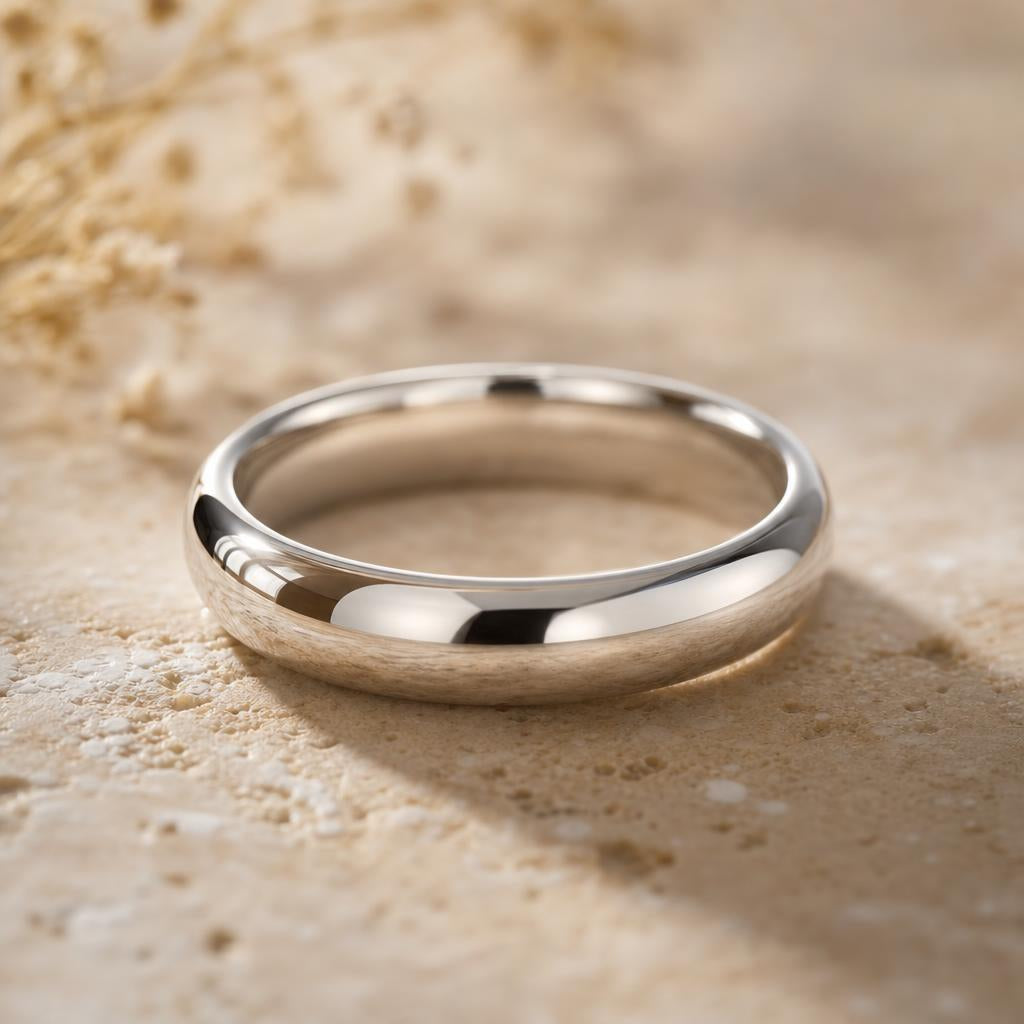
How Long Does Rhodium Plating Last? What It Does For Your Ring
Somewhere between "why does my ring look duller than it did last spring" and "is this normal," there's a word almost nobody explains properly: rhodium. It's on more of your jewelry than you think, and understanding what it actually does will change how you think about wear, care, and when to worry.
Rhodium plating is the quiet workhorse behind that bright, mirror-white finish on most silver and white gold jewelry — including a lot of what's in your own jewelry box. Here's what it is, how long it actually lasts, and what changes over time.
What Rhodium Plating Actually Is
Rhodium is a rare, hard metal from the platinum family — bright white, highly reflective, and naturally resistant to oxidation. In jewelry, it isn't the base metal itself; it's applied as a microscopically thin finishing layer over a base metal (usually sterling silver or white gold) through an electroplating process. That thin layer is what gives a piece its crisp, icy-white brilliance and its scratch resistance.
It's also functional in a second, less glamorous way: rhodium acts as a barrier between your skin and whatever metals sit underneath it. That's part of why a well-plated piece feels comfortable on sensitive skin — the layer you're actually touching isn't the alloy, it's the rhodium.
Worth knowing: Every Gemiros ring is built on a 925 sterling silver base with rhodium, 18k gold, or rose gold plating — nickel-free and hypoallergenic by design, not as an afterthought.
How Long Does Rhodium Plating Last?
This is the question that actually matters, and the honest answer is: it depends on how the piece is worn, not just how it's made. For a ring worn daily — the highest-friction way to wear any piece of jewelry — rhodium plating typically holds its full brightness for one to two years before it starts to show gradual, uneven wear. Necklaces and earrings, which see far less friction, tend to stretch that out to two or three years or longer. A piece kept for occasional wear can look freshly plated for the better part of a decade.
The number that matters most isn't a fixed countdown — it's friction. A ring worn every single day, stacked against other rings, doing dishes and gripping steering wheels, is going to show wear on the high points and the underside of the band well before a ring that comes out for dinner twice a month.
Does Rhodium Plated Jewelry Tarnish?
Here's the part most explanations skip: rhodium itself does not tarnish. It's chemically stable and resists oxidation even better than platinum. What people are actually describing when they say a rhodium-plated piece "tarnished" is usually the layer underneath finally showing through in the spots where the rhodium has worn thinnest — the inside of a band, the back of a stud, the underside of a clasp.
That distinction matters because it changes what you're solving for. You're not fighting tarnish in the traditional sense — you're managing the natural wear pattern of a thin protective layer, the same way you'd expect the sole of a well-loved shoe to wear down at the heel before anywhere else.

The Belle Ring
A round brilliant center in a halo setting, finished in rhodium-plated 925 sterling silver for a bright, mirror-white sparkle from every angle.
Shop The Belle →What Actually Wears the Finish Down Faster
- Friction from other rings. Two rings worn on the same finger rub against each other constantly — this is one of the single biggest accelerants.
- Chlorine and harsh chemicals. Pool water, bleach-based cleaners, and some perfumes are harder on plating than everyday soap and water.
- Lotions and oils. Applied directly over a ring, they build up in the setting and dull the surface faster than wear alone.
- Manual work. Gripping tools, gardening, or anything that presses metal against rough surfaces wears down high points first.
Rhodium Plating Before and After: What Actually Changes
The visible difference is gradual, not sudden. Freshly plated jewelry has an almost liquid-mirror brightness — light bounces off it in a single clean sheet. As the layer thins, that brightness softens first, then unevenness appears: the underside of a band or the back of an earring post may look slightly warmer or duller than the top, since those spots take the most contact. It rarely happens all at once, and it's almost never visible to anyone but the person wearing the piece daily and paying close attention.

The Everlasting Ring
A continuous line of round brilliant stones in rhodium-plated 925 sterling silver — built for the ring you plan to wear every single day.
Shop The Everlasting →When — and How — to Reapply
Re-plating is a routine jeweler service, not a repair. A local jeweler cleans and polishes the piece, then re-applies a fresh layer of rhodium through the same electroplating process used originally. It's typically a same-day or few-day service, and most jewelers can quote you on the spot once they've seen the piece in person. Because rhodium plating cost varies by piece size and local labor rates, it's worth asking a jeweler you trust for a specific quote rather than assuming one number applies everywhere.
A good rule of thumb: if you wear a piece daily and it still looks bright, there's no need to do anything. Re-plate when you actually notice the dulling — not on a fixed schedule. Treating it as routine maintenance, the way you'd rotate tires, keeps the cost and the hassle in perspective.
✦ Pro tip: Take rings off before swimming, showering with heavy-duty cleansers, or applying lotion and perfume directly to your hands. This one habit does more to extend a bright finish than almost anything else.

The Beatrice Ring
A round brilliant center set into a detailed pavé band, finished in rhodium-plated 925 sterling silver for everyday brilliance with vintage character.
Shop The Beatrice →Why This Matters More With Simulated Diamonds Than You'd Think
A common assumption is that the stone is the whole story and the metal is an afterthought. It's actually the opposite: the setting is what most people are looking at day to day, and a bright, well-maintained rhodium finish is a huge part of what makes a ring photograph and read as sharp. Gemiros stones are indistinguishable from a diamond to the naked eye and pass diamond testers — that part of the equation was never in question. Keeping the metal around them looking equally sharp is simply good care, the same as it would be for any fine jewelry.
This is also where a hidden halo or a cushion cut catches extra light: settings like the one on The Duchess use rhodium plating across every visible surface, including the inner halo, so the brightness carries through the whole design rather than just the band.

The Duchess Ring
A cushion-cut center surrounded by a double halo, finished in rhodium-plated 925 sterling silver for maximum brightness at every angle.
Shop The Duchess →Quick Takeaways
- Rhodium is a hard, naturally tarnish-resistant metal applied as a thin plating layer over sterling silver or white gold.
- Daily-wear rings typically hold their full brightness for one to two years; occasional-wear pieces can last much longer.
- Rhodium itself doesn't tarnish — what people notice is the base metal beginning to show through as the layer thins with friction.
- Re-plating is routine jeweler maintenance, not a repair — do it when you notice dulling, not on a fixed schedule.
- Removing rings before swimming, harsh cleaning, and applying lotion is the single easiest way to extend a bright finish.
Frequently Asked Questions
Is rhodium plating worth it?
Yes — it's what gives silver and white gold jewelry that bright, mirror-white finish, and it adds a hypoallergenic barrier for anyone with sensitive skin. The tradeoff is simply that, like any plating, it wears with friction over time and eventually benefits from a refresh.
Can I shower with rhodium-plated jewelry on?
You can, but it's not ideal for the long run. Soaps, shampoos, and hot water all speed up wear on the plating over time. If you're trying to keep a piece looking freshly finished for as long as possible, taking it off first is worth the extra ten seconds.
Will rhodium-plated jewelry turn my finger green?
No. Rhodium doesn't react with skin or oxidize the way some base metals do, which is exactly why it's used as a protective, hypoallergenic barrier in the first place. Discoloration is far more likely to come from a piece with no protective plating at all.
How many times can a ring be rhodium plated?
Effectively as many times as it needs to be, for as long as you own it. Re-plating is a standard, repeatable jeweler service — there's no practical limit to how many times a piece can be refreshed over its lifetime.
What are the downsides of rhodium plating?
The only real downside is that it's a surface layer, not the base metal itself — so it wears unevenly with friction and eventually needs refreshing. It's a maintenance rhythm to expect, not a flaw to worry about.
None of this is a reason for concern — it's simply how plated jewelry works, regardless of where it came from or what it cost. Understanding the actual mechanics means you're never caught off guard by normal wear, and you know exactly what to do about it when the time comes.


