

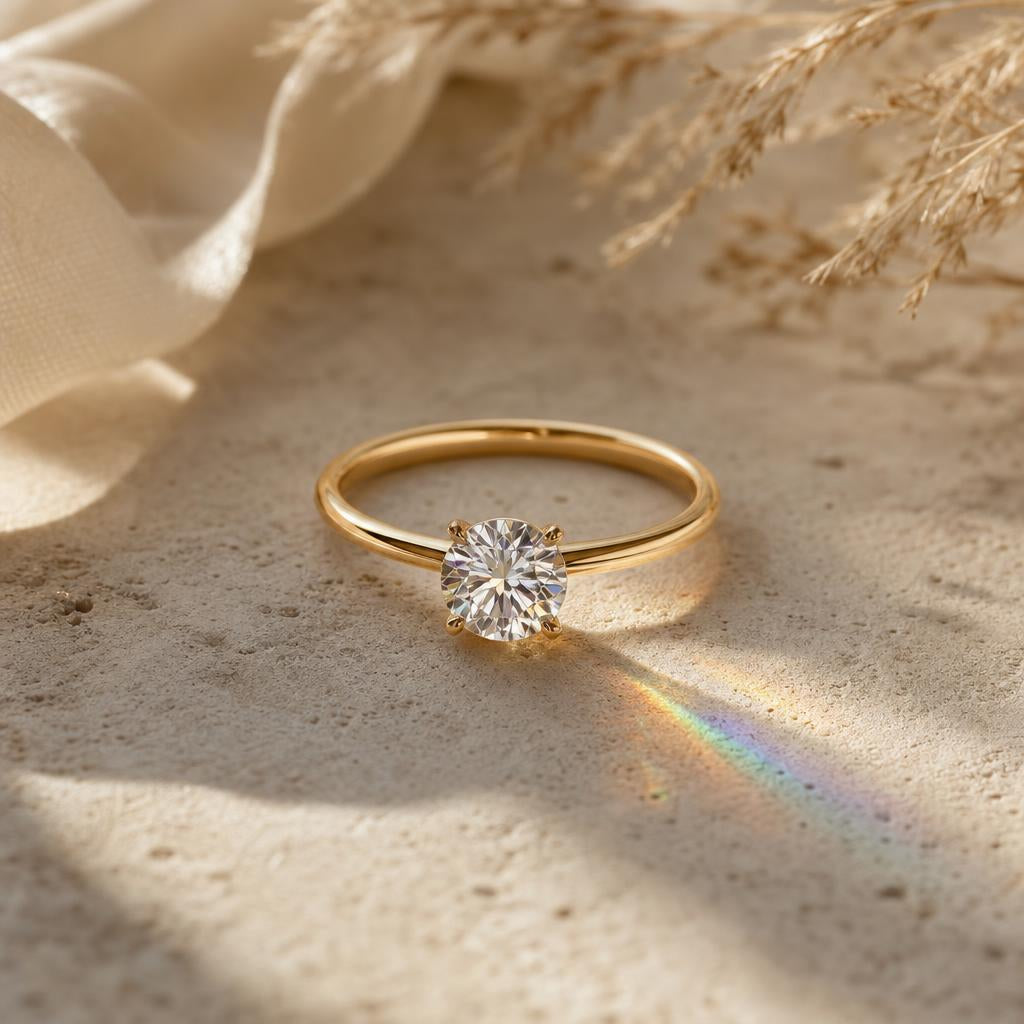
The Best Solitaire Moissanite Rings: Clean, Classic, Unmistakable
A solitaire doesn't ask for attention. It earns it — one stone, one setting, nothing between the light and the sparkle. That restraint is exactly why the solitaire moissanite ring has become the style savvy buyers reach for first: it lets the stone do the talking, and moissanite has plenty to say.
If you've been narrowing down what "the right ring" actually looks like, start here. Below are four worth knowing — each a different cut, each proof that a single stone, set simply, can look more considered than a ring trying to do too much.


Why a Solitaire Setting Is the Smarter Default
It's no accident that moissanite engagement rings have become such a fixture of smart, self-aware ring shopping over the past few years — and the solitaire is where that shift shows up most clearly.
Halos add sparkle by surrounding the center stone with smaller ones. Pavé adds it by lining the band. A solitaire adds nothing — and that's the entire point. Every carat of light-catching work has to come from one stone, in one setting, with nowhere to hide. It's a harder trick to pull off, which is exactly why it reads as more deliberate than a ring built to distract from a weaker center stone.
Moissanite makes that trick easy. Its refractive index sits higher than a diamond's, which means a solitaire moissanite ring throws more fire — those flashes of rainbow light you catch when the stone moves — with nothing added to help it along. Round it out with 925 sterling silver and rhodium or 18k gold plating, and what you're wearing isn't a diamond in miniature. It's indistinguishable from one to the eye, and it passes diamond testers. No one asking to see your ring is running a lab report first.
Choosing a Cut: Round, Oval, Radiant or Emerald
A solitaire lives or dies on the cut, since there's no halo or pavé to soften a shape that doesn't suit you. Each cut reads differently on the hand, so it's worth thinking about the silhouette before the sparkle.

The Éclat Moissanite Ring
A round-cut center stone on a six-prong mount and a plain, polished band — the classic solitaire silhouette, built to maximize brilliance with nothing competing for the eye. The six-prong setting also holds the stone more securely than a standard four-claw mount, which matters if this is a ring you plan to wear daily.
Shop The Éclat Moissanite Ring →Round is the safest, most universally flattering cut — it's also the cut that shows off moissanite's fire most obviously, since brilliant-cut facets are engineered specifically to bounce light back out. Oval elongates the finger and tends to look larger per carat than a round stone of the same size, which is why it's become the go-to for buyers who want visual size without extra weight on the hand. Radiant splits the difference: the faceting of a round brilliant, the angular structure of an emerald cut. And emerald — with its long, open step-cut facets — trades maximum fire for maximum clarity, which is exactly why it photographs so well and reads as quietly expensive rather than loud.

The Vivienne Moissanite Ring
A radiant-cut moissanite center stone on a smooth, polished band. The cut's cropped corners and dense faceting give it more visual weight than a round stone at the same carat — a good option if you want a solitaire with real presence, not just sparkle.
Shop The Vivienne Moissanite Ring →What "Solitaire" Actually Promises — and What It Doesn't
It's worth being precise about the word itself, since "solitaire" and "statement ring" get used almost interchangeably in casual shopping and they're not the same thing structurally. A solitaire is defined by its setting — one center stone, minimal metalwork around it — not by size. You can have a modest 1-carat solitaire or a 5-carat one; the setting stays the same.
The prong count matters more than most first-time buyers realize, too. A four-claw mount is the traditional choice and shows the most stone, since less metal covers the surface. A six-prong setting, like the one on the Éclat, trades a sliver of visible stone for meaningfully better security — worth knowing if you've ever caught a ring on a sweater or a car door. This comparison of four-prong vs six-prong settings covers the tradeoff in more depth than we have room for here.
Worth knowing: Every Gemiros moissanite ring is set in 925 sterling silver with rhodium or 18k gold plating — hypoallergenic and nickel-free, so sensitive skin isn't a reason to rule out a solitaire you actually love.
Affordable Doesn't Mean a Smaller Stone
Shopping for an affordable moissanite engagement ring usually means one unspoken tradeoff: a smaller center stone to keep the price reasonable. This setting sidesteps that math entirely. Because there's no halo or pavé eating into the budget, more of what you're paying for goes directly into the size and quality of the center stone itself — which is exactly why solitaires tend to look larger per dollar than a busier setting at the same price point.
It's the same logic behind a broader shift in ring shopping over the past few years: the visual impact was never actually tied to the price tag people assumed it was. A stone with more fire than a diamond, set in real 925 sterling silver, doesn't need a halo's help to look finished.
Living With a Solitaire, Day to Day
A solitaire's simplicity is also its practical advantage. There's no pavé to catch on fabric, no halo prongs to snag, no delicate detail work to worry about chipping. It's the lowest-maintenance silhouette in the entire moissanite collection, and it still holds up to a full-time rotation — moissanite scores 9.25–9.5 on the Mohs hardness scale, just below diamond, so daily wear isn't a real threat to it.
That said, "low-maintenance" isn't "no-maintenance." Body oils, lotion and everyday buildup will dull any stone's sparkle over time, solitaire or not. A warm-water soak and a soft toothbrush every couple of weeks keeps a round-cut solitaire throwing the same fire it did on day one — this guide on how to clean moissanite rings covers the full routine, travel-friendly version included.
✦ Pro tip: Because a solitaire has no side stones or halo to inspect separately, it's the easiest ring style to check for looseness yourself — hold it up to a light and gently turn the stone. If it moves at all, it's time for a prong check.
Oval, Round or Radiant — Which One Is Actually You?
If you tend to gravitate toward classic, symmetrical shapes and want a ring that will never look dated, round is the answer — it's the cut every other cut gets measured against. If your hand is on the shorter or narrower side and you want the visual lengthening effect, oval earns its reputation. And if you want something with more architectural presence, without going full statement ring, radiant or emerald both deliver that quieter kind of confident.
There's no wrong answer here, which is part of what makes this style such a low-risk way to try the format. If you're proposing this idea to yourself rather than shopping for someone else's approval, that clarity is worth more than chasing a trend.
Quick Takeaways
- A solitaire setting puts all the visual work on the center stone — moissanite's higher refractive index means it delivers more fire than a diamond in that exact setup.
- Round, oval, radiant and emerald cuts each read differently on the hand; pick the silhouette before the sparkle.
- Six-prong mounts hold the stone more securely than four-claw settings, which matters for everyday wear.
- Solitaires are the lowest-maintenance moissanite ring style — no pavé or halo to catch or chip.
- Every Gemiros moissanite ring is 925 sterling silver, hypoallergenic and nickel-free.
Frequently Asked Questions
Is a solitaire moissanite ring a good choice for daily wear?
Yes. Moissanite scores 9.25–9.5 on the Mohs hardness scale, just below diamond, and a solitaire's simple construction means there's no pavé or halo detail to snag or chip. It's the easiest setting in the collection to wear without a second thought.
Does moissanite actually pass a diamond tester?
Yes — moissanite's thermal conductivity is close enough to a diamond's that standard thermal diamond testers read it as a diamond. Some newer testers are calibrated to flag the difference, but to the eye, and to nearly every tester in circulation, it reads as the real thing.
How much should this ring style cost?
It depends on stone size and metal, but a well-made moissanite solitaire in sterling silver costs a fraction of a comparable lab-grown or mined diamond solitaire — without a smaller stone to show for it.
Can you shower or swim with a moissanite ring?
Occasional exposure to water won't damage the stone itself, since moissanite is chemically stable and highly durable. Chlorine and prolonged soap buildup can dull the metal's shine over time, though, so it's still worth taking rings off for pools and heavy cleaning.
What's the difference between a solitaire and a statement ring?
A solitaire is defined by its setting — one center stone with minimal surrounding metalwork, regardless of carat size. A statement ring is defined by overall visual impact, which can come from a larger stone, a dramatic setting, or extra design detail. A solitaire can absolutely be a statement piece; it just gets there through restraint instead of embellishment.
A ring like this isn't a placeholder for something bigger later — it's a complete decision on its own. One stone, cut well, set simply, doing exactly what it was built to do. That's not a compromise. That's just good taste, priced honestly.


