

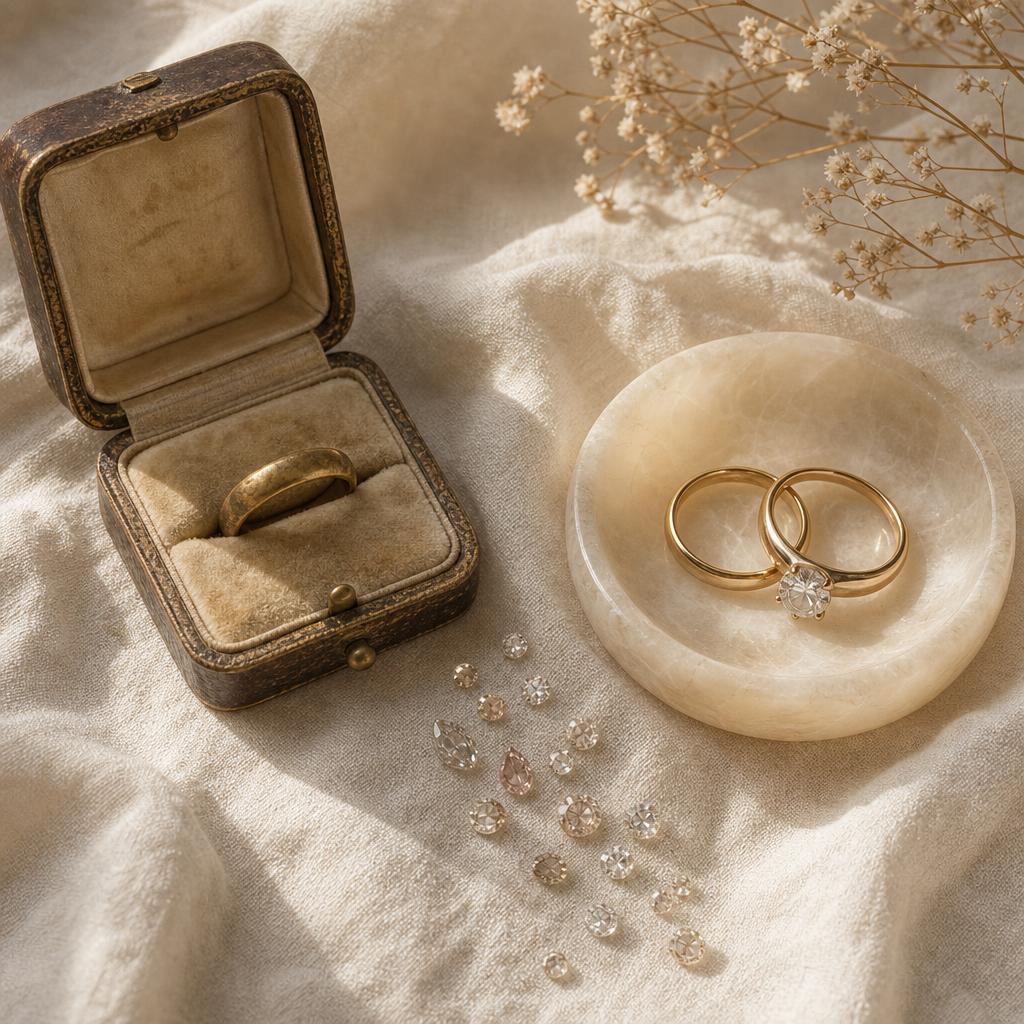
What Your Parents' Generation Valued in Jewelry vs. What You Value Now
Your mother probably has a story about her ring. Where he proposed, who knew before she did, what her own mother said when she first saw the size of the stone. Your story is going to sound nothing like that one — and that is not a loss. It is an upgrade in thinking.
Jewelry has not stopped mattering between generations. What changed is who is allowed to buy it, why she buys it, and what actually counts as value in the first place. Before we get into what shifted and why, here are four pieces that show exactly where that shift lands today.


The Rules Her Generation Followed Without Question
Ask a woman over fifty how she got her good jewelry, and the answer almost always involves someone else's decision. A husband's proposal. A milestone birthday gift chosen by a partner who guessed at her taste. An inheritance that arrived on someone else's timeline, not hers. The ring came from an event, not a choice she made on a Tuesday because she wanted one.
Underneath that pattern sat a quiet set of assumptions nobody had to say out loud. Solid gold meant seriousness. A mined stone meant the giver had spent real money, and spending real money meant he was serious too. Bigger was categorically better, because size was the only variable most people knew how to read. And the whole point of buying a "good" piece was to buy it once — to treat it as the last ring you would ever need, kept in a box for the next generation rather than worn hard and replaced when your taste moved on.
None of that was foolish. It was simply the only information available at the time. A generation shopping before online price transparency, before lab-grown and simulated stone technology matured, before anyone could Google what a jeweler's markup actually looks like, had no real way to separate a stone's beauty from its story. The price was the proof. There was no other proof to check against.
What Actually Changed
Three things happened at roughly the same time, and together they rewired the entire calculation. First, simulated diamonds and moissanite got good — genuinely, measurably good, to the point of passing a diamond tester and standing up to close inspection under any light in a room. Second, information about the diamond industry's actual markup stopped being a trade secret and became something any curious buyer could research in an afternoon. Third, and maybe most quietly important, buying jewelry for yourself stopped being a slightly odd thing a woman did and became simply a thing women do.
Put those three shifts together and the old rule collapses on its own. If the stone looks identical, if the markup was never about material cost in the first place, and if you no longer need a partner's proposal to justify the purchase, then waiting for someone else to buy you a "real" ring is not patience. It is a delay with no actual payoff at the end of it.
The Diamond Was Never Really the Point. The Price Tag Was.
This is the part that tends to surprise people once they sit with it: nobody in that dinner-party conversation about your ring is actually testing the stone. They are reacting to the look — the cut, the sparkle, the way it catches light when your hand moves. A 925 sterling silver setting with a well-cut moissanite or simulated diamond center delivers that exact look. It is indistinguishable from a mined diamond to the naked eye, and it passes diamond testers, because the properties that matter for that test are the properties it actually has. No one at that table, including your jeweler, is going to know the difference unless you tell them.
That is not a workaround. That is the entire premise finally being named out loud instead of quietly assumed. The Ophelia, for instance, is routinely compared to pieces that would run $15,000 or higher at a traditional jeweler — not because it is pretending to be something it isn't, but because the visual impact a buyer is actually paying for was never exclusive to mined stone in the first place.

The Stella Ring
A single round brilliant stone in a clean 4-prong setting — the ring your mother might glance right past, which is exactly the point. No halo, no pavé, nothing extra to signal effort. Just a stone doing all the talking.
Shop The Stella →From Waiting to Choosing
The bigger cultural shift isn't really about stones at all. It's about permission. Your mother's generation largely treated a significant piece of jewelry as something that happened to you, at the hands of someone else, on an occasion that had to be earned or waited for. Your generation treats it as a decision you're allowed to make on your own schedule, funded by your own paycheck, justified by nothing more than wanting it.
That reframing changes what "smart" looks like. It used to mean patience — holding out for the real thing, the right moment, the right person to provide it. Now it means recognizing that a beautifully made ring, correctly priced for what it actually is, doesn't require a waiting period at all. You can build a collection in your twenties instead of receiving one piece in your thirties. You can buy the ring you want the week you decide you want it, and buy the next one whenever your taste moves on, instead of treating a single purchase as a decision for life.
Bigger, Bolder, or Just Smarter?
Size used to be the whole conversation, because size was the only variable a casual observer could actually read. A bigger stone signaled more money spent, and more money spent signaled more love, more seriousness, more status. That math still shows up in how people talk about rings — but it's no longer the only math available.
Now the more interesting question isn't how big a stone is, but how deliberately it was chosen. A double halo cushion cut that reads as dramatic from across the room is a completely legitimate choice if that's genuinely your taste — it's just no longer the only "correct" answer for a woman who wants to be taken seriously. A slim solitaire is an equally confident choice. So is a stack you build one ring at a time. What changed isn't the appetite for sparkle; it's the idea that there's only one acceptable way to have it.

The Duchess Ring
Cushion cut, wrapped in a double halo with a pavé band — proof that "more is more" can still be a considered choice rather than an accident. Big, on purpose, and priced like the smart decision it is.
Shop The Duchess →What Hasn't Changed At All
It would be easy to frame this as a story about two generations who want completely different things, but that's not quite accurate. Your mother wanted to feel celebrated, to own something beautiful, to have a piece that marked a meaningful chapter of her life. You want exactly the same things. The desire underneath the purchase never moved. What moved is the belief about who gets to satisfy it, and how.
There's also real continuity in how people use jewelry to carry memory. A ring passed down still means something, and buying yourself a piece during a hard year, a big year, or an entirely ordinary one still functions the same way it always has — as a small, physical marker of a moment you lived through. The difference now is that you don't need to wait for someone else to hand you that marker. You can choose it, on your own terms, whenever the moment calls for it.
Quick Takeaways
- Your parents' generation largely received significant jewelry from someone else, on someone else's timeline — yours is built on choosing it yourself, whenever you want.
- Solid gold and mined stones were once the only proof of value available; better information and better simulated stones changed that math for good.
- A well-made simulated diamond or moissanite ring is indistinguishable from a mined diamond and passes diamond testers — the look was never exclusive to mined stone.
- Size is no longer the only signal of a "serious" ring — a slim solitaire and a bold double halo are equally confident choices now.
- What hasn't changed: the desire to feel celebrated and to mark meaningful moments with something beautiful.
Frequently Asked Questions
Is a ring only meaningful if it's an heirloom or passed down through a family?
No. Heirlooms carry their own kind of meaning, but a ring you chose and bought for yourself carries a different, equally valid kind — it marks a decision you made about your own life, on your own timeline, rather than a moment that happened to you.
Are diamonds actually worth more now than they used to be?
Not in the way most buyers assume. Retail markup on mined diamonds has always been steep, and wider access to pricing information has made that markup far more visible than it was a generation ago — which is a large part of why simulated diamonds and moissanite have gained so much ground.
Will people be able to tell my ring isn't set with a mined diamond?
A quality moissanite or simulated diamond in a well-made setting is indistinguishable from a mined diamond to the naked eye and passes diamond testers. No one across a dinner table, including a jeweler who isn't specifically inspecting it, is going to clock the difference.
Is it still considered acceptable to buy yourself a significant ring instead of waiting for a gift?
Increasingly, it's the norm rather than the exception. Self-purchased jewelry has moved from a slightly unusual choice to a default one, especially among women who would rather fund their own milestone than wait for someone else's timeline.
What jewelry trends from an older generation are actually still relevant today?
The instinct itself never went out of style — wanting a beautiful piece to mark a meaningful chapter is timeless. What's shifted is the mechanics: who buys it, what it's made of, and how quickly a collection can be built instead of inherited.
The next time your ring comes up in conversation, you probably won't tell the story your mother tells. There won't be a proposal in it, or a moment where you found out what someone else decided you deserved. Instead, there will be a moment where you decided for yourself — which, if you think about it for more than a few seconds, was always the smarter story to be telling.


