

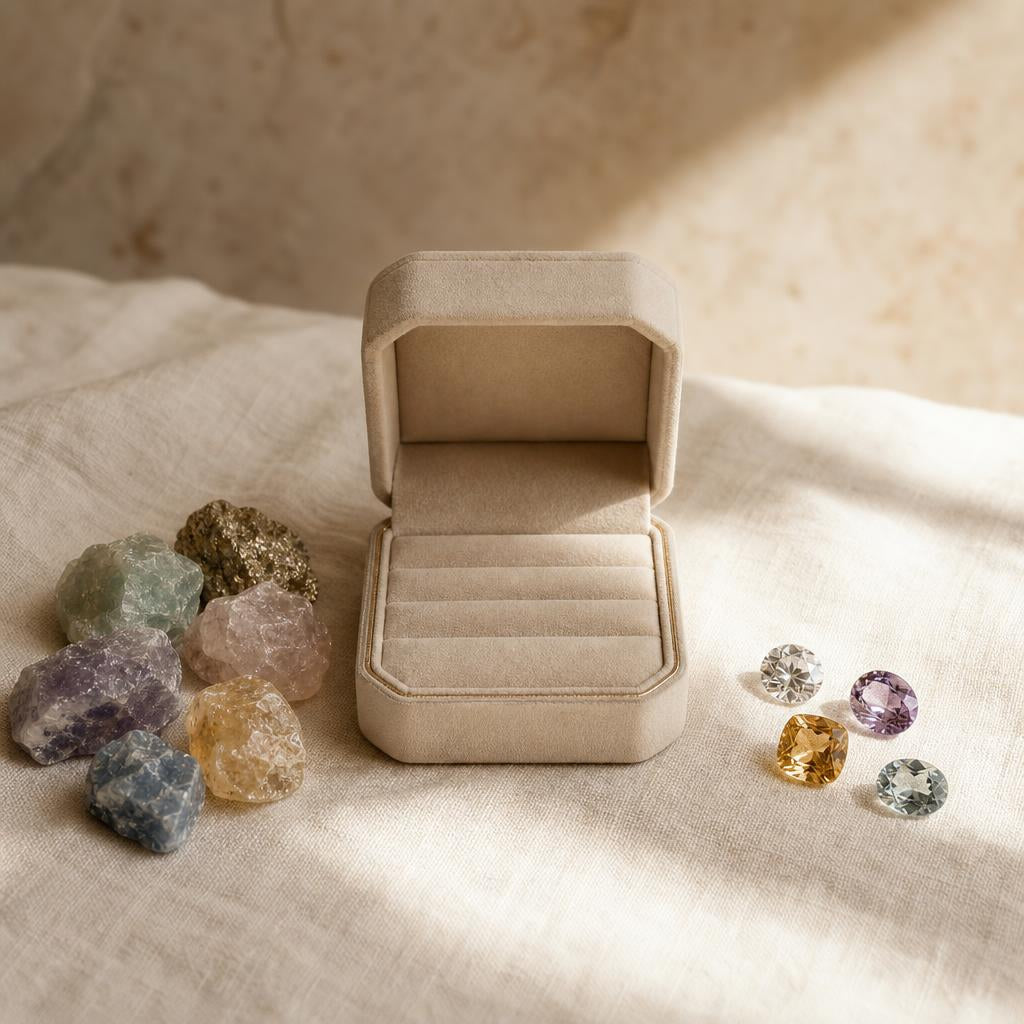
The Engagement Ring Cost Rule: What a Mined Diamond Ring Actually Costs
A mined diamond engagement ring will run you somewhere between $5,200 and $7,300 on average — and that number climbs fast the moment carat weight or clarity grade gets involved. Most women who've done even five minutes of research already know this. What fewer of them stop to ask is the smarter question underneath it: smarter than what, exactly, and who decided that number in the first place?
Before we get into the math, here's a look at the kind of pieces that make the question worth asking — rings built to deliver the exact same visual impact, at a fraction of the ask.


What a Mined Diamond Engagement Ring Actually Costs Right Now
The industry-wide average sits around $5,200 to $7,300 in the US, but "average" is doing a lot of quiet work in that sentence. A one-carat natural diamond alone can run $4,000 to $10,000 before the setting, the band metal, or the resizing are even factored in. Push past two carats and the math stops being linear — a two-carat natural stone can climb past $20,000, since larger rough diamonds are rarer and priced accordingly. None of that is a scare tactic. It's just what the mined-diamond market actually charges once you ask for size and sparkle in the same sentence.
| Stone Type | 1 Carat | 2 Carat | 3 Carat |
|---|---|---|---|
| Natural (mined) diamond | $3,800–$10,000 | $7,600–$29,500 | $26,000–$51,000 |
| Lab-grown diamond | $800–$3,000 | $2,300–$3,600 | $3,800–$6,500 |
Rough industry ranges for round brilliant stones. Cut, color, and clarity move these numbers considerably.
That lab-grown vs. natural diamond price gap is the reason so many buyers have already started asking harder questions about where the premium actually goes. Both stones are chemically identical. One of them simply costs less because it didn't have to be dug out of the ground.
Simulated, Lab-Grown, or Mined: What You're Actually Choosing Between
These get lumped together constantly, and the differences matter more than most listings bother to explain. A mined diamond formed underground over billions of years. A lab-grown diamond is chemically and structurally the same mineral, grown in a controlled environment in weeks rather than eons — same hardness, same fire, same certification process, just a different origin story. A simulated diamond, like the moissanite and cubic zirconia Gemiros sets in 925 sterling silver, is a different stone engineered to mimic a diamond's optical properties almost exactly. It isn't a lesser version of the other two. It's a third option built specifically to solve the problem the first two create: it's indistinguishable from a diamond to the naked eye, it passes diamond testers, and it does that without asking you to finance a decision for the next three years.
None of this is a hierarchy where "closer to a real diamond" automatically means "better ring." It's three different products solving three different problems. Once you know which problem you're actually trying to solve — the look, not the geologic origin story — the rest of the decision gets a lot easier.
The Engagement Ring Cost Rule: Where the "Three Months' Salary" Idea Actually Came From
You've heard some version of it — spend two, or three, months' salary on the ring. It sounds like tradition. It isn't. It's a slogan a diamond company wrote for a magazine ad in the twentieth century, and it worked so well that two generations later, people still repeat it like inherited wisdom. There was no financial logic behind the number. There was a marketing target, and it landed.
Worth knowing: Financial advisors who actually study this stuff consistently call the three-months'-salary guideline exactly what it is — a decades-old ad campaign, not a budgeting principle. Nothing about your relationship is measured by whether you followed it.
Once you know a rule was invented to sell something, it's much easier to stop treating it as a rule at all. That's not a compromise. That's just seeing the mechanism clearly — which, incidentally, is the entire premise this brand is built on.
How Much Should a Man Spend on an Engagement Ring? Wrong Question, Better One
This is one of the most searched phrases in the entire category, and it's telling that it's framed around a man's paycheck rather than a woman's actual taste. The honest answer is that the number should have nothing to do with a salary formula and everything to do with what the ring actually needs to do: look extraordinary, hold up to daily wear, and not require a second mortgage to justify. A stone can be indistinguishable from a diamond, pass a diamond tester, and still cost a fraction of what "tradition" suggests. That's not a downgrade. That's just better information.

The Ophelia
A 4.5-carat oval simulated diamond in a hidden halo setting, set in 925 sterling silver. It reads like it costs $15,000 or higher — because the eye can't tell the difference, and neither can a diamond tester.
Shop The Ophelia →What Else That Money Could Actually Do
Here's the exercise worth sitting with for a minute. Take the average price of an engagement ring — call it $6,000 for round numbers — and instead of routing all of it into a single stone, picture it split differently:
- A ring that looks exactly as impressive, for a fraction of the spend, freeing thousands for a house down payment or a maxed-out emergency fund
- A honeymoon or first big trip together, paid for outright instead of financed
- An entire stack — several rings worn together, restyled by season — instead of one ring worn the same way for a decade
- A meaningful head start on retirement accounts, invested instead of set once and left in a drawer for insurance appraisals
None of these require sacrificing how the ring looks on the hand. That's the part the traditional jewelry store never mentions — because their entire margin depends on the sparkle and the price tag being treated as the same decision.
This is also worth saying plainly: a growing number of women aren't waiting for a partner to run this math at all. They're buying the ring themselves — on their own timeline, at their own number — because the sparkle was never actually the part that required someone else's approval. Deciding what a ring is worth to you, and paying exactly that, isn't a consolation prize. It's the more intelligent version of the same purchase.

The Everlasting
A continuous line of round brilliant simulated diamonds in a full eternity setting — the kind of piece that turns "one ring" into "the start of a stack," without the traditional budget required to do it.
Shop The Everlasting →The Same Math Shows Up in Promise Rings, Too
It's not only engagement rings where the old pricing logic gets applied by default. Promise ring cost expectations have quietly crept upward too, with mid-range pieces now running several hundred dollars for a small stone and a plated band. The same question applies: is the metal and stone actually worth that, or is it worth that because a display case said so? A ring can carry real meaning without carrying a markup built for a different era.
✦ Pro tip: Before you accept any number as "what a ring should cost," ask what you're actually paying for — the materials and craftsmanship, or the decades of marketing that convinced everyone a bigger number equals more love.
Two Rings, Same Look, Very Different Math
Set two rings side by side under normal light — a $6,000 natural diamond solitaire and a 925 sterling silver ring set with a lab-created moissanite stone cut to the same specifications — and the difference isn't visible to the naked eye. It isn't visible to most jewelers, either. What's different is what happens to the rest of the money once the ring is on the hand instead of still in someone's paycheck.
That gap is also why so many of Gemiros' own customers describe the same moment: a friend, a coworker, or even their own jeweler asking where the ring came from, assuming the answer involves a much bigger number than it actually does. That reaction isn't luck. It's what happens when the setting, the cut, and the stone are all doing their job correctly.
Quick Takeaways
- The "two or three months' salary" guideline was a diamond-industry ad campaign, not a financial rule
- Mined diamond prices scale sharply with carat weight — a 2-carat stone can cost more than double a 1-carat one
- A simulated diamond ring can be visually indistinguishable and pass diamond testers, at a fraction of the traditional cost
- The money you don't spend on the "rule" can go toward travel, savings, or an entire ring stack instead of one piece
Frequently Asked Questions
What's the average engagement ring price in the US?
In the US, most sources put the average between $5,200 and $7,300, though that figure includes everything from modest solitaires to five-figure statement pieces — it's a wide average, not a target to hit.
Is the three months' salary rule for an engagement ring actually real?
No. It traces back to a 20th-century diamond industry ad campaign, not any financial planning principle. Most modern financial advisors actively recommend ignoring it in favor of a number that fits your actual savings and goals.
How much should I spend on an engagement ring if I make $100,000 a year?
There's no formula tied to income that holds up under scrutiny. A better approach: decide what you can spend without touching savings or going into debt, then find a ring that delivers the look you want inside that number — which is entirely possible well below five figures.
Is $3,000 too cheap for an engagement ring?
Not remotely. "Too cheap" only exists relative to an invented benchmark. A well-made ring at $3,000, $300, or under $200 can look every bit as impressive as one that costs ten times more — the visible difference comes down to cut and setting quality, not the size of the number on the receipt.
What should you expect to pay for a promise ring?
Promise rings have no industry "rule" attached to them at all, which is exactly why they tend to feel more honest. Most fall well under engagement ring territory, and the sentiment doesn't scale with the price.
Do simulated diamonds actually pass a diamond tester?
Yes. High-quality moissanite and cubic zirconia are specifically chosen for how closely they replicate a diamond's optical performance, and they read as diamonds to standard testers and to the naked eye. No one — including a jeweler — is going to clock the difference across a dinner table.
None of this is an argument for spending less because you have to. It's an argument for spending on purpose — for knowing exactly which number is real data and which one is a slogan somebody else profited from. Once you can tell the difference, the ring gets to be about the ring again: what it looks like, how it makes you feel wearing it, and nothing else.


