

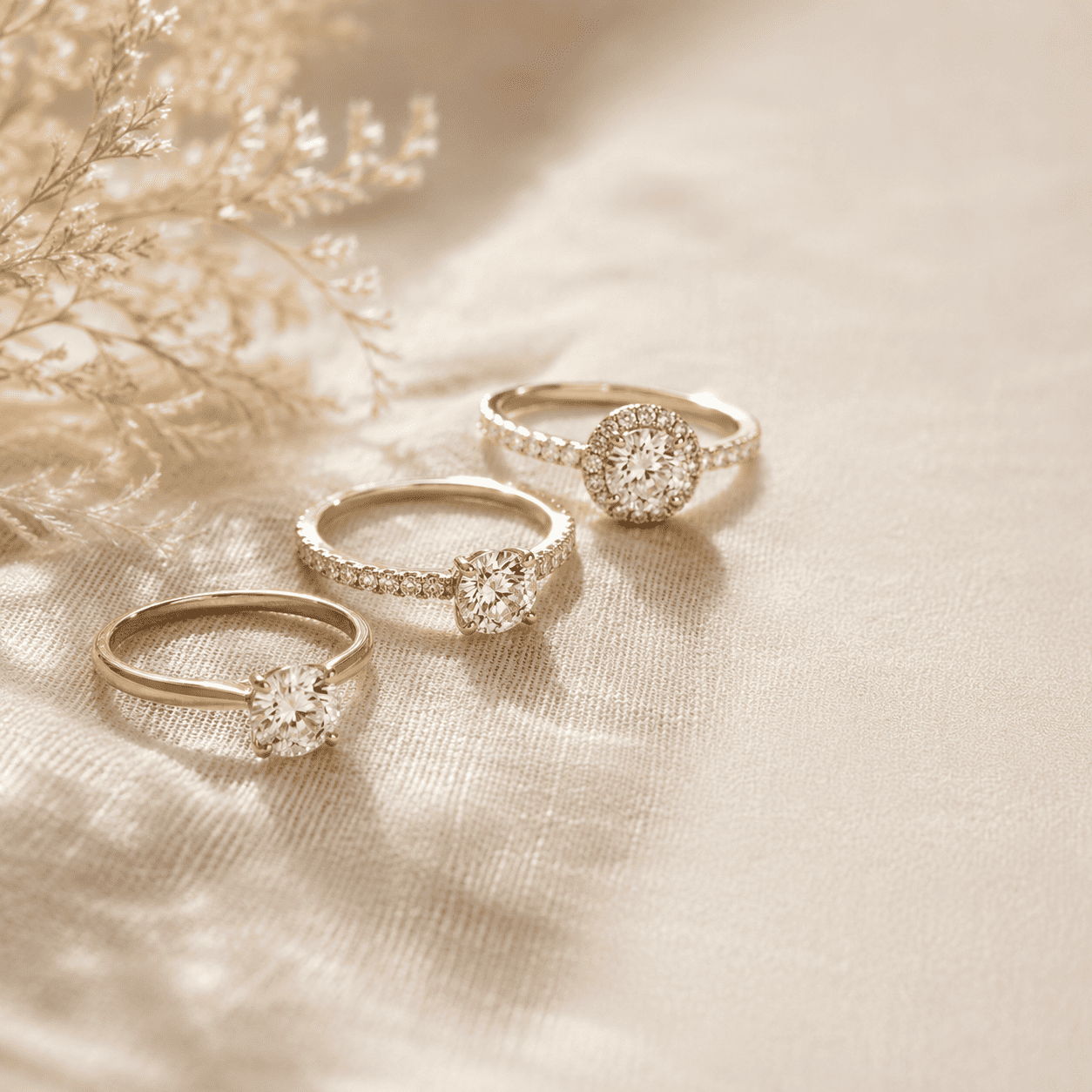
How Much Should You Spend on an Engagement Ring? A Realistic Guide for Every Budget
Someone once convinced an entire generation that you should spend two months’ salary on an engagement ring. That someone was a diamond company. And for decades, it worked. But here’s what actually matters when choosing a ring — and none of it involves your paycheck.
Whether you’re proposing soon or shopping for yourself, the question of how much to spend on an engagement ring can feel loaded with expectation. The short answer is: spend what makes sense for your life. The longer answer is worth reading — because understanding what actually drives ring prices will change how you shop forever.


Where the “two months’ salary” rule came from — and why you can ignore it
In the 1930s, De Beers launched one of the most successful marketing campaigns in history: “A Diamond is Forever.” It worked so well that by the 1980s, a follow-up campaign introduced the two-month guideline — a number entirely invented to increase sales. Before that campaign, one month’s salary was the suggested benchmark. Before that, there was no benchmark at all.
This is worth knowing because the anxiety many people feel about ring budgets is largely manufactured. There is no universal standard. There is no right amount. The only real question is: what works for you, right now, without creating financial stress in the first year of your engagement?
Worth knowing: According to surveys, the average engagement ring spend in the United States hovers around $5,500 — but the median (a more useful number) is significantly lower. Half of all engagement rings are purchased for well under that figure. The average is skewed upward by a small number of very expensive purchases.
What ring budgets actually look like in practice
Rather than anchoring to salary percentages, it’s more useful to think about budget bands — and what each one realistically gets you in terms of look, quality, and longevity.
Under $500
At this range with a natural diamond, you’re looking at very small stones, lower clarity grades, or compromised settings. However, this is where simulated diamond rings genuinely shine. A well-made simulated diamond ring in this range can look extraordinary — optically indistinguishable from a mined diamond to the naked eye — and be set in quality sterling silver or gold-plated metal. If your partner values the look over the provenance, this budget is entirely workable.
$500–$2,000
With a natural diamond, this range gets you something meaningful but still relatively modest — often a small round brilliant solitaire in the 0.3–0.5 carat range. Lab-grown diamonds become more accessible here. For simulated diamond rings, this budget is more than you need to get something spectacular, which is actually a freeing place to be.
$2,000–$5,000
This is where natural diamonds start to offer genuine visual presence — 0.7 to 1.0 carat stones with good clarity. Lab-grown diamonds in this range can be notably larger. For couples who want the “real diamond” narrative but have more moderate budgets, lab-grown is worth serious consideration here.
$5,000 and above
At this level, natural diamonds become visually impressive, with better cut grades and larger carat weights coming into reach. The emotional weight of a mined stone matters more to some people than others — and if it matters deeply to you or your partner, there’s no shame in that. Just go in knowing what you’re paying for: partly the stone, partly the story.
Worth knowing: Cut quality affects a diamond’s brilliance more than almost any other factor — more than size, more than colour, more than clarity. A well-cut 0.7 carat diamond will outsparkle a poorly cut 1.0 carat stone every time. Whatever your budget, prioritise cut above everything else.
The conversation no one has before proposing
Here’s the thing about surprise proposals: they often result in rings the recipient has to pretend to love. The most successful proposals tend to involve couples who have, at minimum, discussed the broad strokes — style preferences, metal preferences, whether the ring matters as much as the moment itself.
If you’re not sure what your partner wants, the right move is almost never to guess at a number and buy blind. It’s to have a gentle, casual conversation — or to propose with a placeholder ring and choose together afterward. Many couples find that shopping together, without a fixed budget anchor, leads to a ring that’s genuinely loved rather than diplomatically accepted.
✦ Pro tip: If you want the proposal to be a surprise but aren’t sure of her style, look at the jewellery she already wears. A woman who gravitates to simple, delicate pieces is unlikely to want a statement halo ring. Someone who layers bold pieces might feel underwhelmed by a minimalist solitaire. Her existing jewellery is the best style guide you have.
Why the simulated diamond conversation is worth having
The engagement ring market has changed significantly in the past decade. Lab-grown diamonds and high-quality simulated stones have made it genuinely possible to get a visually stunning ring for a fraction of what natural diamonds cost — and the stigma that once surrounded alternatives has largely faded among younger buyers.
The key distinction between lab-grown diamonds and simulated diamonds is this: lab-grown diamonds are chemically identical to mined stones, created in controlled conditions rather than extracted from the earth. Simulated diamonds — which include high-grade cubic zirconia and moissanite — are optically similar but chemically different. Both are durable, beautiful, and wearable every day.
For couples who care more about the ring’s appearance than its molecular composition, simulated diamond rings open up a different kind of question: instead of “how much should I spend to get a ring that looks impressive?”, the question becomes “what style and design will she love most?” That’s a much more interesting question to answer.

The Beloved Ring
A full pavé half-eternity band with brilliant round-cut simulated diamonds set in individual bezel-style settings. The Beloved wears beautifully as a standalone ring or paired with an engagement ring — its continuous row of stones creates an effect that reads as effortlessly expensive. Available in silver, gold, and rose gold.
Shop The Beloved Ring →What “value” actually means in fine jewellery
The jewellery industry conflates price with value in ways that don’t always hold up to scrutiny. A ring’s value to the person wearing it comes from how much she loves it, how often she wears it, and what it means to her — none of which is determined by the carat weight of the stone.
A $200 simulated diamond ring that she reaches for every single day delivers more everyday value than a $6,000 natural diamond that lives in a drawer because she’s afraid to wear it on holiday or to the gym. This isn’t a reason to underinvest in an engagement ring if you can comfortably afford a beautiful natural stone — it’s simply a prompt to think about what the ring will actually be used for.
Travel rings have become popular precisely because many women with expensive engagement rings have learned this lesson the hard way: they’ve left their real ring at home on too many occasions, or they’ve had that awful moment in an airport security queue when they realize they can’t remember where they put it. A beautiful simulated stone that she can wear everywhere — the beach, the gym, international travel — may actually get more use and bring more daily joy than a mined diamond locked in a safe.

The Duchess Ring
A cushion-cut simulated diamond centre stone with a double halo setting — one inner hidden halo, one outer — and a fully pavé-set band. The Duchess is one of those rings that stops people mid-sentence. The layered halo structure maximises brilliance from every angle, and the cushion cut gives it a softness that photographs beautifully. For anyone who wants maximum visual impact, this is it.
Shop The Duchess Ring →Questions worth asking before you set a budget
Rather than starting with a number, try starting with these questions. The answers will point you toward a budget more naturally than any guideline can.
- Does she care about natural diamonds specifically? Some women do, genuinely. Others don’t at all. If you don’t know, ask — directly or through a trusted friend.
- How does she feel about wearing jewellery every day? If she’s already careful about her current rings, a ring she’s nervous to wear isn’t a gift — it’s an obligation.
- Are you planning to buy a home, travel, or start a family in the next few years? A ring that costs three months’ mortgage down payment will feel different in two years than it does today.
- Does she care more about the style or the stone? Many women are far more attached to a setting they love than to the technical specifications of the gem inside it.
- Would she ever want to upgrade later? Some couples start with a more modest ring and upgrade it on a significant anniversary. This is a completely legitimate path — and it means the early ring doesn’t need to be the forever ring.
Quick Takeaways
- The “two months’ salary” rule was invented by a diamond company and has no objective basis — ignore it.
- The median engagement ring spend is considerably lower than the average; half of all rings are purchased for well under $5,500.
- Cut quality is the single most important factor in how brilliant a diamond or simulated stone appears — prioritise it over size.
- A ring she’ll wear every day is worth more in real terms than an expensive ring she’s afraid to take off the shelf.
- Simulated diamond rings have closed the visual gap with mined diamonds, making it genuinely possible to get a spectacular ring at any budget.
- Shopping together — or proposing with a placeholder — often leads to a ring she loves more than any surprise guess could.
Frequently asked questions
Is it okay to spend under $500 on an engagement ring?
Absolutely. What matters is that the ring is something she’ll genuinely love wearing. At under $500, high-quality simulated diamond rings are a genuinely beautiful option — and many women prefer a style they adore in this range over a more conventional stone they feel neutral about at a higher price.
Do lab-grown diamonds hold their value?
Lab-grown diamond prices have fallen significantly in recent years as production scales up. They do not hold their value the way rare natural diamonds can. If investment value matters to you, a natural diamond from a reputable grader is the better choice. If wearability and appearance matter more, lab-grown and simulated options are excellent.
What is the difference between a simulated diamond and a lab-grown diamond?
A lab-grown diamond is chemically identical to a mined diamond — carbon atoms in a crystal structure, just created above ground. A simulated diamond (such as cubic zirconia or moissanite) has a different chemical composition but is made to resemble a diamond visually. Both are durable enough for everyday wear; simulated options are typically far less expensive.
Should I propose with the ring or choose it together?
This depends entirely on your partner’s personality and preferences. If she has strong style opinions and has never mentioned a particular ring she loves, proposing with a placeholder and choosing together is genuinely romantic — not a cop-out. Many couples find the experience of choosing a ring together more meaningful than receiving a surprise that doesn’t quite fit their taste.
Can you resize a simulated diamond ring?
Most simulated diamond rings can be resized by a local jeweller, though settings with a full eternity band (stones all the way around) are harder to resize without disturbing the stones. When in doubt, check with the retailer before purchasing — and consider ordering a half or quarter size larger if you’re unsure, since rings are generally easier to size down than up.
The right budget for an engagement ring is the one that leaves you financially comfortable, reflects something she’ll genuinely love, and doesn’t anchor your first year of engagement to a credit card statement. Start from there, and the number tends to find itself.


