

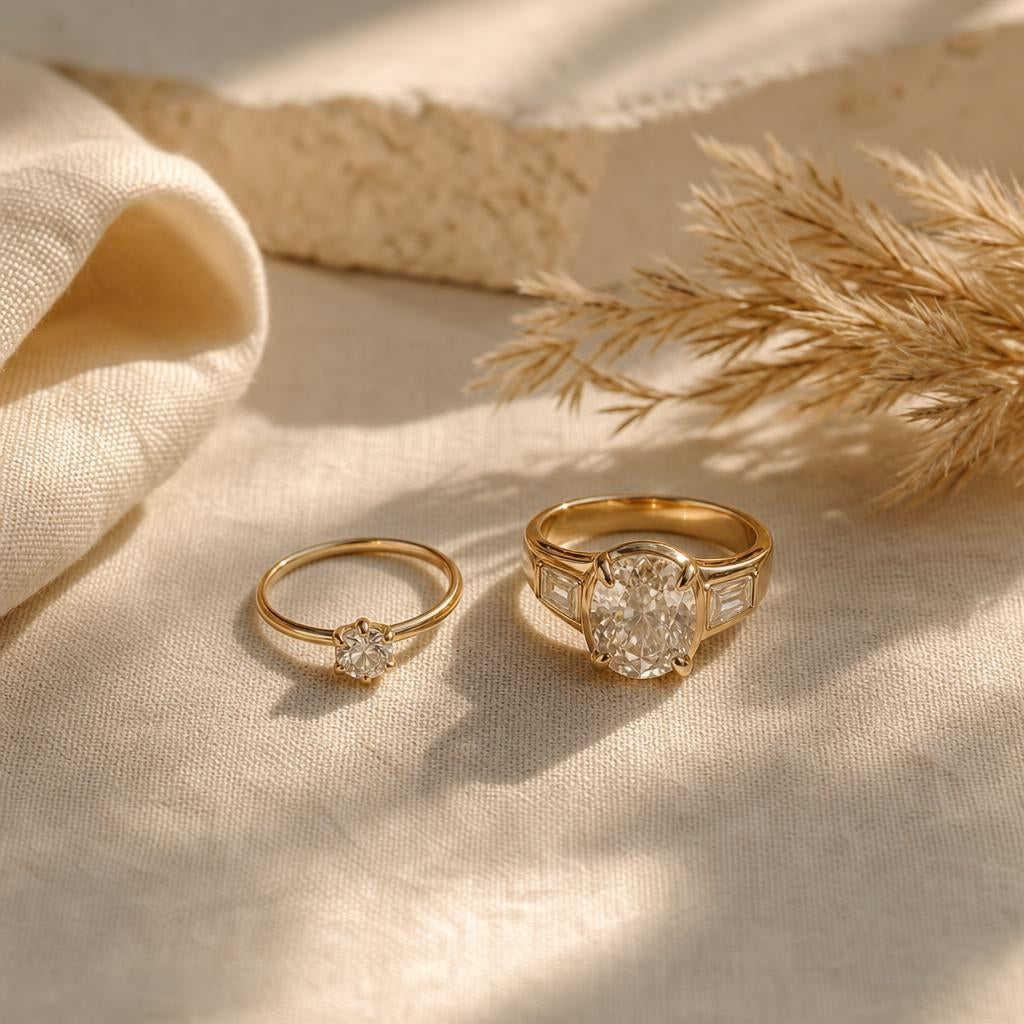
The Ring You Buy at 25 vs. the Ring You Buy at 35: How Taste Shifts
At 25, you buy a ring because you finally can. At 35, you buy one because you finally know. Somewhere between those two purchases, your taste didn't just change — it settled. And the ring you'd pick today probably looks nothing like the one you'd have picked a decade ago, for reasons that have very little to do with fashion.
This isn't a story about trends aging badly, though some do. It's about what actually shifts when you go from buying jewelry to see what you like, to buying jewelry because you already know exactly what you'll reach for on a Tuesday. Here's what that shift tends to look like, and a few pieces from the current Gemiros collection that map onto each end of it.


What You're Actually Buying at 25
At 25, most of what you buy is still an experiment. You're not just choosing a ring — you're choosing a version of yourself you're trying on for the first time: the woman who wears halo settings, or doesn't. The one who likes a little sparkle at her desk job, or keeps things quiet. You haven't fully answered those questions yet, and that's exactly why the rings that make sense at 25 tend to be the flexible ones.
Practically, that means classic silhouettes that go with almost anything you already own, because your wardrobe, your job, and your sense of your own style are all still moving targets. It also usually means a tighter budget, whether that's genuinely tight or just instinctively cautious — a habit left over from years of being told to save first, splurge later. So the ring that gets bought is rarely the boldest one in the case. It's the one that feels safe to wear every single day without a second thought, because at 25, "every single day" is still the whole point.
✦ Pro tip: If you're buying your first "real" ring for yourself, pick the piece you'd feel comfortable wearing to a first date, a job interview, and a Sunday grocery run — in that order. Versatility, not drama, is what actually gets worn.
A round-cut pavé band or a soft halo setting tends to do the most work here, precisely because it reads as classic rather than trend-driven. It won't look dated in five years, and it won't compete with whatever else you decide to add to your hand as your collection — and your confidence — grows.
What Changes by 35
By 35, the questions have mostly been answered. You know if you're a stacker or a one-ring woman. You know whether you gravitate toward warm metals or cool ones, whether you like your jewelry to whisper or announce itself, and — critically — you know what you actually wear versus what just sits in a drawer looking pretty. That clarity changes the whole calculus of what you buy next.
The budget conversation shifts too, but maybe not in the direction you'd expect. It's less "how much can I justify spending" and more "how much is it worth spending on something I'll wear for the next twenty years." That reframing tends to unlock pieces that would have felt excessive at 25: a larger center stone, a more architectural cut, a setting that has real presence instead of just blending in.

The Lumière Ring
A 4-carat round brilliant solitaire in a refined 4-prong setting — the kind of ring that stops feeling like "too much" once you actually know it's exactly enough.
Shop The Lumière Ring →There's also a quiet shift toward architecture over ornament. Where 25 favored round, familiar shapes, 35 is often where women start reaching for step cuts and sharper geometry — emerald, asscher, radiant — because by now you've seen enough rounds and halos to know what genuinely catches your eye versus what's simply expected. An asscher cut, with its deep step facets and unmistakable Art Deco lineage, is a good example of a shape that rarely gets chosen first, but often gets chosen eventually.

The Astrid Ring
A 3-carat asscher-cut center stone with baguette side stones — sharp, structured, and unmistakably confident in a way that takes most women a decade to actually want.
Shop The Astrid Ring →It's Not Really About Age — It's About What You've Already Figured Out
The 25-versus-35 framing is useful shorthand, but the real driver isn't your birth year. It's how many rings you've already bought, worn, loved, and quietly retired. Some women arrive at their "35 ring" at 27, because they did the experimenting early. Others are still in exploration mode well into their forties, and there's nothing wrong with that either — a smaller, evolving collection just means more of the fun is still ahead of you.
What does correlate reliably with time, though, is how you weigh the same handful of factors. Here's the honest version of how those priorities tend to move:
| Priority | Typically at 25 | Typically at 35 |
|---|---|---|
| Budget mindset | What feels safe to spend | What it's worth over 20 years |
| Stone shape | Round, familiar | Step cuts, architectural |
| Setting | Halo, pavé — forgiving and flexible | Solitaire or bold — confident and specific |
| Main question | "Will this go with everything?" | "Do I actually love this?" |
| Wear pattern | Everyday, low-commitment | Everyday, high-intention |
| Collection size | One ring, testing the waters | A curated few, each one earning its place |
Worth knowing: Neither end of this spectrum is "better" jewelry — a well-made round solitaire is not a starter ring you eventually graduate from. Plenty of women land on a classic round or halo setting at 35 and stay there for good, because it turns out that was their taste all along, not a placeholder for it.
The One Priority That Doesn't Actually Change
Wearability. At 25 or 35, the ring that gets worn is the one that survives actual daily life — typing, washing hands, pulling on gloves, forgetting it's even there. Low-profile settings, secure prongs or bezels, and a band that sits flush against your hand matter just as much at any age. The difference is that at 25, you might not think to check for it, and by 35, it's usually the first thing you ask about.
That's also where a lot of buyer's remorse actually comes from — not from choosing the "wrong" style, but from choosing a ring that looked right in a photo and never quite worked in real life. If a setting snags on sweaters or a stone sits too high to clear a glove comfortably, no amount of taste alignment will make you reach for it on a Tuesday morning.
How to Tell Which Version of "You" Is Shopping Right Now
If you're not sure whether you're in 25-mode or 35-mode regardless of your actual age, ask yourself one question: are you shopping to find out what you like, or are you shopping to finally get the thing you've wanted for years? The first instinct points toward something classic and flexible. The second points toward something specific — even if it's bolder, sharper, or more expensive than what you'd normally pick.
There's also a simpler test. Picture the ring sitting in a drawer at the end of a long week, next to two or three others you already own. If it's your first piece, almost anything versatile will earn its place. If it's joining a small, considered collection, it needs a real reason to be there — a shape you don't already have, a setting that does something the others don't.
Quick Takeaways
- At 25, versatility wins — classic round or halo shapes that go with an evolving wardrobe and taste.
- By 35, clarity wins — architectural cuts and bolder settings chosen because you actually know what you love.
- The shift is about self-knowledge and collection size more than age itself.
- Wearability — low-profile, secure, comfortable — matters at every stage and is the real predictor of what gets worn.
- Neither stage is a placeholder for the other; plenty of women land on their forever style early, and plenty take their time.
Frequently Asked Questions
Is it wasteful to buy a "25 ring" if I'll probably want something different later?
Not at all. A well-made, versatile ring earns its keep for years, and it becomes the foundation piece you stack against or compare future purchases to. Think of it as the first data point in figuring out your taste, not a mistake to correct later.
What if I already know I want a bold, architectural ring in my twenties?
Buy it. This framing describes a common pattern, not a rule. If you've already done the self-knowledge work — through borrowing, trying on, or simply knowing your own taste early — there's no reason to wait for a milestone birthday to buy the ring you actually want.
How many rings should I actually own before I "graduate" to a statement piece?
There's no set number. The better signal is whether you find yourself repeatedly drawn to a shape or setting you don't currently own. That recurring pull, more than any tally of past purchases, is usually the clearest sign you're ready for something more specific.
Do simulated diamond rings hold up well enough to be a long-term, "35 era" investment piece?
Yes. Quality simulated stones set in solid sterling silver or gold vermeil are built for daily wear, and because you're not paying for mined-diamond pricing, the same budget stretches to a bolder cut or larger stone than it would with a natural diamond — which is exactly the kind of trade-up a lot of 35-year-old shoppers are making.
Wherever you land on this spectrum right now, the honest answer is that your taste isn't finished changing — it's just further along than it was five years ago, and it'll keep moving. The rings that mark that movement are worth choosing on purpose, not by accident. Buy the one that fits the woman you actually are today, not the one you think you're supposed to be by a certain age.


