

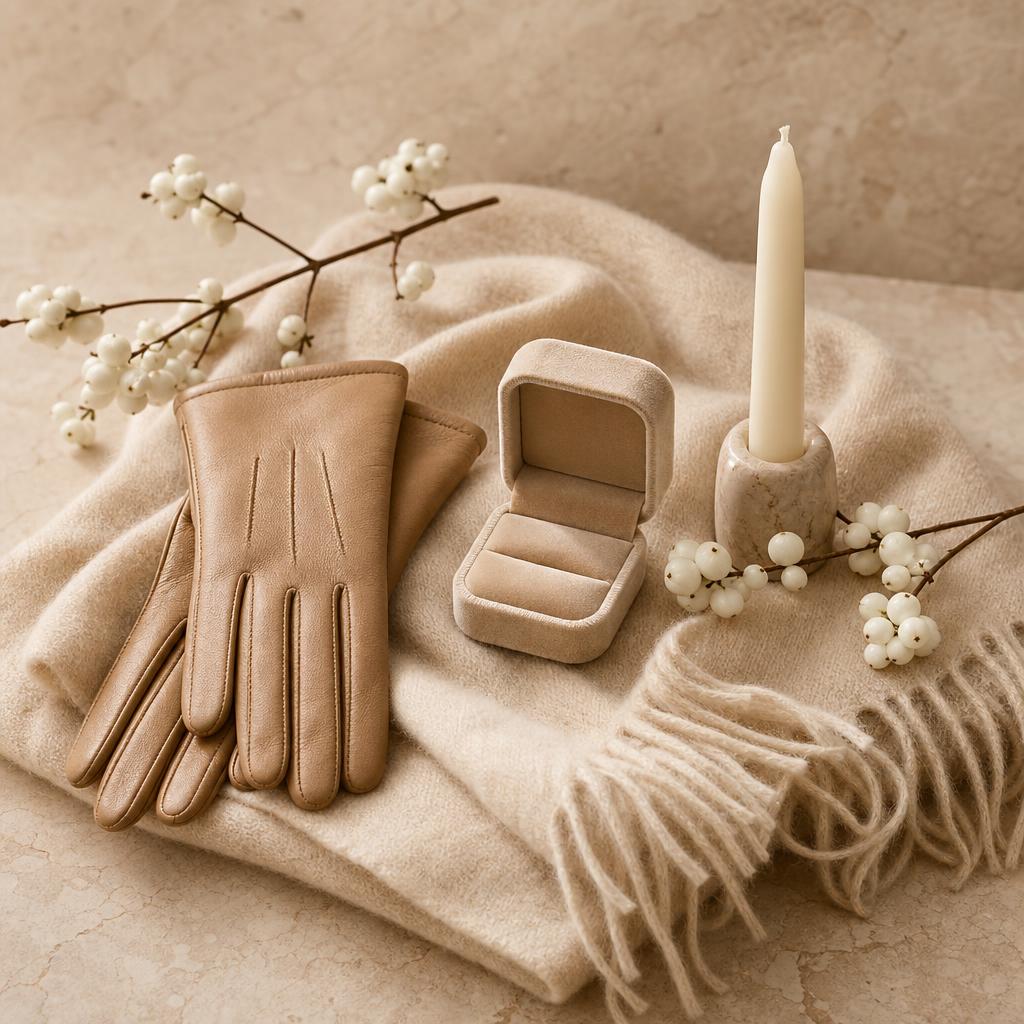
Wedding Guest Jewelry for Winter: Rings That Work With Sleeves, Gloves and Layers
Winter weddings run on a different rulebook. The dress has sleeves. The venue has a coat check. Somewhere between the welcome cocktail and the first dance, your hands spend half the night inside gloves — and the other half catching candlelight across a table you can't stop glancing down at. Choosing wedding guest jewelry for a cold-weather ceremony means picking rings that actually survive that back-and-forth, not just ones that look good in a mirror before you leave the house.
The good news: rings are the easiest thing to get right when you're dressing for a winter wedding as a guest, precisely because they don't compete with a coat, a scarf, or a sleeve the way a necklace does. You just have to choose ones built to hold their own in low light, under fabric, and against a bare hand the moment the gloves come off.


Why winter dressing changes the ring math
A summer wedding guest look is mostly bare skin — wrists, collarbones, ankles, all of it available for jewelry to do its work. Winter takes most of that away. Sleeves cover the wrist. A coat covers the shoulders on the walk in. Gloves cover the hands until the ceremony starts. What's left, for most of the night, is your face and your hands the moment they come out of your pockets. That's exactly why rings carry more weight at a winter wedding than they do at any other time of year — they're often the only jewelry doing visible work once the cardigan goes on.
It also means the ring has to work twice: once against bare skin at the reception, and once peeking out from under a cuff or a glove line at the ceremony. A low, close-set stone can disappear under a sleeve. A ring built to sit slightly proud of the hand — the way a halo setting does — keeps catching light even when most of your hand is covered.
The glove problem nobody mentions
If you're wearing gloves to the ceremony, plan around them rather than pretending they won't happen. A ring with a low profile slides on and off under a glove without snagging the lining — something a tall cathedral setting or an oversized cluster will fight you on every single time. This is where a piece like the Stella earns its place: a clean 4-prong solitaire that goes on smoothly, sits close to the finger, and still throws real sparkle the moment your hand is bare again for photos or the toast.
Worth knowing: If you're debating between two rings for a glove-heavy event, pick the one with the lower profile. You can always add sparkle with a second ring later in the night — you can't un-snag a glove lining mid-ceremony.
Building a look around long sleeves
Long sleeves change where the eye naturally lands. Instead of traveling up a bare arm, it stops right at the cuff — which means your hand, and whatever's on it, becomes the visual endpoint of the whole outfit. This is a genuine advantage. A ring with real presence, like the Ophelia with its hidden halo and pavé band, reads as intentional rather than incidental precisely because there's nothing else pulling focus above the wrist.
The other advantage of sleeves: they hide a ring's underside completely, so you can wear a bigger, more dramatic stone than you might choose for a bare-armed summer look without it feeling like too much. A cushion cut with a full halo, like the Maxima, reads as polished rather than overdone when it's the only jewelry visible from the elbow down.
Stacking for warmth-layered outfits
Winter weddings tend to involve more layers overall — a dress under a wrap, a wrap under a coat — and that layered instinct works just as well on your hands. A single band worn alongside your ring adds dimension without adding a second focal point, which matters when everything else about your outfit is already doing more (fabric, texture, a heavier hem).

Everlasting Ring
A continuous line of pavé that sits flush against another ring instead of competing with it — the easiest way to layer for a winter wedding without the stack looking accidental.
Shop Everlasting Ring →Keep it to one supporting band, not three. A layered winter outfit already has a lot going on texturally — a second thin ring reads as intentional; a fourth one starts competing with the coat you just checked.
What actually works for a black-tie winter wedding
Winter is prime season for formal, black-tie weddings — the kind held in a ballroom instead of a backyard, where the dress code says something and everyone takes it seriously. The jewelry that works for a black-tie wedding guest follows a simpler logic than people expect: fewer pieces, more polish. A single ring with real sparkle does more for a formal look than several smaller ones layered together, because a black-tie room is already full of shine — candlelight, silverware, string lights — and a cluttered hand just gets lost in it.
This is where a hidden halo or a full halo setting earns its keep. Both are built to throw light from multiple angles rather than one flat facet, which is exactly what a dim, candlelit ballroom rewards. Skip anything with a loose or dangling element for a seated dinner — nothing that catches on linens or a clutch strap during a toast.
Rings and the rule of three
A useful shortcut borrowed from wedding guest jewelry etiquette in general: pick a maximum of three jewelry "zones" for the whole outfit — say, earrings, a ring, and nothing else — rather than maximizing every zone at once. For a winter wedding, your ring is very often one of only two zones actually visible once the coat and scarf are on, which means it can afford to be the more deliberate choice rather than the safest one.

Isabella Ring
A pear-cut center stone wrapped in a halo of pavé — enough presence to read from across a ballroom table, polished rather than overdone.
Shop Isabella Ring →Metal tone, matched to a winter palette
Winter wedding color palettes tend to run cooler and richer than summer ones — deep greens, burgundy, navy, charcoal. A platinum-toned setting reads cleanly against almost all of it, which is part of why it's the default choice across most of the Gemiros collection. If your outfit leans warmer — camel, cream, blush — a rose gold or gold-toned ring picks up those undertones instead of fighting them. Either way, the moissanite and simulated diamond stones at the center do the same job regardless of metal tone: they're indistinguishable from a mined diamond to the eye, and they pass diamond testers, so the only real decision left is which tone flatters your outfit.
One thing worth saying plainly: none of this is about finding something that looks close enough. A Gemiros ring set in 925 sterling silver isn't a stand-in for a "real" one — it's the real ring, worn by a woman who has already worked out that the markup at a traditional jewelry counter was never actually about quality. That's a different decision than settling, and it shows in the way the piece actually wears through a long, cold, candlelit night.
Quick Takeaways
- Choose a low-profile ring if you're wearing gloves — it goes on and off cleanly under the lining
- Long sleeves free you up to wear a bigger, more dramatic stone than a bare-armed summer look would allow
- Stick to one supporting band if you're stacking — a layered winter outfit doesn't need a fourth ring competing for attention
- For black-tie weddings, fewer pieces with more sparkle beats several smaller ones fighting for the same light
- Platinum-toned settings suit cooler winter palettes; rose gold or gold suits warmer ones
Frequently Asked Questions
What jewelry should you wear to a wedding as a guest in winter?
Start with what will actually stay visible under a coat, sleeves, and possibly gloves — for most winter guests, that means a ring and a pair of earrings, rather than a necklace that a scarf or collar will hide most of the night. Choose one piece with real presence rather than several smaller ones, and make sure whatever you pick can go on and off easily if gloves are part of your outfit.
Is it okay to wear a statement ring to someone else's wedding?
Yes — a statement ring is one of the few pieces of wedding guest jewelry that reads as personal style rather than competing with the bride, since it's not something typically associated with bridal jewelry the way a tiara or a certain pearl set can be. Just keep the rest of your hand simple so the ring stays the clear focal point rather than one of several competing pieces.
Do rings need to match my other jewelry at a winter wedding?
Matching metal tones is a nice-to-have, not a rule. If your ring is platinum-toned and your earrings are gold, the outfit won't fall apart over it — what actually reads as "put together" is restraint in how much jewelry is visible at once, not perfect metal consistency across every piece.
What's the etiquette around wearing rings that might outshine the bride?
The etiquette concern here is less about how much a piece sparkles and more about what it references. Skip anything that reads as explicitly bridal — a veil-adjacent hair piece, a head-to-toe pearl set — but a ring with genuine sparkle is expected and welcome. Nobody mistakes a guest's ring for the bride's; the actual risk is wearing something loud enough to distract during quiet moments like vows or a toast, not sparkle itself.
A winter wedding asks more of a single ring than almost any other event on the calendar — it has to survive a coat check, hold its own under a sleeve, slide easily on and off a glove, and still catch the light by the time the dancing starts. Choose one built for that job, and you won't think about it again until it's time to take your coat back at the end of the night.


