

Wearing Rings to a Wedding as a Guest: How to Look Considered Without Upstaging Anyone
The unwritten rule of wedding guest dressing has always been about restraint — not in the sense of wearing less, but in wearing things that read as considered rather than competing. Rings are part of that calculus. Too many, too large, or too bridal, and you tip from elegant to upstaging. Too few, and you look as though you didn't give the occasion a second thought.
Getting it right is less about following rules and more about understanding context. The wedding you're attending, where you'll be sitting, who you are to the couple — all of it shapes what "appropriate" actually looks like on your hands. What follows is a practical guide to navigating the ring question as a guest, along with some of the Gemiros pieces that work best in a wedding setting.


The Real Rule Isn't About Size
There's a pervasive but imprecise piece of advice that circulates every wedding season: keep your jewellery small as a guest. That's not actually the rule. The real principle is subtler — wear things that read as intentional, that complement your outfit and the occasion, and that don't perform louder than the celebration itself.
A large, dramatic ring doesn't automatically violate this. A delicate ring worn carelessly might. Context and composition matter more than individual piece size. What you're aiming for, as a guest, is the sense that you thought about it — that every choice on your hands has a reason.
That said, there are a few specific shapes and styles that consistently create friction at weddings, and a few that almost always read correctly. Understanding both gives you a much cleaner decision to make on the morning of.
What to Consider Before You Choose
The formality of the event
A garden party wedding in summer calls for different hands than a black-tie evening ceremony in a hotel ballroom. At a relaxed outdoor wedding, delicate rings in lighter metals — a slim eternity band, a single pavé ring, perhaps two thin bands stacked — fit the visual register of the day. You don't need to underplay at a casual wedding, but heavy architectural pieces can feel mismatched against an open-air ceremony.
At a formal evening wedding, the register shifts. You can carry more. A single statement ring on the right hand, or a considered stack of two to three bands, fits the elevated context without overshooting it. Evening lighting is also more forgiving for sparkle — diamond-like stones catch candlelight beautifully, and a well-chosen ring adds to the occasion rather than competing with it.
Your relationship to the couple
Close family members — mothers of the bride or groom, sisters, close friends in the bridal party — can dress up more fully. That's usually expected, and the couple likely counts on it. The further you sit from the inner circle, the more reason there is to err on the side of quiet elegance over statement. It's not about diminishing yourself — it's about reading the room.
The outfit you've chosen
This matters more than most people account for when deciding on rings. A heavily embellished dress calls for simpler rings — competing texture creates visual chaos. A clean-lined dress, a sleek column gown, or anything minimalist gives you more latitude to carry sparkle. If your outfit is already doing work, let your rings be secondary. If your outfit is restrained, a considered ring stack or a single elegant piece fills the gap gracefully. If you want to understand which ring shapes work best with your proportions before you start building, this guide to choosing rings by hand shape and finger length is a useful starting point.
The Left Hand vs. Right Hand Question
This is worth pausing on. At a wedding, the bride's left hand carries the most charged symbolism in the room. Wearing a large, engagement-style ring on your left hand — especially a solitaire or halo design with a prominent centre stone — can read as an unintentional echo of the occasion. It's not a rule that's often said out loud, but most guests intuitively sense it.
The cleaner choice for a statement ring is the right hand. It reads as a confident, intentional style decision rather than a symbolic statement, and it removes any possible awkwardness around ring-finger optics.
Your left hand isn't off-limits — if you wear a wedding or engagement ring every day, you naturally keep it on. But if you're adding rings specifically for the occasion, the right hand is usually the better canvas for anything with presence. For a fuller look at how to style rings on the right hand intentionally, see our guide to wearing a ring on your right hand.

The Belle Ring
A round brilliant centre stone in a classic halo setting with a pavé band — elegant, occasion-worthy, and designed to sit beautifully on the right hand. The Belle has the presence of a statement ring without the bridal associations of a plain solitaire.
Shop The Belle Ring →Eternity Bands: The Nearly Infallible Wedding Guest Ring
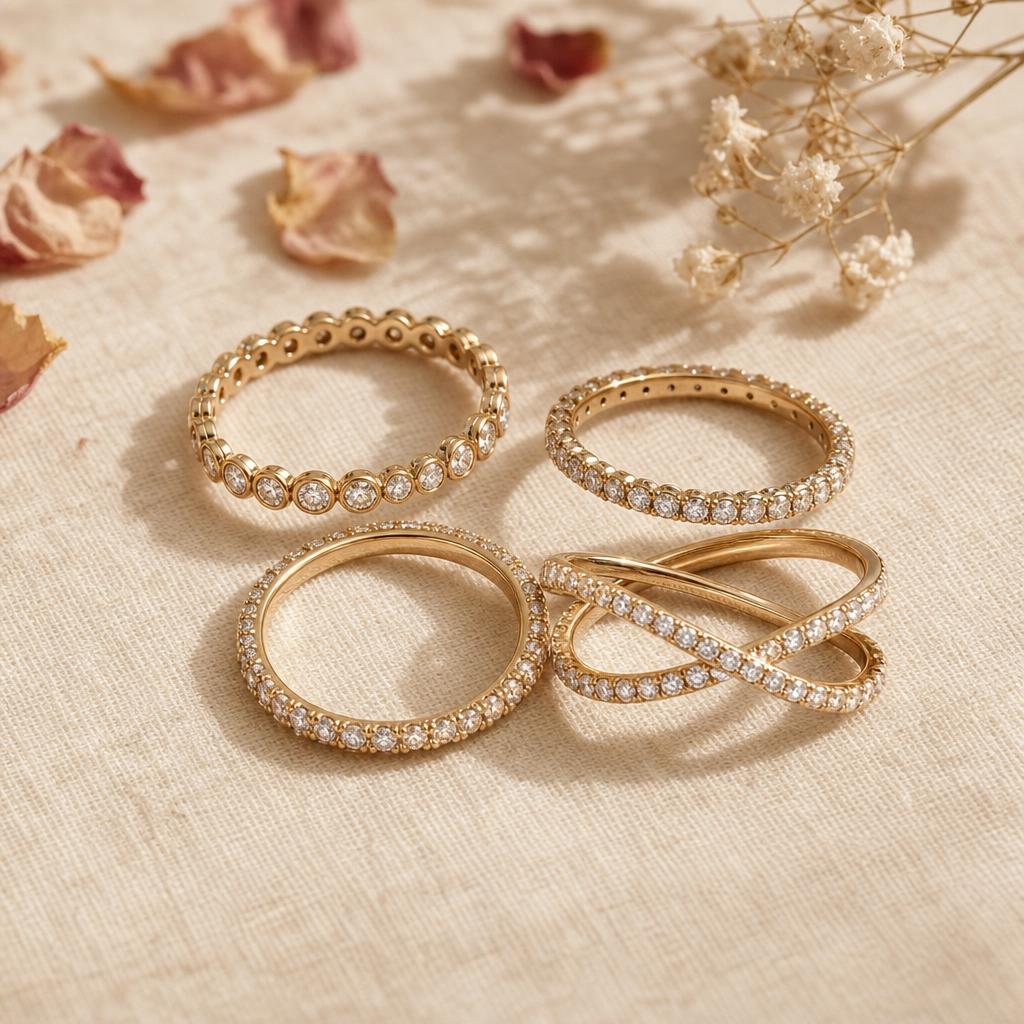
If there's a single category of ring that almost always works at a wedding, it's the eternity band. Whether full eternity or half eternity, pavé or bezel-set — these rings carry sparkle without scale. They read as celebratory, they're occasion-appropriate, and they don't signal anything beyond a love of wearing beautiful things.
Part of why eternity bands work so well at weddings is their symbolism: they represent continuous, enduring love, which rhymes with the occasion in a way that feels harmonious rather than competitive. Wearing one as a guest feels like dressing for the celebration rather than arriving in parallel to it.
Stack two or three eternity bands on one finger, or spread them across two fingers of the right hand, and you have a ring look that's genuinely elevated without requiring anything close to a statement piece. The composition is the statement. If you'd like inspiration on how to combine multiple bands without the result looking accidental, these five stacking combinations are a helpful reference.
Worth knowing: Eternity bands make excellent travel rings too — so if you're attending a destination wedding, they do double duty as pieces that look intentional in holiday photos but carry none of the anxiety of bringing valuable jewellery abroad.
What to Avoid (And Why)
The large clear solitaire on the left ring finger
This is the specific combination most likely to create friction: a prominent clear stone in a prong solitaire setting, worn on the left ring finger. It visually echoes the bridal ring in the most direct way possible. It's not a rule that's enforced, but it's the kind of detail that registers — if not consciously, then in the general feeling of the room. If you own a ring like this and wear it every day, keep wearing it; the alternative would be obviously awkward. But if you're selecting specifically for the occasion, there are better choices.
Heavy stacking on both hands
Wedding guest dressing benefits from restraint in proportion. A full stack on each hand, both heavily loaded with rings, can feel as though you're attending a jewellery show that happens to be scheduled alongside a wedding. The visual noise competes with the environment — and weddings have a specific emotional and visual composition worth respecting.
Pick one hand, pick one story. Either a considered stack on the right, or a single elevated piece that does the work alone. If you wear slim bands, understanding how band width affects a stack will help you find the balance between cohesive and crowded.
Anything that photographs as bridal
There's a practical consideration too: wedding photos. If you're close to the couple, you may end up in professional photographs. Rings that echo bridal styling can read oddly in these images years later — not because of any etiquette violation, but simply because of the visual associations involved. Eternity bands, crossover bands, and halo rings in small-to-medium sizes read as guests; large plain solitaires read as bridal. It's a subtle distinction, but worth knowing.

The Beatrice Ring
A round brilliant stone set in a vintage-inspired pavé band — the Beatrice reads as elegant and considered without solitaire associations. Beautiful for garden, romantic, or heritage venue weddings, and works equally well on left or right hand.
Shop The Beatrice Ring →Building a Considered Wedding Guest Ring Look
The wedding guest ring equation comes down to three variables: the hand you're wearing them on, how many rings, and how they relate to each other visually. There's a framework that simplifies the decision.
The single-hand stack
Choose one hand as your ring hand — typically the right. Then build a stack of two to three rings in a coordinated metal. Three slim eternity bands in white gold or silver, varied slightly in stone style (pavé, bezel, plain), create a stack that's cohesive and elegant. The individual pieces are quiet; the composition is the statement. This approach works at virtually every formality level. If you're starting from scratch with stacking, these flush-sitting stacking rings are a reliable starting point.
The one statement ring
Pick a single ring that carries the entire look. Everything else, if you wear anything else, should be simple enough to disappear. A halo ring on the right hand, or a beautiful eternity band with some presence to it, is complete. The risk is adding too much and diluting what you chose.
The matched metal principle
For weddings specifically, keeping metals consistent across all your jewellery — rings, earrings, necklace if you wear one — reads as intentional in a way that signals you considered the full picture. It's the detail that separates "got dressed" from "got dressed for this." If you tend to mix metals habitually, this guide on mixed metal stacking covers when it works and when it doesn't — useful context before you decide either way.
✦ Pro tip: Think about which metal tone best complements your outfit. Rose gold reads beautifully against warm tones — blush, terracotta, warm nude. Yellow gold is striking against jewel tones. Silver and white gold work universally but especially well with cool colours — navy, sage, slate, soft ivory.
Destination Weddings: A Different Calculation
Destination weddings introduce a specific consideration: how do you bring sparkle on a trip without the anxiety of carrying valuable pieces through airports, on boats, and into unfamiliar hotel rooms? If you're navigating a beach or poolside ceremony as part of the celebrations, it's also worth knowing which jewellery actually holds up in saltwater, sunscreen and heat — not all pieces are equal.
Simulated diamond rings — made with quality stones in 925 sterling silver — are the practical answer that requires no compromise on appearance. They photograph identically, look the same to the eye, and carry none of the anxiety. If something goes missing in transit, you've lost the cost of a very nice dinner, not something irreplaceable.
This is one of the reasons Gemiros eternity bands travel so well. Pack three or four rings in a small travel case knowing that any loss is entirely manageable, and that none of them look anything other than beautiful in photographs. For a broader look at building a travel jewellery kit that works across every occasion — including weddings — this guide to the 7-piece travel jewellery capsule covers all the practical decisions. The guest with the most considered hands at a destination wedding is often the one who thought ahead.
Quick Takeaways
- The goal isn't to wear less — it's to wear things that read as intentional and occasion-appropriate
- Eternity bands are the safest, most elegant choice for a wedding guest
- For statement rings, the right hand is a smarter canvas than the left
- Avoid large clear solitaires on the left ring finger — they visually echo the bridal moment
- Match your metals across all jewellery for a polished, pulled-together look
- For destination weddings, simulated diamond rings solve the travel anxiety entirely
Frequently Asked Questions
Can I wear a large ring as a wedding guest?
Yes — the relevant variable isn't size but style and hand. A large sculptural ring reads as personal expression, which is fine. A large clear solitaire on the left ring finger reads as bridal, which creates unintentional confusion. If you're wearing something substantial, make it the right hand.
Is it OK to wear a halo ring to a wedding?
Generally yes. A halo ring is appropriate on the right hand, and fine on the left if it's your everyday ring. The combination to navigate is a halo solitaire chosen specifically for the occasion and worn on the left ring finger — that pairing reads most bridal. On the right hand, a halo ring reads as elegant jewellery rather than a competing statement.
How many rings is too many at a wedding?
There's no universal number, but a useful guideline: one hand, three rings maximum. Two heavily stacked hands starts to read as maximalist in a way that can feel at odds with the gravity of a ceremony. If you love stacking, concentrate it on one hand and keep the other bare or with a single slim band.
Can I wear an eternity band as my main ring at a wedding?
Absolutely — it's one of the strongest choices you can make. A full pavé or bezel-set eternity band is celebratory, elegant, and symbolically resonant with the occasion without being bridal. Stack two or three for more impact, or wear one substantial eternity band as your only ring and let it carry the look entirely.
What if I don't know the dress code?
Default to one ring on the right hand. A single slim eternity band or a delicate pavé ring is appropriate at every formality level — from casual garden party to formal black tie. You can always remove rings at the reception if the energy shifts; you can't add what you didn't bring.
A wedding is one of the most composed, considered environments you'll wear jewellery in. The rings you choose don't need to be modest — they need to be right. Eternity bands, considered stacks on the right hand, and anything that reads as expressive rather than bridal will serve you beautifully from ceremony through the last song of the night.


