

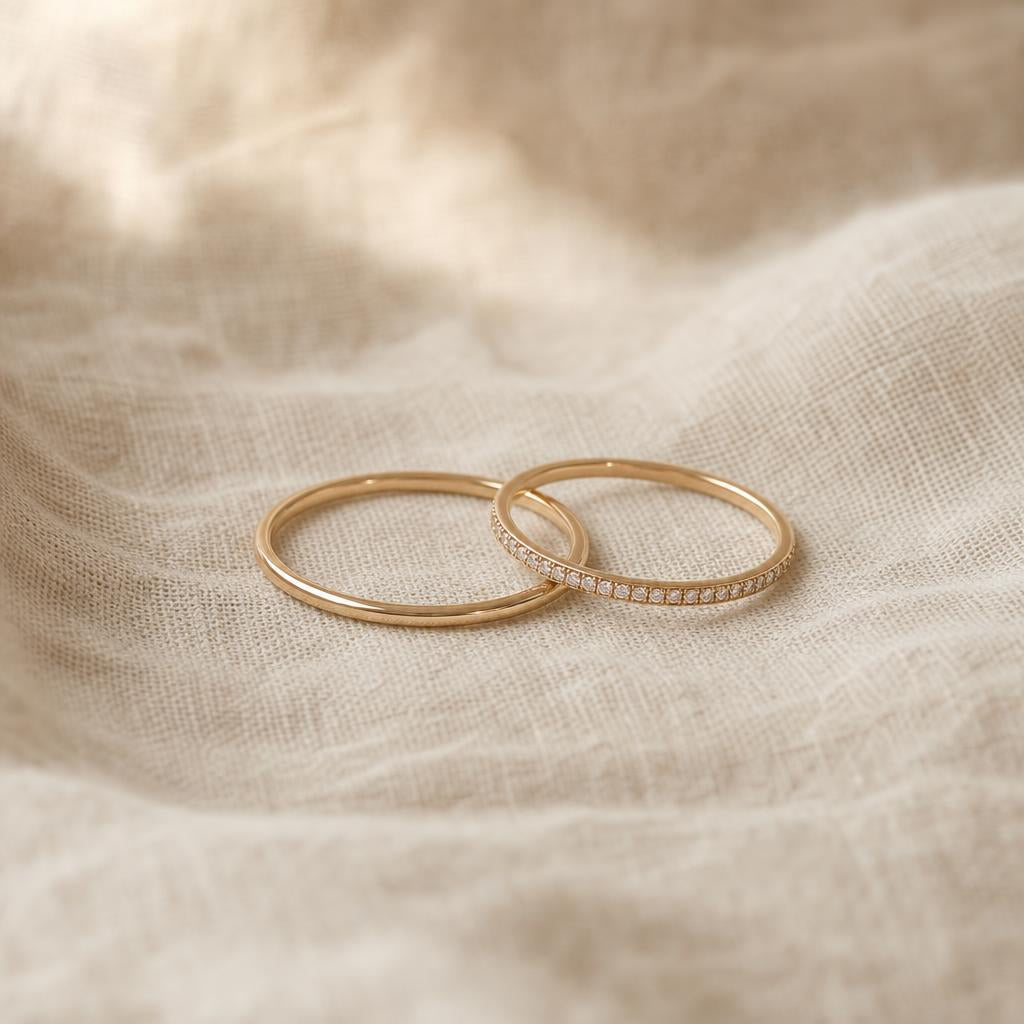
Wedding Bands for Thin Engagement Rings: What Actually Fits Without Overlap
Here's the math nobody explains before you buy: a 1.5mm engagement ring shank and a 3mm wedding band don't sit together, they sit against each other. One presses a visible ridge into the side of the other. If you own a delicate ring and you're now shopping for a wedding band for a thin engagement ring, the width you choose matters more than the metal color, the setting style, or almost anything else on the listing.
The good news: this is a solved problem, not a compromise. You just need to know what actually sits flush before you add to cart.


Why Thin Engagement Rings Change the Stacking Math
A thin shank isn't a downside. It's actually the smarter build: less metal means the center stone gets all the attention, the ring sits lower on the finger, and it layers more easily with everything else you already wear. The tradeoff is that thin shanks are unforgiving about what goes next to them. A wide, domed wedding band next to a 1.5mm shank doesn't read as "layered." It reads as two rings that don't belong to the same hand.
This is the piece most buying guides skip. They'll tell you to pick a wedding band you love and hope it works. You're allowed to want more precision than that.
What "Thin" Actually Means, in Millimeters
Band width is measured across the top of the shank, and the range most buyers are actually working with breaks down like this:
| Width | Feels Like | Best Paired With |
|---|---|---|
| 1.2mm – 1.6mm | Ultra-thin, barely-there | Another ultra-thin band, worn flush |
| 1.7mm – 2.2mm | Thin, still delicate | A slightly domed or textured thin band |
| 2.3mm – 3mm | Standard, noticeable | Most stacking bands, thin or mid-width |
| 3mm+ | Statement width | Worn alone, or with a contour band cut to match |
If your engagement ring falls in that 1.2mm–2.2mm range, you're not choosing between "thin" and "not thin" wedding bands. You're choosing how thin, and which setting handles that width without disappearing.
The Overlap Problem, and Why It Happens
Overlap isn't really about width alone — it's about where the metal sits in relation to the stone. A halo or hidden halo ring flares out at the base, even if the shank itself is thin. Push a straight stacking band directly against that flare and it either wedges under the halo or leaves a visible gap you can see straight through. A solitaire or pavé shank with no halo is the easiest to pair, because the width is consistent all the way around — what you see at the top of the ring is what you get at the base.
Worth knowing: Curved and contour bands exist specifically to solve the halo problem. They're shaped to trace the outline of a halo or side stones, closing the gap that a straight band would leave. If your engagement ring has a halo, start there before assuming a straight band won't work.
The other quiet variable is the wedding band's own profile. A flat-profile band and a domed-profile band in the same width will sit differently — flat edges tend to catch less against a thin shank, while a high dome can rock slightly if the two rings aren't perfectly aligned in width.

Wishbone Ring
A pavé eternity band with a consistent, low profile all the way around — the kind of build that sits flush against a thin shank instead of fighting it.
Shop Wishbone Ring →Bezel, Pavé, and Baguette: Which Band Style Actually Sits Flush
Setting style changes how a band behaves next to a thin engagement ring, not just how it looks:
- Bezel-set bands have a smooth, rubbed edge with no raised prongs to catch. They're the most forgiving option against a thin shank, since there's nothing for the two rings to snag against during the day.
- Pavé bands keep a low, even profile across the entire width, which is why they're the most common recommendation for stacking. The surface stays close to the finger instead of rising up.
- Baguette-accented bands read as more architectural and sit slightly higher, so they pair best with an engagement ring that has some width of its own rather than an ultra-thin 1.2mm shank.
None of these are "correct" on their own. The point is matching the setting to the shank you already have, not defaulting to whichever band photographs best on its own.

Amore Ring
Built for an oval-shaped engagement ring, with a continuous eternity band that echoes the curve of an oval stone instead of cutting straight across it.
Shop Amore Ring →Curved vs. Straight: Matching the Contour
A straight band works cleanly against a solitaire or a low-set pavé shank with no flare. A curved or notched band is built specifically to trace around a stone that juts outward — a halo, a hidden halo, or side stones. Wearing the wrong shape doesn't just look slightly off; it's the actual mechanical cause of the gap you're trying to avoid. Get the contour right first, and width becomes the only variable left to solve for.
✦ Pro tip: Try the band on the correct finger before assuming it fits your stack. A wedding band can measure "thin" on paper and still sit slightly high or low depending on how your specific engagement ring is built — the only real test is seeing the two rings together.
Pairing a Thin Engagement Ring With a Thicker Wedding Band, on Purpose
Not everyone wants two matching whisper-thin bands. Pairing a thin engagement ring with a thick wedding band is its own deliberate look — it reads as intentional contrast rather than a mismatch, as long as the wider band has a smooth, flat inner edge that won't dig into the shank next to it. The rule that actually matters here isn't width parity. It's whether the wider band's inside edge is finished cleanly enough to rest against delicate metal without wearing it down over time.
Sterling silver handles this well on both sides of the equation. A thin sterling silver ring doesn't need the same reinforced width that a soft, high-karat gold band would, since 925 silver is naturally more rigid — one more reason a genuinely thin band can still hold its shape through daily wear instead of warping against its neighbor.
Quick Takeaways
- Match width first: a band within about 0.5mm of your engagement ring's shank will sit the most flush.
- Check the contour: curved or notched bands are built for halos; straight bands are built for solitaires and low pavé.
- Bezel and pavé settings sit lowest and snag the least against a thin shank.
- An ultra-thin band engagement ring pairs most reliably with another thin, low-profile band — not a wide domed one.
- Contrast pairing (thin ring, thicker band) works fine as long as the wider band's inner edge is smooth.
Frequently Asked Questions
What actually counts as a "thin" wedding band?
Most jewelers put the line around 2mm. Anything from about 1.2mm to 2mm reads as thin and delicate; anything above 3mm starts to feel like a statement width. If you're shopping specifically for thin wedding bands, staying under that 2mm mark is the safest way to guarantee the look you're picturing.
Are thinner wedding bands actually comfortable for everyday wear?
Yes — a lighter, narrower band is often more comfortable than a wide one, especially for someone who isn't used to wearing multiple rings at once. Less metal means less bulk between and around your fingers, which is part of why thin bands have become the default stacking choice.
Should the band always match your engagement ring's width exactly?
Not exactly, but close. Staying within roughly half a millimeter of your engagement ring's shank is the safest range. Go much wider and you risk overlap and gapping; go much thinner and the band can look like an afterthought next to the ring it's supposed to complete.
Is a 2mm band too thin to hold up over daily wear?
No — in 925 sterling silver, a 2mm band is a genuinely durable everyday width, not a fragile one. The material matters more than the number: solid sterling silver holds its shape at widths that would be a real concern in a much softer metal.
Can a slightly wider stacking band still sit flush against a thin engagement ring?
It can, if the profile is right. A flat-profile band with a smooth inner edge will sit more predictably next to a thin shank than a domed or heavily textured one, even at a slightly wider width. Profile and contour do as much work as the millimeter count itself.
You already know your ring better than any generic buying guide does. The only real homework here is checking three things — width, contour, and setting profile — before you commit. Get those three right and the band you choose won't just match your engagement ring. It'll look like it was built for it.


