

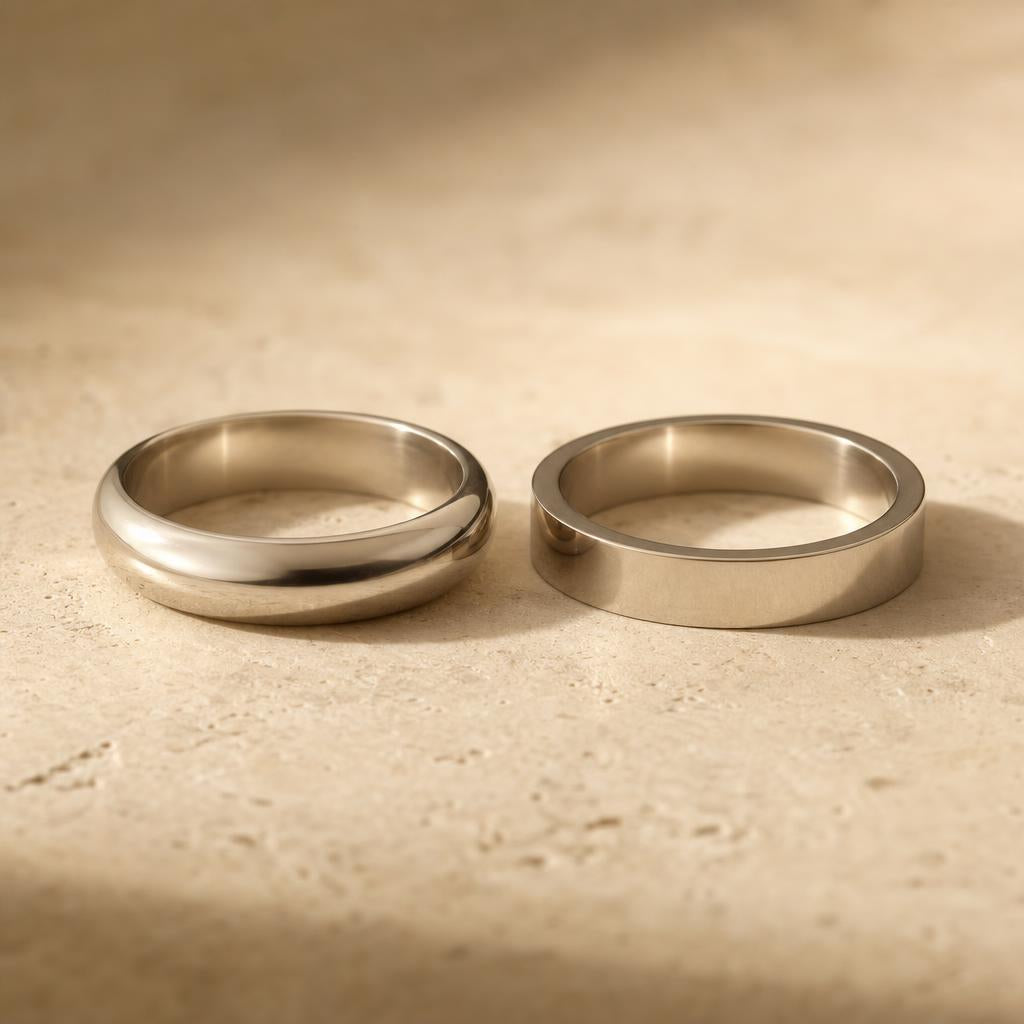
Domed vs. Flat Wedding Bands: How Profile Changes Comfort & Stacking
Nobody compliments a wedding band's profile. They notice the sparkle, the metal tone, maybe how it sits next to your engagement ring — but the shape of the band itself, the part your finger actually feels a thousand times a day, stays invisible. Until it isn't.
Two women can buy the exact same width, the exact same metal, the exact same number of stones — and end up with completely different rings simply because one chose a domed profile and the other chose flat. It is the most overlooked decision in a stacking band, and it is entirely yours to make on purpose.


What "Domed" and "Flat" Actually Mean on a Band
Strip away the metal, the stones, the setting style, and every wedding band boils down to one basic decision: what shape is the metal itself doing between your knuckles? A domed wedding band curves outward from center, rising to a gentle peak before sloping back down on either side — think of it as a soft hill rather than a straight line. A flat band does the opposite. Its outer surface stays level, often finishing in crisp, defined edges that give it a squared, architectural look.
Neither shape is more "correct." They are two different engineering decisions that happen to produce two very different daily experiences, and the difference is felt far more than it is seen in a photo.
| Profile | Feel on the hand | Visual character | Stacking behavior |
|---|---|---|---|
| Domed | Rounded, glides over knuckles, less edge contact | Soft, traditional, understated | Sits slightly higher; pairs well with one or two other pieces |
| Flat | Structured, more surface contact, distinctly present | Modern, architectural, graphic | Sits close and flush; built for layering multiple thin bands |
Comfort: The Case for a Domed Profile
A comfort fit wedding band almost always means a domed interior and exterior working together — the rounded shape reduces how much metal actually touches your skin at any given moment, which is why it glides over knuckles instead of catching on them. This matters more than it sounds like it should. A ring you take on and off daily, or never take off at all, earns or loses your goodwill in exactly this kind of small, repeated moment.
✦ Pro tip: If you type, lift, garden, or spend your day using your hands constantly, a domed profile is the quieter, more forgiving choice — it simply has less flat surface to catch on gloves, fabric, or the edge of a laptop.

The Cherish Ring
A rounded eternity band where each stone sits in its own smooth bezel — the closest thing to a domed profile with sparkle still built in. No sharp edges, no snag points, just a continuous line of light around the finger.
Shop The Cherish Ring →925 sterling silver naturally lends itself to a smooth, rounded finish, which is part of why domed profiles feel so at home in this metal. Combined with rhodium or gold plating, the curve catches light continuously rather than in isolated flashes — a softer kind of sparkle that reads as quietly expensive rather than loud.
Flat Bands: The Architectural, Stack-Ready Choice
Flat profiles trade a little bit of glide for a lot more visual precision. Because the surface stays level, light hits it in clean, defined lines instead of a single rounded highlight — which is exactly why flat bands read as more modern, more graphic, more intentional. They photograph beautifully because there is no curve to soften or distort the shot.

The Devotion Ring
Baguette-cut stones set into a channel, with a level, structured top edge — the clearest example of a flat profile in the collection. It sits close to the finger and stacks flush against almost anything next to it.
Shop The Devotion Ring →The tradeoff is subtle but real: flat edges do contact the skin more directly, especially on wider bands. For a single ring worn occasionally, that rarely registers as anything. For a band that lives on your finger permanently, it is worth trying on before you decide it doesn't matter to you.
How Profile Changes the Way a Stack Sits Together
This is where the decision stops being purely personal and starts being structural. If you already have a collection in mind, the profile of each piece changes how the whole stack behaves on the hand — not just how each ring looks alone.
Worth knowing: Two domed bands sitting side by side tend to look bulkier than their width suggests, because each curve adds visual height. Two flat bands stack close and flush, almost like one continuous piece of metal. Mixing one of each is often the most intentional-looking combination of all — the contrast reads as a choice, not an accident.
Anyone hunting for wedding ring stack ideas eventually runs into this exact tension: rounded pieces feel soft and cohesive together, but a stack made entirely of domed bands can start to look shapeless from certain angles. A single flat band dropped into that mix acts almost like a frame — it gives the eye somewhere to land before it moves on to the curve of the next piece.
Which Profile Is Right for You?
There is no universal answer here, only a more honest question: what does your day actually look like? If your hands are busy — typing, lifting, constantly in motion — a domed, rounded profile is going to disappear into your routine faster and more completely. If you're building a deliberate, layered stack and want each piece to read as sharp and considered, flat profiles give you that structure to work with.
Whichever direction you choose, the goal is the same one behind every well-built stack: something that looks like it was decided on purpose, by someone who already knew what she wanted.
Buying Confidently: What to Check Before You Order
Profile is one of the few details a product photo genuinely struggles to show you. A straight-on shot flattens the curve of a domed band and can make a flat band look softer than it actually is, so it's worth looking for close-up or side-angle images before you decide, and reading the setting description rather than judging by the thumbnail alone.
Fit matters just as much as shape. Order your true, known ring size rather than rounding up or down on instinct — every Gemiros ring ships in whole US sizes, so if you've never been sized before, it's worth measuring properly first rather than guessing. A domed profile in the wrong size won't feel any more comfortable than a flat one; the shape only helps once the fit itself is right.
Material is the other half of the comfort equation, and it's easy to overlook next to profile. Every Gemiros band is 925 sterling silver at its core, nickel-free and hypoallergenic, which matters more than shape does if your skin reacts to cheaper alloys. A rounded, comfort-fit profile in a metal that irritates your finger is still going to irritate your finger — the two decisions work together, not as substitutes for each other.
None of this is complicated once you know to look for it. It just rewards the buyer who reads past the hero shot, which — if the rest of this guide has made anything clear — is exactly the kind of buyer you already are.
Quick Takeaways
- A domed band curves outward from center; a flat band stays level with crisp, defined edges.
- Domed profiles glide over knuckles with less skin contact — the logic behind most comfort fit designs.
- Flat profiles sit closer to the finger and read as more architectural, especially in photos.
- Domed bands stack softly together; flat bands stack flush and precise.
- Mixing one domed piece with one flat piece is a simple way to make a stack look deliberate.
Frequently Asked Questions
What does "domed" mean on a wedding band?
It refers to the outer profile of the metal curving outward from the center of the band, rather than staying flat. The curve is what makes a domed wedding band glide smoothly over the knuckle instead of catching on it.
What kind of wedding band is most comfortable for everyday wear?
For most people, a rounded or bezel-set profile with fewer sharp edges feels the most comfortable across a full day of wear, since there's less flat surface catching on gloves, fabric, or your other hand.
Are comfort fit wedding bands worth choosing over a standard flat band?
If you wear your ring every single day without taking it off, yes — the difference shows up in small, repeated moments rather than all at once. If you rotate pieces or wear a ring occasionally, the distinction matters far less.
Can you mix domed and flat bands in the same stack?
Yes, and it's one of the more intentional-looking combinations you can build. A flat band gives the eye a clean line to rest on, while a domed piece next to it adds softness — together they read as a considered contrast rather than a mismatch.
The profile you choose won't show up in a single photo, and no one is going to ask you about it at dinner. But it's the decision you'll feel every single day, in every single moment your hand touches something else — which makes it worth choosing on purpose, not by default.


