

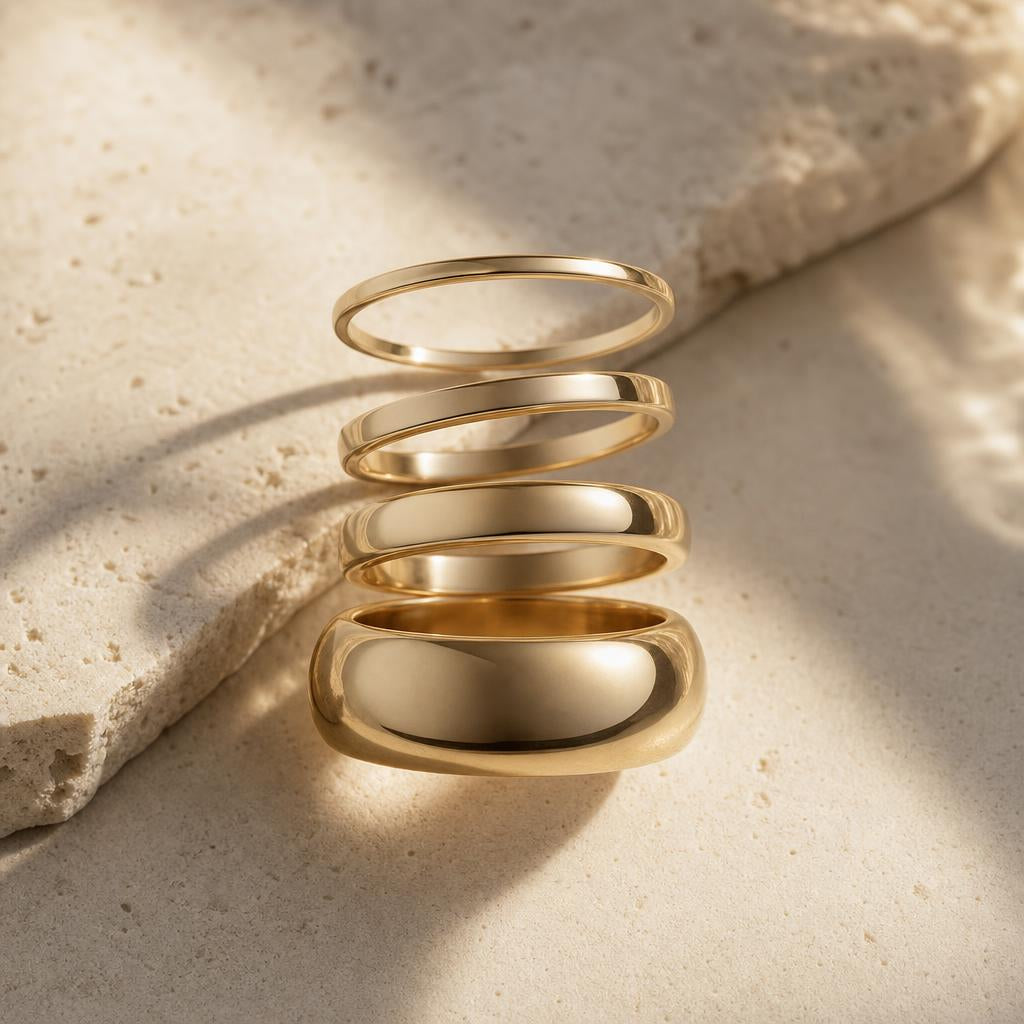
Wide vs. Narrow Wedding Bands: Wedding Ring Stack Ideas for Every Hand
There's a persistent myth in ring shopping that one width is correct — that a slim 2mm band is the tasteful choice and anything bigger is trying too hard. It isn't true. Width changes how a band reads on your hand, how it behaves next to the rings around it, and how loud or quiet your whole stack feels. Once you understand what width actually does, choosing between wide and narrow stops being a guess and starts being a decision you make on purpose.
Before the mechanics of millimeters, sizing, and how bands sit together, here's a spread of stacking-ready styles across the width spectrum — from a bold full-eternity band to the most delicate crossover line.


What "Wide" and "Narrow" Actually Mean
Band width is measured in millimeters, edge to edge, and the range is bigger than most people expect. Anything from about 1.5mm to 2mm reads as delicate — the kind of band that disappears into a stack rather than announcing itself. The 2mm to 4mm range is the industry's standard zone, wide enough to feel substantial without overpowering a center stone. Cross 4mm and you're in wide wedding band territory: bold, contemporary, confident enough to be worn completely alone. There's no ceiling that makes a band "too much" — only a ceiling for what suits your hand and what you're stacking it against.
None of these categories are fixed rules, either. A 3mm band next to a delicate 1.5mm crossover reads as the "wide" piece in that particular stack, even though 3mm would be considered standard on its own. Width is relative to whatever it's sitting next to, which is exactly why the same ring can look completely different depending on what you pair it with.
The Case for Going Wide
A wide band doesn't need backup. It holds its own shape and presence whether it's stacked with three other rings or worn solo on a day when that's the only piece you reach for. It also tends to photograph better in low light — more metal surface means more light catching the edges. For a band you might wear on its own some days and layered on others, width is what makes it feel finished either way, not like half of an outfit. And because it's set in 925 sterling silver, that wider surface holds its polish and shine through daily wear instead of showing fatigue the way a soft, thin metal might.

The Cherish Ring
Individually bezel-set stones give this band a substantial, sculptural presence — the kind of piece that works as a standalone statement or as the anchor of a wider stack.
Shop The Cherish →The Case for Narrow, Delicate Bands
Narrow wedding bands do the opposite job well: they layer without crowding. A slim band lets a center stone stay the focal point, and it lets you stack two, three, or four rings on one finger without the whole arrangement turning into a wall of metal. If your engagement ring already has a busy setting — pavé, a hidden halo, a cluster of accent stones — a thin band gives it room to breathe instead of competing for attention. Narrow doesn't mean flimsy. It means the width is doing a supporting role instead of a lead one.
Wedding Ring Stack Ideas That Balance Wide and Narrow
The stacks that look intentional almost always mix widths on purpose rather than by accident. A common formula: one wide anchor band, one or two narrow supporting bands, and your center ring holding the visual middle ground. Deliberately mismatched stacked wedding bands — different widths, slightly different finishes — read as curated because the contrast is doing something, not because pieces were thrown together. What actually looks accidental is stacking three bands of nearly identical width; the eye can't tell where one ring ends and the next begins, and the whole hand reads flat instead of layered.

The Destiny Ring
Two slender pavé lines that cross and meet — a soft, narrow counterpoint that sits comfortably next to a wider anchor band without ever fighting it for attention.
Shop The Destiny →Does Stacking Order Matter?
Less than most people assume. Tradition places a plain band closest to the knuckle and anything more decorative above it, but there's no rule that actually locks you into that order — the visual logic matters more than the sequence. Put your widest piece where you want the eye to land first, whether that's at the base of the stack or the top. If a band has a raised setting, put it where it won't get shadowed by a taller neighbor. Beyond that, rearranging is free — the same three rings can look like three different stacks depending on the order you put them in that morning.
How Wide Should a Woman's Wedding Band Be?
There's a genuinely useful starting point here: if you plan to wear your wedding band flush against an engagement ring, matching or nearly matching their widths keeps the two from rubbing and wearing down each other's edges over time. Beyond that, width comes down to proportion. Shorter or narrower fingers often look most balanced in something under 4mm, since anything wider can visually shorten the finger. Longer fingers can carry a wider band without it looking oversized. And if you already know you'll wear the band alone on some days, sizing toward the wider end tends to feel more finished solo than a very thin band does.
Worth knowing: Wider bands fit more snugly than narrow ones at the same stated size, because more metal is in contact with your finger. If you're moving from a narrow band to something 4mm or wider, it's worth double-checking your size rather than assuming your old number still applies.
How Metal and Finish Change What Width Reads As
Width isn't the only variable doing work here — finish changes how substantial a band feels, too. A high-polish surface on a wider band throws more light and can read even bolder than its millimeter measurement suggests, while a matte or brushed finish on that same width quiets it down. This is part of why 925 sterling silver with rhodium plating is such a forgiving base for experimenting with width: it takes a mirror polish well, it's nickel-free and hypoallergenic, and it holds its shine on both a delicate 2mm line and a substantial 6mm dome without either one looking cheap or thin. The metal isn't fighting the width — it's supporting whichever effect you're going for.
Building Your Stack Without Overthinking It
You don't need to plan the whole stack on day one. Most women who wear layered rings well built the look over time — one wide anchor piece purchased now, a narrow layer added later, a bolder band swapped in when the mood strikes. The stack is allowed to evolve. What matters is that each new piece earns its place next to what's already there, rather than being added just because a slot on your finger is empty.
It also helps to think about how often you'll actually rearrange things. Some women build a stack and wear it the same way for years; others treat their rings the way they'd treat a jewelry box, swapping pieces in and out depending on the day, the outfit, or just the mood. Neither approach is more correct than the other — the only real mistake is buying width you don't actually like just because a chart says it's "standard."
Quick Takeaways
- 2–4mm reads as standard; under 2mm is delicate; over 4mm is a wide, statement-making width.
- Wide bands hold their own alone; narrow bands are built to layer without crowding a center stone.
- Mixing widths on purpose — one anchor, one or two supporting bands — looks intentional. Matching widths too closely can read as flat.
- Match widths where bands sit flush against each other to prevent wear over time.
- There's no fixed stacking order — build around what you want the eye to land on first.
Frequently Asked Questions
What actually goes into a wedding ring stack?
There's no required formula. Most stacks build around a center ring — often the piece with the most visual weight — flanked by one or more supporting bands in a different width, texture, or finish. Two or three rings is common; some women wear four or five once they've built up a collection over time.
Are mismatched stacked wedding bands still in style?
Yes — deliberately mixed widths, metals, and finishes have moved from a trend to a default approach for a lot of women. The distinction that matters is intentional versus accidental: contrast that's chosen on purpose reads as curated, while several similar rings piled on together without a plan tends to look cluttered instead of layered.
Should my wedding band be the same width as my engagement ring?
Only if you plan to wear them flush together every day. In that case, matching widths keeps the two bands from rubbing against each other and wearing down their edges. If they'll sit with any gap between them, or you'll wear them separately some days, the widths can differ without causing any practical issue.
Does the order I stack my rings in actually matter?
Only as much as you want it to. There's a traditional order — plain band closest to the knuckle, more decorative pieces above it — but nothing locks you into it. Reordering the same rings changes which piece catches the eye first, so it's worth experimenting rather than treating any single order as fixed.
None of this requires getting it perfect on the first try. A stack is not a single decision you make once and live with forever — it's a small, evolving collection that should feel like it belongs to you specifically, built at whatever width and pace actually suits your hand. You don't need anyone's permission to change it as your taste does, and you don't need to justify a wide band to anyone who assumes delicate is the only tasteful option. The width you choose is simply the width that looks right on your hand — nothing more complicated than that.


