

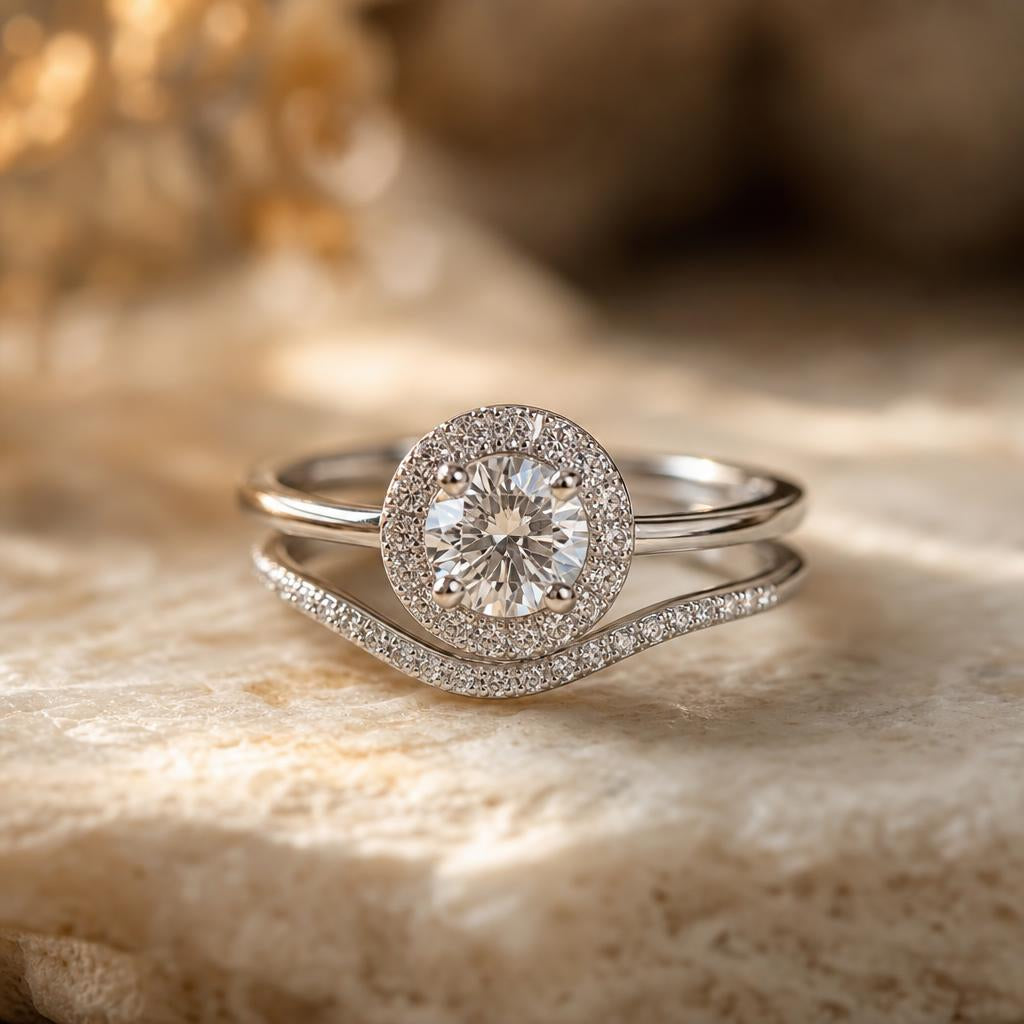
Wedding Bands for Halo Engagement Rings: How to Avoid the Gap at the Base
A halo ring is not a shy ring. The center stone sits inside its own frame of light, which is exactly the point — but that frame is also why so many women stall out the moment they start shopping for a wedding band to wear beside it. Halo settings flare wider and sit at a different height than a plain solitaire, and the wrong band leaves a sliver of bare finger between the two rings that no amount of adjusting will fix.
The good news: this is a solved problem, not a mystery. Once you understand why the gap happens, choosing the right wedding band for a halo engagement ring becomes a matter of matching band shape to setting height — not trial and error.


Why Halo Rings Leave a Gap in the First Place
A halo isn't just decorative — it's structural. The circle of accent stones sits on its own raised basket, which means the widest point of the ring is often the halo itself, not the shank underneath it. A plain straight band is cut to sit flush against a shank of a fairly predictable width. Push it up against a halo's flared basket and there's nowhere for it to go — it either stops short, leaving a visible gap, or it rocks against the outer stones every time you move your hand.
This is worth knowing before you shop, because it reframes the problem correctly. You're not choosing a band based on which one looks prettiest in isolation. You're choosing one that's actually shaped to clear the halo's footprint — and that's a fit question first, a style question second.
Worth knowing: The gap shows up most on hidden halo settings like the Ophelia and Maxima, where the accent stones sit slightly beneath the center stone rather than flush around it. The visual effect is subtler day to day, but the basket underneath still needs the same clearance.
The Three Band Shapes That Actually Solve It
Straight bands — when they still work
A straight, plain band can sit next to a halo ring without any modification, but only if the halo is set high enough on a raised gallery that the band can slide directly underneath it. Some of our hidden halo styles — the Ophelia in particular — are cut with enough clearance at the base that a slim straight band sits close without touching. It's worth trying before assuming you need something more elaborate.
Curved and contour bands — the most common fix
A contour wedding band is simply a straight band with a deliberate dip or arch cut into one edge, shaped to trace the outline of the halo it's meant to sit beside. Instead of butting up against the basket, the metal curves around it, closing the gap without any part of the band actually touching the stones. This is the most reliable option for wider halos, and it's why most halo-and-band pairings you'll see styled together use some version of a curved profile rather than a straight one.
Slip-under bands — the quiet, no-gap option
Less commonly discussed but genuinely useful: a band cut to tuck slightly beneath the halo's overhang, so it reads as a straight band from above while still closing the physical gap underneath. It gives the cleaner look of a plain band with the functional fit of a curved one, which makes it worth asking about if you want minimal visual break between the two rings.
Matching the Band to Your Halo's Shape
Shape changes more than you'd expect. A round halo and an elongated oval halo don't create the same footprint, and the band that clears one won't automatically clear the other.
Oval and elongated halos
Oval centers taper at both ends, so the halo around them isn't a uniform circle — it narrows toward the tips and widens through the middle. A curved wedding band with an oval engagement ring generally needs the deepest dip at the center of the arc, tapering back to flush at the sides, so it hugs the widest part of the stone without leaving daylight at the narrow ends.

The Isabella
Pear-shaped centers create an asymmetric halo — narrow at the point, wide at the crown — so a curved band paired here needs an uneven arch rather than a symmetrical one to close the gap on both sides.
Shop The Isabella →Cushion and square halos
Cushion-cut centers, like the Maxima, sit inside a squared-off halo with soft corners. Because the basket is boxier rather than round, a slightly wider contour band tends to sit better than a narrow one — it has more surface area to trace the straighter edges of the halo instead of just the curve.
Round halos
Round halos, like the Belle, are the most forgiving shape to pair. Because the footprint is symmetrical from every angle, a gently curved band with an even dip works from any rotation, which is part of why round halo styles are so often sold pre-paired with a matching band.
Double halos and extra-wide baskets
Double halo settings add a second ring of accent stones, which pushes the total footprint even wider than a single halo.

The Duchess
With two rings of pavé stacked around the center stone, the Duchess needs a band with a deeper, wider curve than a single-halo setting — a shallow dip won't clear the second row of stones.
Shop The Duchess →How to Actually Test the Fit Before You Commit
You don't need to guess. Slide the candidate band next to your halo ring on the same finger and look at it from above, from the side, and from your own point of view looking down at your hand — the angle you'll actually see most days. Rotate your hand slightly. If the band rocks, catches on the halo's outer stones, or leaves a visible sliver of skin from any angle, it's not the right cut for that particular setting, no matter how good it looked on its own.
✦ Pro tip: If you're buying online, ask for the millimeter measurement of the halo's widest point (not just the center stone's carat weight) and compare it against the band's stated curve depth. Carat weight tells you nothing about footprint — the physical width is what actually determines fit.
It's also worth remembering that this pairing doesn't have to be a single, permanent decision made on your wedding day. Plenty of women wear their halo ring alone for months, or years, before adding a band — and plenty more swap between a curved band and a straight one depending on the day. There's no rule that says the pairing has to be locked in immediately, or that it can't change.
Quick Takeaways
- Halo settings sit wider and higher than plain solitaires, which is why straight bands often leave a gap
- Curved and contour bands are the most reliable fix — they trace the halo's outline instead of butting against it
- Slip-under bands give a straight-band look with a curved band's actual clearance
- Oval and pear halos need an uneven, asymmetrical curve; round halos are the most forgiving to pair
- Double halos need a deeper, wider dip than a single halo of the same center stone
- Always test the fit on your actual finger, from multiple angles, before deciding
Frequently Asked Questions
What wedding band goes with a halo engagement ring?
It depends on how high the halo sits. If the basket is elevated enough for a straight band to slide underneath without touching, a plain band works. If the halo sits lower or flares wider, a curved or contour band — cut with a dip that traces the halo's shape — is the more reliable choice.
Can you wear a straight wedding band with a halo ring?
Sometimes, but only if the setting has enough clearance underneath the basket. Hidden halo styles are more likely to allow this than a traditional halo, since the accent stones sit tucked beneath the center stone rather than flush around it.
What's the difference between a curved band and a contour band?
In practice, the terms are used interchangeably. Both describe a band with a shaped dip or arch designed to sit flush against an engagement ring's setting rather than in a straight line. Some jewelers reserve "contour" for a deeper, more sculpted curve and "curved" for a gentler one, but there's no universal rule.
Do I need a custom band for my specific halo ring?
Not necessarily. Many curved bands are cut to a standard depth that works across several halo widths. A custom or made-to-match band matters most for unusual shapes — like a very elongated oval or a double halo — where a standard curve may not clear the full footprint.
Are halo engagement rings still in style?
Yes — halo settings have stayed one of the most consistently popular styles for over a decade, largely because the extra ring of stones makes a center stone read visibly larger without changing its actual carat weight. Pairing it with the right band is a styling detail, not a sign the setting itself is dated.
A wedding band for a halo engagement ring isn't a compromise you settle for — it's a fit you get right once, then stop thinking about. Know the shape of your halo, know which of the three band styles actually clears it, and the rest is just choosing the one you like best.


