

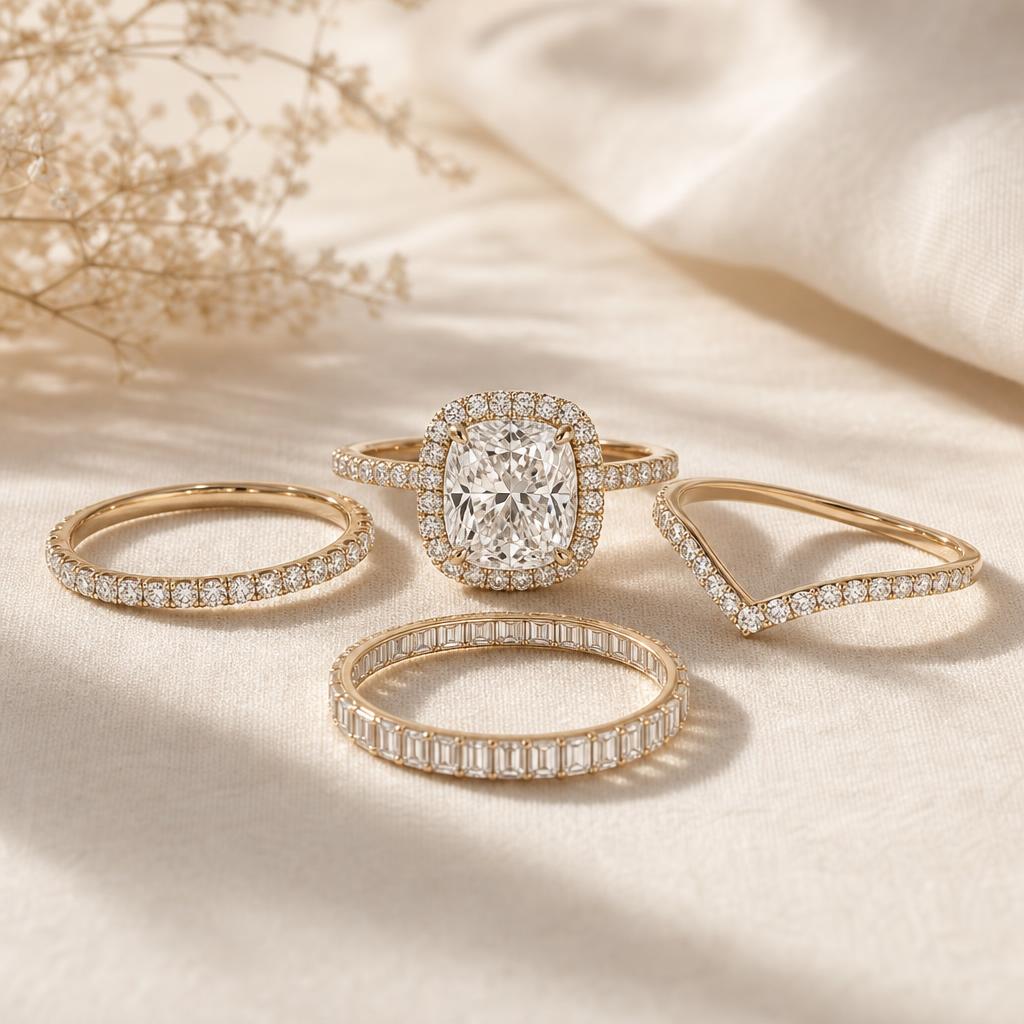
Wedding Bands for Cushion Cut Rings: Which Shapes Sit Flush and Which Ones Gap
The cushion cut is one of the most romantic shapes in jewellery — soft corners, rounded edges, a little extra depth that catches light differently from any angle. But that same shape creates one of the most common pairing problems in all of ring stacking: the gap. A flat-sided wedding band sits flush against a round or oval cut without drama. Against a cushion, that curved profile beneath the stone creates a visible space that many women find unexpectedly frustrating after years of buying into the idea that any band will do.
This guide exists because most ring pairing advice is generic. It will tell you to "choose a band that complements your ring" without ever explaining what complement means geometrically. Here, you'll learn exactly which band shapes sit cleanly against a cushion cut, which ones leave a gap and why, and which Gemiros bands work with both the Duchess and the Maxima — two of the most popular cushion settings in the collection.
Why the Cushion Cut Creates a Pairing Challenge
Most engagement ring settings terminate at a relatively flat shank — round cuts, oval cuts, even princess cuts generally drop into a band that runs level and uninterrupted. The cushion cut is different. The stone's profile tends to sit slightly higher, and the halo or setting detail (particularly the decorative basket and any lower pavé work) creates a curved, dimensional base where the stone meets the band. This is the geometry that causes the gap problem.
A plain flat wedding band sits perfectly flat. A cushion cut setting curves. The two shapes meet at one point on each side rather than flush across the entire surface — and on a finger, that pinch creates a visible gap that catches fabric, collects moisture, and can make even an expensive combination look sloppy. The solution isn't finding a special material or a compromise ring. It's understanding which band profiles are shaped to bridge that gap by design.
Worth knowing: The gap problem isn't about ring quality or price — it's pure geometry. A straight band will gap against a curved setting every time, regardless of the metal or stone quality. The right shaped band eliminates the gap entirely.
Band Shapes That Work: The Flush-Fitting Options
The slim pavé eternity
Of all the wedding band profiles that pair with a cushion cut, a slim pavé eternity band is the most versatile and the most popular. Because the band is narrow and relatively thin in profile, it can sit snugly against the wider base of a cushion setting without fighting the geometry. The pavé stones run the full or half circumference, which means there's no blank metal face pressing against the ring — just a continuous line of stones that nestle naturally beside it.
The key is keeping the band width proportionate. A band that's too wide will start to lift at the point of contact and re-introduce the gap; a band under 2mm tends to disappear visually against a bold cushion halo. The sweet spot for most cushion cuts is 1.5–2.5mm — wide enough to be seen, narrow enough to sit flush without fighting the setting's profile.

The Forever Ring
A slim, seamless row of round pavé stones in a lightweight band that sits close against the shank of any cushion setting. Available in silver, gold, and rose gold — this is the most universally compatible wedding band in the Gemiros collection for cushion cut wearers.
Shop The Forever Ring →The chevron (wishbone) band
A chevron band curves upward at the centre — pointing slightly upwards like an arrow or inverted V. This shape is sometimes called a wishbone band because of its silhouette. What makes it ideal for cushion cuts is that the curve accommodates the dimensional base of the setting rather than fighting it: instead of pressing flat against a curved surface, the angled sides meet the shank at a complementary angle and the stone sits neatly in the V-shaped dip above the band.
The visual effect is intentional. A chevron band frames the stone from below, directing the eye upward toward the centre diamond and creating a design that reads as considered rather than coincidental. Many cushion cut wearers who've tried straight bands and found the gap frustrating switch to a chevron band and wonder why they ever hesitated — the pairing is that clean.

The Wishbone Ring
A pavé-set chevron band that curves upward to frame the cushion centre stone beautifully. The angled profile fills the natural gap created by a cushion setting, creating a seamless, flush fit that looks custom-designed even when worn with an existing ring.
Shop The Wishbone Ring →The full eternity band
A full eternity band — stones running the entire circumference of the band — works with a cushion cut because the setting profile is identical all the way around. Unlike a solitaire with a blank shank underside, a full eternity band has no "wrong side" pressing against the engagement ring: whatever portion of the band faces the engagement ring is the same as the rest of it. This creates a visually consistent pairing, and because the band can flex slightly as the stones are set into it, it tends to conform to the engagement ring's shank more gracefully than a rigid plain metal band.

The Everlasting Ring
A full circle of round pavé-set simulated diamonds — no gaps, no blank metal, just continuous sparkle around the entire band. Because the setting profile is uniform all the way around, it pairs with cushion cuts without the fit compromise that plain-shank bands create.
Shop The Everlasting Ring →The Bands That Gap — and When to Use Them Anyway
Plain metal bands
A flat, unadorned metal band will always gap against a cushion setting. This is not a defect — it's geometry, and it's consistent regardless of metal type, cost, or quality. The gap is simply the space between a flat surface and a curved one. Some women don't mind the gap; others find it catches fabric or feels irritating. If you choose a plain metal band, wear it on the other side of the engagement ring (on the finger tip side rather than the hand side) so the pairing reads as a deliberate separation rather than an accidental misfit.
Wide, flat-profile pavé bands
A wide pavé band with a flat underside has the same problem as a plain metal band — the width exaggerates rather than hides the gap. The band presses against the shank at two points on the very edges, creating a bridge effect with visible air in the middle. The wider the band, the more pronounced the gap. If you want width and sparkle paired with your cushion, two stacked slim bands work better than one wide band.
Bands with tall stone settings
Any band where the stones sit in high, elevated settings — channel-set princess cuts, tall bezel bands — adds vertical height at the point where the rings meet. This creates both a gap beneath and a visual step between the two rings, which can make the combination look disjointed. Keep setting height consistent between your engagement ring and wedding band: if the main ring sits high, choose a low-profile band. If the main ring is lower, you have more flexibility.
Worth knowing: The baguette eternity band is a partial exception. Because baguette cuts are rectangular with flat table tops, a baguette band sits more flush against curved settings than a round brilliant eternity of the same width — the stones create a firmer contact surface.

The Devotion Ring
A continuous row of baguette-cut simulated diamonds in a sleek channel setting. The flat, step-cut profile of baguette stones creates a firmer contact with a cushion shank than round brilliants of the same width — an unexpected but consistently successful pairing for cushion cuts that want something architectural.
Shop The Devotion Ring →The Cushion Rings: Understanding What You're Pairing With
The gap problem varies depending on which cushion ring you own. Not all cushion settings create the same profile at the base. A ring with a plain, tapered shank and a simple four-prong basket will gap less than a ring with a full pavé shank, decorative basket work, or a hidden halo around the base of the stone. Understanding your specific ring's profile tells you how much accommodation your band needs to make.

The Duchess Ring
A cushion-cut simulated diamond with two layers of hidden halo surrounding the base of the stone — this is one of the most detailed settings in the collection, which means the base profile is more dimensional than a plain cushion solitaire. The Wishbone Ring is the best pairing: the chevron shape fills the space created by the double halo beautifully.
Shop The Duchess Ring →
The Maxima Ring
A 3.5-carat cushion cut with a bold halo and a pavé shank that runs down to a slightly curved base. The Maxima's base profile is less extreme than the Duchess's double halo, giving you more flexibility in band choice — the Forever Ring, the Wishbone, and the Devotion all work cleanly with this setting.
Shop The Maxima Ring →Stacking Two Bands on a Cushion Cut
Wearing two bands on either side of a cushion cut is increasingly popular, and it works better than one wide band for exactly the reason outlined above: two slim bands conform to the ring's base geometry more naturally than one wide flat band trying to bridge the entire gap at once. The result is a three-ring stack that looks architectural and intentional rather than improvised.
The most coherent version of this stack uses two identical slim pavé bands — one on each side. The symmetry reads clearly and the cushion stone sits centred and balanced between them. A variation that works almost as well: one slim straight eternity on one side, one wishbone band on the other. The wishbone fills the gap more closely on the stone side, while the slim straight band creates an anchor on the other. The contrast reads well in person and photographs beautifully.
✦ Tip: If you're stacking two bands with a cushion cut, order both in the same metal and the same approximate width before committing. Hold them against the ring in person before wearing — what looks balanced in a flat image can shift when you account for your finger's natural taper.

The Destiny Ring
Two delicate pavé bands that cross at the centre — a different shape to a plain eternity, and one that creates an intentional design moment between the two bands rather than simply adding one more straight line beside the engagement ring. Pairs particularly well with the Maxima when worn on the outer side of the stack.
Shop The Destiny Ring →Quick Takeaways
- Cushion cuts create a curved base profile — flat straight bands will always gap against them
- Slim pavé eternity bands and wishbone (chevron) bands are the best fits: they sit flush by design
- Wide flat-profile bands exaggerate the gap — stack two slim bands instead
- Baguette eternity bands are a strong alternative: the flat stone profile creates better contact than round brilliants
- A double hidden halo cushion (like the Duchess) needs a wishbone or curved band; a standard cushion halo (like the Maxima) gives you more pairing flexibility
- Two slim matching bands — one on each side — is the cleanest, most intentional approach for a cushion cut stack
Frequently Asked Questions
Will any wedding band gap against a cushion cut?
Only flat-profile bands gap consistently. Slim pavé eternity bands, wishbone bands, and V-shaped contour bands are specifically designed to accommodate rounded and cushion settings. A flat plain metal band or a wide flat pavé band will gap — but a shaped band will not.
Does the gap matter if it's a simulated diamond ring?
The gap issue is purely about fit and comfort, not about the stone material. A simulated diamond cushion cut has exactly the same setting geometry as a mined diamond cushion cut — the gap problem and the solutions are identical.
Can I solder a wedding band to a cushion cut engagement ring to eliminate the gap?
Soldering permanently joins the two rings, which makes resizing more complicated later. A better solution for most women is a properly shaped band — wishbone or slim eternity — that sits flush by design. No soldering needed, and you retain the flexibility to wear the rings separately.
What width wedding band works best with a cushion cut?
1.5–2.5mm is the general sweet spot for most cushion settings. Narrower than 1.5mm and the band disappears visually against a bold halo setting; wider than 2.5mm and you start to run into gap issues again. The right width also depends on your finger — narrower fingers carry narrower bands more proportionately.
I have a cushion cut with a plain (non-halo) setting. Do I still need a shaped band?
A plain cushion solitaire without halo has a simpler base profile and gaps less dramatically than a halo or double-halo setting. You have more flexibility: a slim eternity band or a carefully sized straight band may sit well enough. That said, a wishbone band will always sit more flush — it's worth trying both against your ring before committing.
The cushion cut is genuinely one of the easiest stones to build a ring stack around — once you understand the geometry. The gap isn't a design flaw to work around; it's a constraint that points you toward shaped bands that, in most cases, look better beside a cushion cut than a flat band ever would. A wishbone band under a cushion halo, or two slim eternity bands framing it on either side, creates something that feels considered and complete in a way that a single straight band alongside the same ring never quite achieves.


