

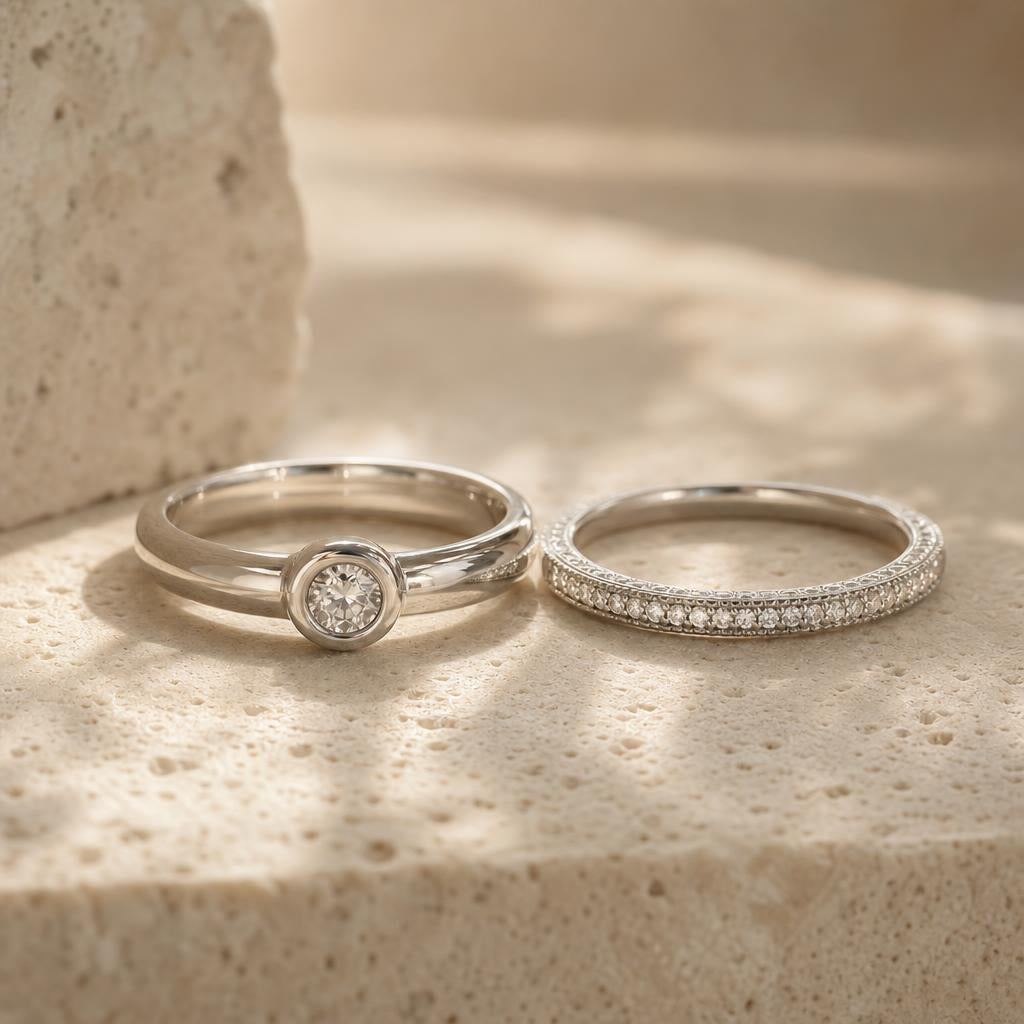
Bezel Set Wedding Bands: What Actually Pairs With a Bezel-Set Ring
A bezel setting solves one problem beautifully — no prongs to catch, no claws to snag on a sweater — and quietly creates another one nobody warns you about. Half the wedding bands that look flawless in a display case won't actually sit flush against it.
The fix isn't complicated once you understand what a bezel is actually doing along the sides of your ring. It's a rim, not a claw, and that rim is what decides which bands clear it, which ones leave a gap, and which ones were built to sit right up against it from the start.


What a bezel setting actually does to your stacking options
A prong setting leaves gaps you can build around — a plain band can usually slide under or between the claws without much thought. A bezel closes that door. The rim runs continuously around the stone, which means whatever you stack next to it has to either sit flat against a straight edge or curve to follow the shape of the setting itself. There's no in-between, and that's exactly why so many women end up back at the search bar after the engagement ring is already on their hand.
Flush-fit straight bands
If your bezel sits low against the finger — flush, with very little height between the stone and the shank — a slim, straight band will usually sit right up against it with no visible gap. This is the simplest pairing and the one most bezel-set engagement rings are designed around from the start.
Curved and contoured bands
A higher bezel, or one with a slightly raised gallery underneath the stone, tends to leave a sliver of space that a straight band can't close. A curved or contoured band — one shaped to dip and rise around the bezel's silhouette — solves this without needing anything custom-made. It's the same logic jewelers have used for prong settings for decades, just applied to a smoother edge.
✦ Pro tip: Before buying, look at your ring from the side, not just from above. A low, flush bezel almost always works with a straight band. Anything with visible height under the stone is a strong signal to go curved.
Bezel set wedding bands: matching the setting, not fighting it
The most seamless pairing isn't always a plain metal band — it's a second bezel. When the wedding band echoes the same smooth-edged construction as the engagement ring, the two pieces read as one continuous idea instead of two rings that happen to be next to each other. It's the difference between a stack that looks assembled and one that looks intentional.

The Cherish Ring
Individually bezel-set stones circle the entire band, each one framed the same way your center stone is. Built to echo a bezel setting rather than compete with it.
Shop The Cherish Ring →Half bezel engagement ring settings need a different approach
Not every bezel wraps all the way around. This open-backed style leaves the sides of the stone exposed, holding it in place at the top and bottom only. That open construction actually gives you more room to work with — a pavé band can tuck into the exposed sides without the visual collision a full bezel creates, which is why half-bezel wearers tend to have an easier time finding a band that clears comfortably on the first try.
Matching the band to your ring's shape
Oval bezel wedding band pairings
An oval bezel is long and narrow, which means a straight band typically leaves small triangular gaps on either side where the stone curves away from the shank. A slightly curved band, or one with a gentle dip built specifically for elongated shapes, closes that space far more cleanly than a straight edge ever will.
Round and cushion bezel pairings
Round and cushion bezels are the most forgiving shapes to stack against — their symmetry means a straight band clears evenly on both sides. This is where a delicate pavé band earns its place: the sparkle reads as a natural continuation of the bezel's brilliance rather than a competing focal point.

The Destiny Ring
A slender pavé band built to sit close to the finger, designed for exactly this kind of clean, flush pairing next to a round or cushion bezel.
Shop The Destiny Ring →What changes when your bezel has side stones
A bezel set engagement ring with side stones adds width the center bezel alone doesn't account for. The band now needs to clear not just the main stone's rim, but whatever sits on either side of it — which usually rules out a band that sits perfectly flush and calls for one with a slight step or curve built in, so it can rise over the side stones instead of running straight into them.
Worth knowing: A bezel is one of the most secure settings there is. The rim wraps the stone's edge completely, which means there's no prong to catch, bend, or work loose over years of wear — the metal itself is doing the protecting, not four thin claws.
Vintage-inspired bezel settings
Vintage bezel engagement ring styling
This older style often carries extra detail along its edge — milgrain beading, a scalloped profile, or an engraved gallery — that a plain modern band can visually clash against. The more reliable move is choosing a band with a matching level of detail, even in miniature, so the two pieces feel like they belong to the same era rather than two different decades stacked together.
Mixing textures without it looking like a mismatch
A bezel doesn't have to be paired with another bezel to work. A textured pavé band, a baguette-lined eternity band, or even a simple polished edge can all sit beautifully next to a bezel setting — the key is choosing one texture to be the quiet one. If your engagement ring is already the clean, sculptural piece in the stack, let the band carry the sparkle. If your bezel already has stones running through it, a plainer band gives the eye somewhere to rest.

The Devotion Ring
A continuous circle of baguette-cut stones, built to add texture and movement next to a smoother bezel-set center without overwhelming it.
Shop The Devotion Ring →None of this requires guessing, and it definitely doesn't require a custom order and a six-week wait. A bezel is a shape with rules, and once you know them, building a stack that actually sits flush is a matter of matching a few clear details — not luck.
Quick Takeaways
- A low, flush bezel usually pairs with a straight band; a raised or higher bezel usually needs a curved one.
- A second bezel-set band creates the most seamless, continuous look next to a bezel engagement ring.
- Half bezel settings leave more room to work with than full bezels, since the sides of the stone stay exposed.
- Oval and elongated bezels usually need a curved band; round and cushion bezels clear a straight one evenly.
- Side stones add width — look for a band with a slight step or curve instead of one that sits perfectly flat.
Frequently Asked Questions
What wedding bands go with a bezel-set engagement ring?
It depends on how the bezel sits. A low, flush bezel typically pairs cleanly with a slim, straight band. A higher or more raised bezel usually needs a curved or contoured band to close the gap. A second bezel-set band is the most seamless option of all, since it echoes the same construction rather than contrasting with it.
What's the difference between a half bezel and a full bezel?
A full bezel wraps the entire stone in a continuous rim of metal. A half bezel holds the stone at the top and bottom only, leaving the sides exposed. That open construction gives a wedding band more room to tuck in close, which is why half-bezel settings are often easier to stack than full ones.
Is a bezel setting secure enough for everyday wear?
Yes — a bezel is considered one of the most secure settings available. The metal rim wraps the stone's edge completely, so there's no prong to catch, bend, or loosen over time. It's a setting built for hands that actually do things, not just hands that get photographed.
Do bezel-set rings ever go out of style?
No — the bezel is one of the oldest setting styles in jewelry, and it keeps resurfacing because the appeal isn't trend-driven. It's a clean, architectural look with a practical edge, which is exactly the kind of design that keeps making sense long after a passing style has moved on.
What if my bezel-set engagement ring has side stones?
Look for a wedding band with a slight step or curve rather than one that sits perfectly straight. Side stones add width beyond the center bezel, and a flat band will usually run into them instead of clearing them.
Whatever setting started your collection, the stack around it doesn't have to be a compromise. Pay attention to how your bezel actually sits on the hand, choose a band built to match that shape rather than fight it, and the rest is just a matter of picking the finish you love most.


