

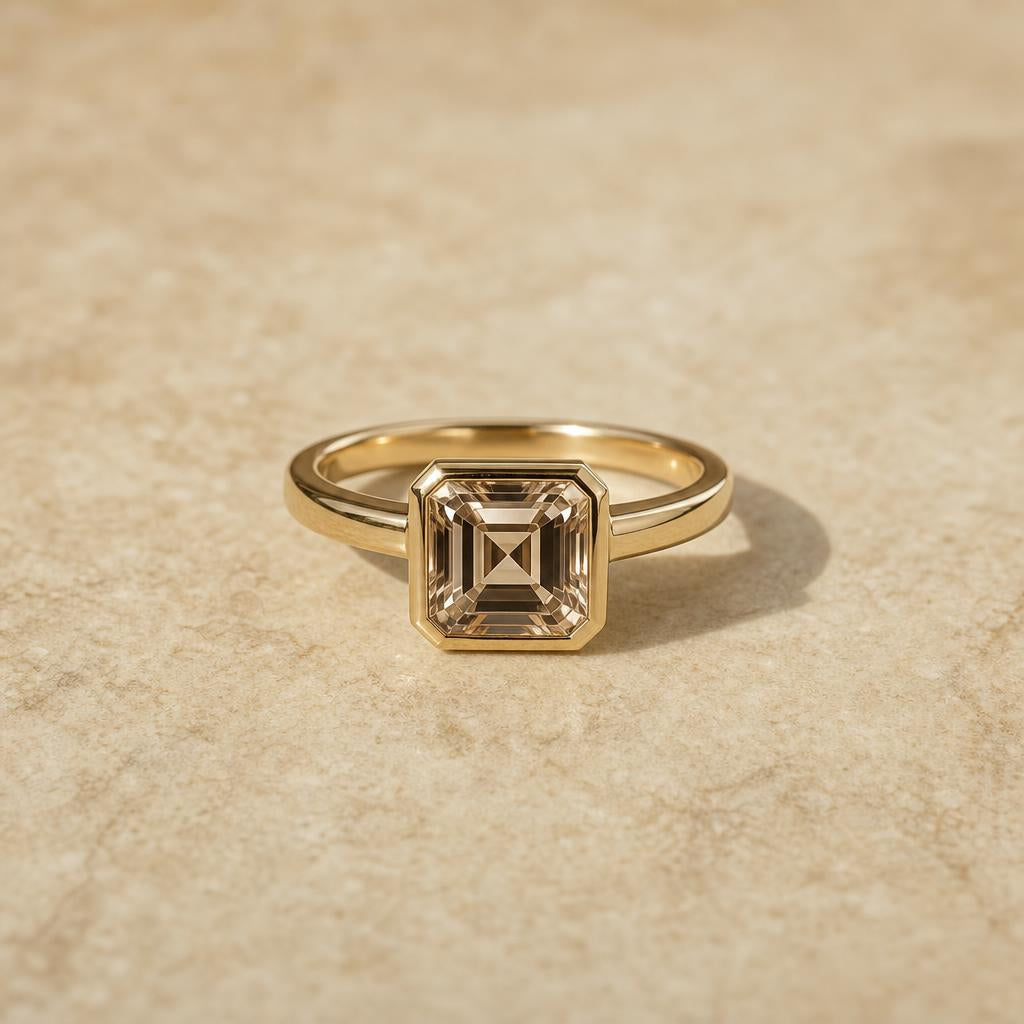
The Best Wedding Bands for an Asscher Cut Engagement Ring
An Asscher cut ring is one of the few shapes that actually changes the pairing rules. Its squared, deeply cropped corners and high crown don't behave like a round or oval stone — which is exactly why most generic "wedding band" guides leave you more confused than when you started.
If you already own or are considering an Asscher cut ring, here's the good news: choosing a wedding band for an Asscher cut engagement ring isn't complicated once you understand what the shape is actually doing on your hand. Before we get into that, here are four styles worth knowing — two Asscher cut rings, and two of the stacking bands that pair with them best.

Why the Asscher Cut Pairs Differently Than Other Shapes
Most engagement ring shapes are curved somewhere — a round brilliant has no straight edges at all, and even a pear or oval has a girdle that flows. The Asscher cut doesn't. It's a square step cut with cropped, octagonal corners, a high crown, and a table that sits flat and open. That geometry is what gives it the "hall of mirrors" effect everyone loves — but it also means a curved wedding band, the kind that hugs a rounded stone perfectly, often leaves a visible gap at the corners of an Asscher.
The fix isn't complicated. It just means starting from a different assumption than you would with a round or oval center stone: straight lines pair with straight lines, and curves are the exception here, not the default.
The Three Wedding Band Styles That Actually Work
Most searches on this topic surface the same three answers, because they're genuinely the styles that hold up against this shape's straight edges and high crown. Here's how each one actually behaves next to a real Asscher cut ring.
The Straight, Simple Band
A plain, straight-edged band is the safest and most classic choice for an Asscher cut solitaire. Because the ring's own band is typically straight and unadorned, a matching straight band sits flush against it with no gap and no visual competition — the stone stays the focal point. This is especially true when the Asscher solitaire sits on a simple, polished shank, where nothing about the profile calls for a curve.

The Échelon Ring
A 1.25 carat Asscher cut solitaire held in a clean four-prong setting on a polished band — the kind of straightforward silhouette that pairs cleanly with almost any straight band you already own or plan to add.
Shop The Échelon Ring →The Pavé or Eternity Band
An eternity or half-eternity band adds continuous sparkle without introducing a curve that fights the Asscher's angles. Because the stones sit low and even across the band, it reads as texture rather than shape — which means it doesn't need to physically contour around the center stone to look intentional. An Asscher cut eternity band, worn on its own or stacked beside the engagement ring, is one of the few ways to add brilliance to this shape without breaking its geometric line.

The Eternity Ring
A full circle of brilliance in a classic 2.0mm profile — worn solo, stacked next to an Asscher cut center stone, or layered into a larger collection, it never needs to match the shape it's sitting beside.
Shop The Eternity Ring →The Bezel Band
Bezel settings share the Asscher's architectural, clean-lined mood, which makes them a natural stylistic match even though they're not shaped to trace the stone's outline. Individually bezeled stones read as a series of small, contained squares of light — a rhythm that feels deliberate next to a step-cut center stone rather than accidental.
Worth knowing: Bezel bands sit slightly higher than pavé, so try both against your specific ring before committing — the right height depends on how high your Asscher's crown sits.

The Cherish Ring
Individually bezeled stones create a bubble effect around the finger, with each one held more securely than a traditional prong setting — a durable, low-profile option for everyday stacking.
Shop The Cherish Ring →What About a Curved or Contour Band?
Curved bands exist to solve one specific problem: a low-set, rounded stone that leaves a gap next to a straight edge. An Asscher cut ring rarely has that problem, because its own band is usually straight to begin with — so a curved band often solves a gap that was never there, while introducing a new one at the stone's sharp corners instead. If your setting is unusually low or your ring has an antique-style curved shank, a gently curved band can still work — just try it in person before buying rather than assuming it will behave the way it does with a round or oval stone.
If you want movement without a true curve, a crossover or woven design is a better middle ground. It reads as dynamic without asking the metal to bend around the stone's corners.

The Destiny Ring
Two delicate pavé bands cross and weave together, adding visual interest without the gap risk of a fully curved profile — an easy way to introduce movement next to a geometric center stone.
Shop The Destiny Ring →Matching Metal, Width, and Proportion
Once you've settled on a band style, three practical details decide whether the pairing actually looks intentional:
- Metal consistency. Keeping the same metal tone across both rings reads as considered rather than mismatched — a silver Asscher solitaire paired with a silver band wears and photographs as a single cohesive piece.
- Width proportion. A band that's too thin next to a bold 3-carat Asscher can look like an afterthought; a band that's too wide can compete with the center stone instead of supporting it. As a general rule, aim for a band within a millimeter or so of your engagement ring's own shank width.
- Setting height. A high-set solitaire, like a four-prong Asscher, gives a straight band more room to sit flush against the underside of the setting. A lower setting needs more care — and usually favors the straight or bezel styles above over anything curved.
✦ Pro tip: Try the pairing in person or with a printed-to-scale mockup before committing — the same band can look completely different next to a 1-carat solitaire versus a 3-carat three-stone setting.
If Your Asscher Has Side Stones
A three-stone Asscher — like a center stone flanked by baguette side stones — needs a band that clears the extra width at the base of the setting, not just the center stone itself. A straight band still works here, but it may need to sit slightly lower or narrower than it would next to a plain solitaire, simply because there's more metal and more stone real estate at the base of the ring to work around.

The Astrid Ring
A 3-carat Asscher cut center stone with two baguette side stones and unmistakable Art Deco presence — a bolder starting point that calls for a slightly more deliberate band pairing than a simple solitaire.
Shop The Astrid Ring →Asscher Cut vs. Emerald Cut: Does It Change the Band Logic?
The two get confused constantly, and it's worth clearing up before you shop for a band. An Asscher cut versus emerald cut comparison comes down to proportion: the Asscher is square, the emerald cut is rectangular, and the Asscher typically has a higher crown, which gives it a slightly more faceted, kaleidoscopic sparkle than the broader, glassier flashes of an emerald cut. For band-pairing purposes, the logic above holds for both shapes — straight and bezel bands are the safer starting point, curves are the exception — but an emerald cut's more elongated silhouette can sometimes tolerate a gentle curve that a true Asscher can't.
Can You Get an Asscher Cut Band in Moissanite?
Yes — and it's worth considering if you want the same fire and clarity in your band that you have in your center stone. An Asscher cut moissanite ring gives you that same architectural step-cut sparkle in a piece designed to be worn every day, without needing to match a diamond's price to get diamond-level presence on your hand.
Quick Takeaways
- Straight, pavé, eternity, and bezel bands all pair naturally with an Asscher cut ring's square, high-crowned profile.
- Curved bands solve a gap problem that Asscher rings rarely have — test in person before assuming you need one.
- Match metal tone and keep band width proportional to your center stone's scale.
- Three-stone Asscher settings need a band that clears the extra width at the base, not just the center stone.
Frequently Asked Questions
What does an Asscher cut ring actually symbolize?
The Asscher's concentric, step-cut facets are often read as a nod to structure and permanence — a deliberate, architectural choice rather than a maximalist one. It's less about symbolism in the traditional sense and more about choosing a shape that feels considered.
What's the real difference between an Asscher cut and an emerald cut?
Shape is the main difference — Asscher is square, emerald is rectangular. The Asscher also tends to have a higher crown and smaller table, which gives it a more concentrated, kaleidoscopic sparkle compared to the emerald cut's longer, more subtle flashes of light.
Why is the Asscher cut considered such a rare shape?
Its step-cut facets are unforgiving — they don't hide inclusions the way a brilliant cut does, and the proportions have to be precise for the "hall of mirrors" effect to actually read. That precision is part of why it's less commonly chosen than rounder, more forgiving shapes.
Does my wedding band have to match my engagement ring's metal exactly?
Not strictly, but it's the easiest way to make two separately chosen pieces read as one considered look. If you do want to mix metals, keep at least one element — like the stone setting style — consistent so the pairing still feels intentional rather than accidental.
Can I get an Asscher cut band in moissanite?
Yes. An Asscher cut moissanite band gives you the same step-cut sparkle as your center stone in a piece built for daily wear, and it pairs naturally with a moissanite or simulated diamond engagement ring since both throw light the same way.
What's the best wedding band for a solitaire Asscher ring?
A straight, simple band is the most reliable starting point for a solitaire setting — it sits flush against a typically straight shank and lets the center stone stay the focal point. From there, an eternity or bezel band are the next-best options if you want more sparkle or texture.
The Asscher cut asks for a slightly different approach than a round or oval center stone, but the logic is straightforward once you know what to look for: straight lines first, curves only when your specific setting calls for one, and metal and width kept in proportion. A well-chosen Asscher cut wedding band should never feel like an afterthought — it should look like it was designed for exactly this shape, even if you bought the two pieces months apart. Whether you're starting with a solitaire or a three-stone setting, the right band is less about finding something that matches perfectly and more about finding something that doesn't fight the shape you already love.


