

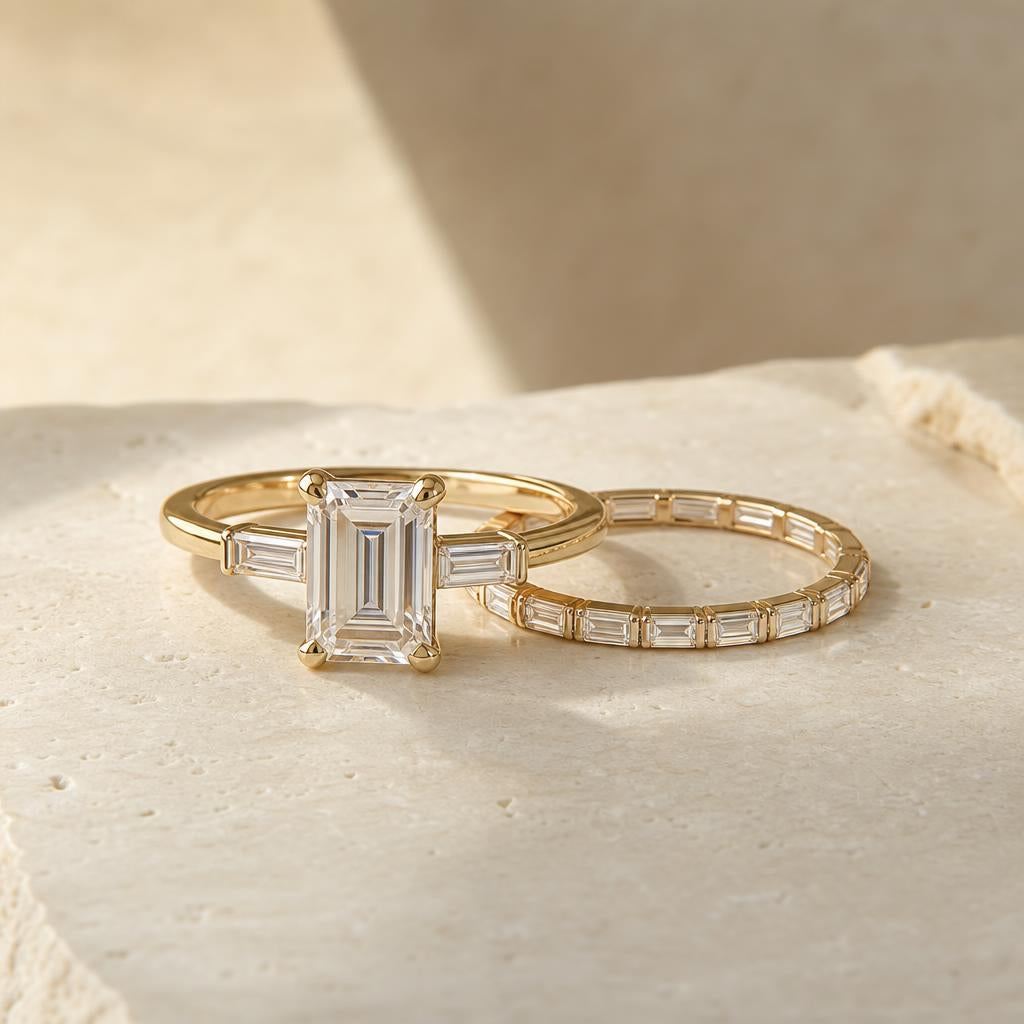
What Wedding Band Actually Works with an Emerald Cut Ring? A Shape-by-Shape Breakdown
Emerald cut rings are unforgiving in the best way. Their clean rectangular silhouette and step-cut facets demand a wedding band that respects the geometry — not one that fights it. Get the pairing right and the result is one of the most sophisticated ring stacks you can build. Get it wrong and you'll have a visible gap, a band that curves awkwardly away from the ring, or a stack that looks busy rather than considered.
This guide covers every band shape worth considering, the specific things to look for in each, and the styles that consistently work best alongside an emerald cut stone.


Why Emerald Cuts Are Different
Most engagement ring shapes — oval, round, pear, cushion — have curved bases. That curve creates a practical problem: the wedding band either needs to contour around the curve, sit flat with a gap at the bottom, or be custom-made to wrap precisely. None of these solutions are effortless, and all of them require thought.
An emerald cut ring is rectangular with straight sides. That changes the pairing problem entirely. A straight-sided band sits flush against a straight-sided stone. There is no curve to engineer around, no gap to fill. The challenge isn't fit — it's style. Specifically: does the band you choose complement the geometric, architectural quality of the step cuts, or does it detract from it?
Worth knowing: The term "emerald cut" refers to the cutting style — rectangular with step-cut facets arranged in parallel layers — not the stone colour. Emerald cut diamonds, moissanites, and simulated diamonds all share the same architectural silhouette and the same band-pairing logic.
The Bands That Work Best
Baguette eternity bands: the architectural match
If you want the single most visually coherent pairing for an emerald cut ring, this is it. Baguette stones are themselves rectangular, step-cut, and geometric. Placing a baguette eternity band alongside an emerald cut stone is the jewellery equivalent of choosing a typeface that matches the grid — it's the same visual language, scaled down. The result is a stack that looks intentional, not assembled from spare parts.
Baguette bands also have a significant practical advantage for emerald cut pairings: because the stones are rectangular and flat-topped, the band's profile is relatively slim without sacrificing coverage. It sits flush, reads as sophisticated, and doesn't compete with the large flat table of the centre stone.

The Devotion Ring
A full eternity band set with channel-set baguette stones. The rectangular stone shape mirrors the geometry of an emerald cut centre stone, making this the most architecturally coherent pairing in the Gemiros collection. Slim enough to sit flush, striking enough to wear alone.
Shop The Devotion Ring →Slim pave eternity bands: the reliable default
A slim pave eternity band — one continuous row of small round stones — is the most versatile wedding band choice for an emerald cut ring. It doesn't try to mimic the step-cut aesthetic, but it doesn't fight it either. The sparkle is subtle, the profile is narrow, and the flatness of the band's top surface respects the clean geometry of the centre stone rather than layering a competing visual texture over it.
The key word is slim. A narrow pave band in the 1.5–2mm range disappears beautifully against the larger scale of an emerald cut. A wider band risks making the stack look heavier and less precise. Emerald cuts reward restraint — the band should support the centre stone, not announce itself alongside it.
Of the pave eternity options in the Gemiros collection, the Everlasting Ring and the Infinity Ring are both strong choices. The Everlasting Ring has a seamless, continuous pave line; the Infinity Ring offers a subtly different stone arrangement that catches light from a slightly different angle — worth considering if you're planning to stack two bands.

The Infinity Ring
A pave eternity band with round simulated diamonds set continuously around the full circumference. The slim profile and even sparkle make this a highly versatile companion for any emerald cut ring — it doesn't compete, it completes. Works equally well as a single band or as part of a layered two-band stack.
Shop The Infinity Ring →Bezel set bands: the contemporary, architectural choice
A bezel set band replaces the classic prong-and-pave look with round stones encased in a continuous metal frame. Visually, it reads as more solid and geometric than pave — which makes it an interesting partner for an emerald cut. The two together have a distinctly modern, architectural quality that's different from the more traditional pave pairing, and increasingly popular with women who want a ring stack that looks designed rather than simply decorated.
Bezel settings also have a very flat, snag-free profile. If you work with your hands, wear gloves, or simply prefer a band that moves through the world without catching on things, a bezel eternity is a practical as well as aesthetic choice. The Cherish Ring sits low against the finger and doesn't raise above the surface of the ring it's paired with — exactly the quality you want when your centre stone is already a low, wide rectangle.
What About Curved or Contoured Bands?
Curved or contoured bands are designed to wrap around a rounded engagement ring base. An emerald cut doesn't have a rounded base — it has flat, straight sides. A curved band placed against a straight-sided ring will bow away from it at the bottom, leaving a visible gap that makes the stack look incomplete.
Some curved bands are cut so subtly that they're close to straight, and in those cases the gap can be minimal. But if you're buying a band specifically for an emerald cut ring, there's no reason to compensate for a problem that doesn't exist. Straight bands sit flush. Start there.
✦ A practical check: When shopping online, look for the band's profile view in product images. A straight band will have a flat inner edge; a curved band will have a visible arch. When in doubt, read the product description — curved bands are almost always listed as "contoured" or "curved" by the seller.
Width: How Narrow Is Too Narrow, How Wide Is Too Wide
Emerald cut rings vary enormously in scale. A narrow, elongated stone reads very differently from a wide, squat one — and the right band width shifts accordingly.
As a general principle, the band should be noticeably narrower than the width of the emerald cut's table (the flat top surface). If the table is 7mm wide, a 2mm pave band works beautifully. A 4mm band starts to compete. A 1mm band risks disappearing entirely. For most emerald cut rings, 1.5–2.5mm is the sweet spot for a single band. If you're stacking two bands, go slimmer still on each individual ring.
On stacking two bands: A baguette eternity on one side and a slim pave eternity on the other is one of the most elegant combinations you can build around an emerald cut ring. The two styles are complementary — one geometric, one classic sparkle — and together they frame the centre stone without overpowering it. The Devotion Ring paired with the Infinity Ring is a good starting point for this combination.
Metal Matching — and When to Mix
Emerald cut rings are most commonly set in white gold, silver, or platinum — the cool metal tones suit the clean, precise character of the step cuts. Wedding bands in the same metal read as a coherent, intentional set. Rhodium-plated sterling silver is a practical and affordable way to achieve this look: the Gemiros bands in silver are all rhodium-plated, which gives them the same bright white finish that matches white gold and platinum settings.
Mixed metals can work, but emerald cuts are less forgiving of this than round or oval cuts. The strong geometric silhouette draws attention to every detail of the stack, including metal contrast. If you're mixing metals deliberately, make it a visible styling choice — choose two bands, one in each metal, and let that contrast be clear rather than accidental.

The Forever Ring
A slim pave eternity band in rhodium-plated sterling silver. Round simulated diamonds set continuously around the full ring, no break in the sparkle. For an emerald cut ring in white metal, this is the clean, classic complement. Also available in 18k gold and rose gold for those planning a deliberate metal mix.
Shop The Forever Ring →What to Avoid
A few band types that consistently cause problems for emerald cut rings:
- Deeply curved contoured bands — they gap at the base and make the stack look unfinished
- Ornate, highly detailed bands — milgrain edging, floral motifs, vintage filigree — these tend to compete with the step-cut pattern of the emerald rather than complement it, creating visual noise where you want visual clarity
- Very wide bands (3mm and above) — unless your emerald cut is unusually large, a wide band overwhelms the careful proportions of the stone
- Bands with prominent raised settings — anything that raises noticeably above the shank will prevent the band sitting flush against the side of the engagement ring
Quick Takeaways
- Emerald cuts have straight sides — straight bands sit flush; curved bands gap
- Baguette eternity bands are the most architecturally coherent pairing (step cut meets step cut)
- Slim pave eternity bands (1.5–2mm) are the most versatile and widely flattering choice
- Bezel set bands offer a contemporary, clean alternative to classic pave
- Keep the band noticeably narrower than the emerald cut's table surface
- Rhodium-plated silver matches white gold and platinum at a fraction of the price
- Avoid contoured, ornate, or wide bands — precision and restraint are the guiding principles
Frequently Asked Questions
Does a wedding band have to sit perfectly flush against my emerald cut ring?
A flush fit looks the most intentional, but a very small gap isn't a problem — it can even protect the setting by preventing the rings from pressing against each other constantly. What to avoid is a large, visible gap caused by a curved band against a straight ring. If the gap is barely noticeable at rest, it's fine.
Can I wear the wedding band on the other side of my engagement ring?
Yes — and for some emerald cut rings, wearing the wedding band on the right side (closer to your fingertip) rather than the left (closer to your hand) can look more balanced, depending on whether your centre stone leans slightly asymmetric. Try both and see which feels right for your specific ring.
Is a baguette eternity band practical for everyday wear?
The main consideration with baguette bands is that the rectangular stones have exposed corners, which can theoretically snag on fabric more than round stones in a bezel or pave setting. In practice, a well-set channel baguette band — where the stones sit within a metal channel rather than above it — is quite snag-resistant. The Devotion Ring uses channel-set baguettes, which keeps the profile smooth and practical for daily wear.
How many bands can I stack with an emerald cut ring?
Two bands — one on each side — is the most common and most elegant arrangement for an emerald cut. Three is possible if the bands are very slim (under 1.5mm each) and the emerald cut is a larger stone. Beyond three, the stack starts to overwhelm the centre stone and lose the architectural clarity that makes an emerald cut distinctive in the first place.
The emerald cut rewards precision in every detail — and that extends to the band you choose to wear with it. The good news is that the geometry largely solves the problem: straight sides, straight band, flush fit, architectural pairing. The choice comes down to whether you want the band to echo the step-cut aesthetic (baguette), be quietly present (slim pave), or make a clean, modern statement of its own (bezel). Any of those three choices will look exactly right.


