

Wedding Bands for Three-Stone Engagement Rings: What Actually Clears the Extra Width
A three-stone ring does something a solitaire never has to: it takes up space. Two side stones flare the setting wider at the base, which means the wedding band you picked out for a single round stone often doesn't sit right next to it — there's a gap where the metal curves away, or the band rides up over the side stones instead of nesting beside them. It's not a style problem. It's a width problem, and it has an actual answer.
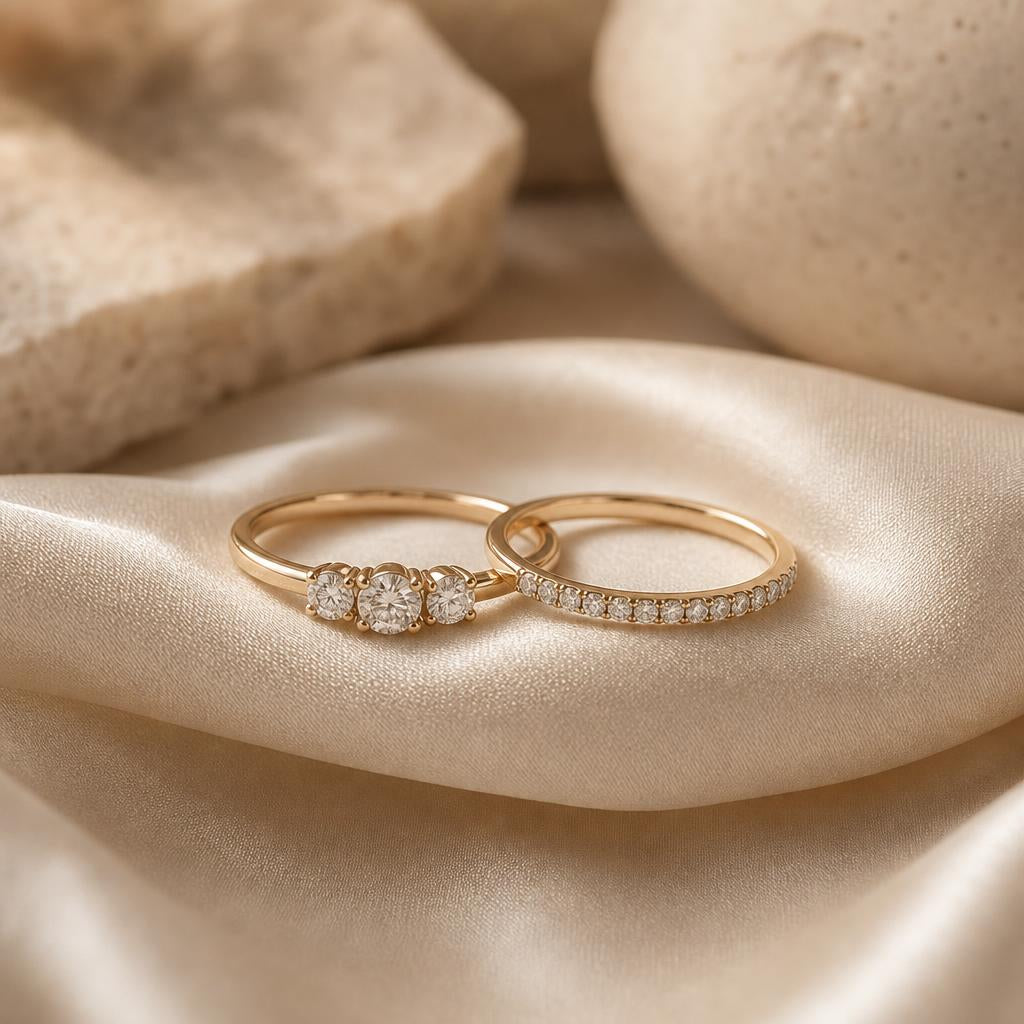
Before you get into settings and profiles, it helps to see what a well-built three-stone ring looks like next to the pieces designed to stack with it — so here are four to start with.


Why Three-Stone Engagement Rings Stack Differently
A solitaire is one stone sitting on a shank of fairly consistent width. A three-stone setting is three claims on that same finger space — a center stone plus two side stones, usually held in their own prongs or a shared gallery, which means the ring is physically wider where it meets the base of your finger than a single-stone setting of comparable size. That width doesn't disappear once the ring is on. It's what any band you add has to work around.
This is also the reason a side stone engagement ring reads as more substantial on the hand than its carat count alone would suggest — the side stones extend the visual line of the ring outward, which is exactly why they're popular in the first place. The tradeoff is that a straight, uncurved band pushed up against that width usually leaves a visible triangle of empty space at the base, right where the eye lands first.
Worth knowing: the gap isn't a manufacturing flaw in either ring — it's simple geometry. A straight band is a straight line; a three-stone setting curves outward at the base. Two different shapes don't meet flush unless one of them is built to bend toward the other.
Curved and Flush-Fit Bands: The Straightforward Fix
The most reliable way to close that gap is a band with a built-in curve — sometimes called a contour or shadow band — shaped to trace the outline of the three-stone setting instead of running straight across it. Because the curve is cut into the band itself, it tucks directly under the side stones rather than butting up against them, which is what actually eliminates the visible gap rather than just minimizing it.
If a curved band isn't available in the style you want, a slim, low-profile pavé band is the next best option — the thinner the band, the less width it needs to clear, and the less noticeable any small gap becomes. The Everlasting Ring's continuous line of pavé stones was built with exactly this kind of stacking in mind: a 3mm band slim enough to sit close to a wider setting without competing with it.

The Everlasting Ring
A continuous line of pavé-set simulated diamonds on a slim 3mm band — low profile enough to sit close against a wider three-stone setting instead of leaving daylight underneath it.
Shop The Everlasting →When a Straight Band Actually Works
Not every three-stone setting needs a curved band. If the side stones sit low and close to the finger rather than raised on their own prongs, or if the ring has a slightly domed profile that naturally leaves breathing room at the base, a straight half-eternity band can sit beside it without issue. This is worth checking before you assume you need a custom-curved piece — sometimes the simplest option is also the correct one.
A slim, unfussy stacking band also does something else worth considering: it lets the three-stone ring stay the visual focus. The Forever Ring's half-eternity pavé design is deliberately understated for this reason — a stacking piece that adds sparkle without pulling attention away from the ring it's sitting next to.

The Forever Ring
A half-eternity pavé band, straight and understated — the right call when your three-stone setting already sits close enough to the finger that a curve isn't necessary.
Shop The Forever Ring →Matching the Architecture: Baguette and Step-Cut Bands
Round pavé isn't the only route. If your three-stone ring leans architectural — sharper lines, a more graphic silhouette — a baguette-cut band tends to read as a more intentional pairing than a soft round-stone band would. The straight edges of a baguette echo the geometry of a radiant, emerald, or asscher center stone instead of contrasting with it, which is part of why baguette eternity bands have become such a fixture in stacking guides lately.
The Devotion Ring takes this approach with a full circle of baguette-cut stones — a band with enough visual weight to hold its own next to a three-stone setting rather than disappearing beside it.

The Devotion Ring
A continuous circle of baguette-cut simulated diamonds — a sharper, more architectural stacking option for a three-stone ring with strong linear lines.
Shop The Devotion Ring →Pairing With a Vintage-Style Setting
If your three-stone ring has a vintage or heirloom-inspired profile — milgrain edging, a slightly raised gallery — a band that matches that detailing will read as a set rather than two separate purchases. A plain, modern pavé band next to a vintage-styled three-stone ring can look like an afterthought; matching the era of the design, even loosely, tends to look considered instead.

The Beloved Ring
A vintage-influenced eternity band with a softer, more detailed profile — built to complement a three-stone ring that already leans toward heirloom styling.
Shop The Beloved Ring →Getting the Fit Right Before You Buy
A few practical things to check before you commit to a pairing:
- Look at the gallery, not just the top of the ring. Two three-stone rings with similar-looking center stones can have very different base widths depending on how the side stones are set. Check the ring from the side, not just from above.
- Order your usual size in both pieces. Gemiros rings run in whole sizes only, so there's no half-size adjustment to compensate for a slightly tight or loose stack — get your primary ring's fit right first, then size the band to match.
- Try before you commit to a curved piece. A contour band is shaped for stacking, which means it's a less flexible fit on its own. If you think you might ever wear it separately, weigh that against how much you want the flush look.
- Don't assume a gap is a dealbreaker. A small, even gap on both sides can look intentional — it's an uneven or one-sided gap that tends to read as a mismatch.
Quick Takeaways
- Three-stone rings are wider at the base than solitaires — that's geometry, not a flaw.
- Curved or contour bands close the gap directly; slim, low-profile bands are the next best option.
- Match the material: baguette bands for architectural settings, vintage-detailed bands for heirloom-style rings.
- Check the ring from the side before choosing a band, and size the primary ring first.
Frequently Asked Questions
What wedding band goes well with a three-stone engagement ring?
A curved or contour band designed to trace the shape of the setting is the most reliable option, since it eliminates the gap left by the side stones rather than just minimizing it. If a curved piece isn't available, a slim, low-profile pavé band is the next best choice — the thinner the band, the less noticeable any gap becomes.
What are the side stones on a ring called?
They're simply called side stones, and a ring built around them — a center stone flanked by two smaller stones — is often described as a three-stone or trilogy setting. The stones themselves are usually named by their cut: heart, pear, baguette, or round, depending on the design.
Are three-stone rings still in style, or are they outdated?
They're solidly in style — three-stone settings have stayed a mainstay because the design does something a solitaire can't: it adds visual width and sparkle without needing a larger center stone. What has changed is the framing, from a strictly symbolic "past, present, future" story toward simply being a striking, wearable shape.
Are three-stone rings more expensive than solitaires?
In fine jewelry, yes, generally — more stones means more cost. That math doesn't apply the same way here: every Gemiros three-stone ring is priced the same as our solitaires, because the price is set by the design rather than by mined-diamond carat weight.
What does a three-stone ring symbolize?
The traditional reading is past, present, and future — the three stones representing a relationship's timeline. Plenty of women choose the style purely for how it looks on the hand, and both reasons hold up equally well.
How big should the side stones be on a side stone ring?
Side stones are typically a fraction of the center stone's size — large enough to add visible sparkle and width, small enough that the center stone still reads as the focal point. If the side stones start to rival the center stone, the ring shifts from a three-stone setting into a different look altogether.
A three-stone ring was never going to pair with just anything — it takes up real space on the hand, and the band that joins it should be chosen with that in mind rather than picked for looks alone. Get the width right first. Everything else, from metal tone to stone cut, is the easy part.


