

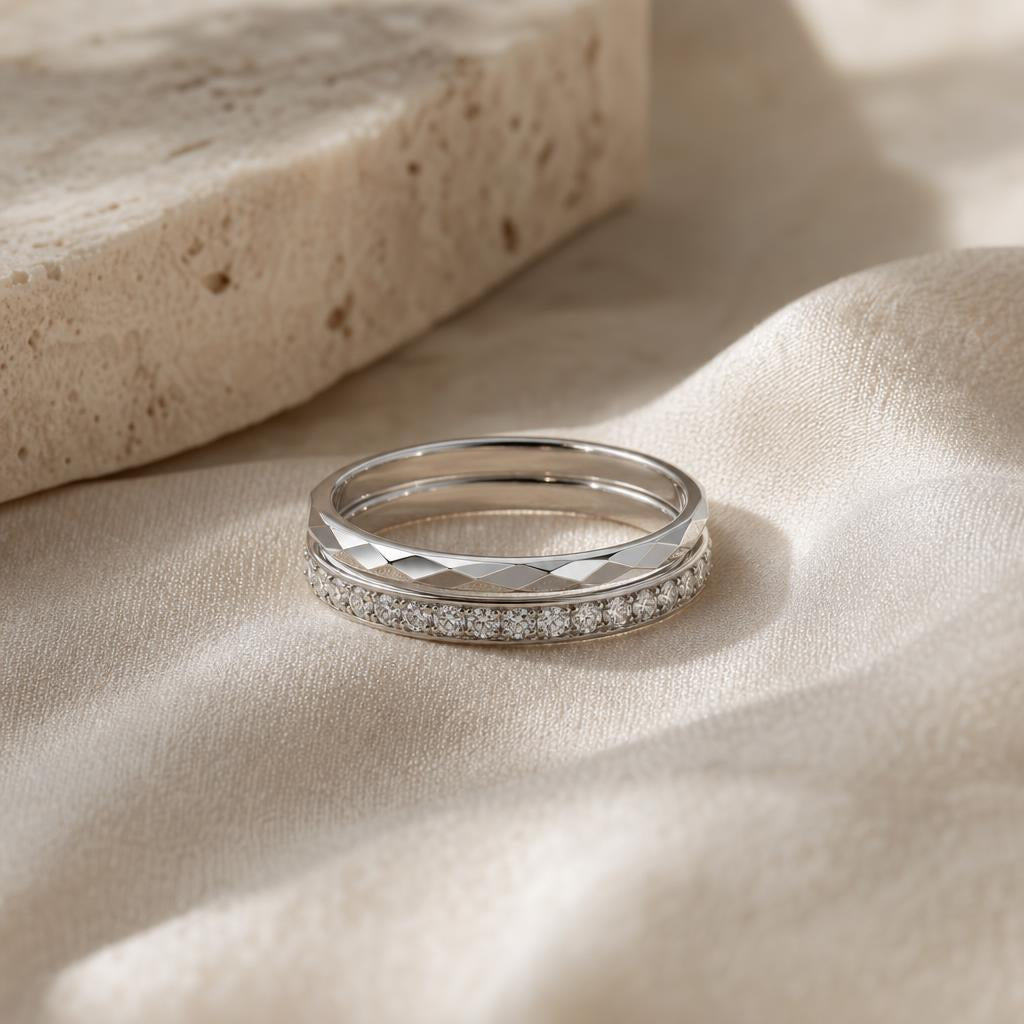
Wedding Bands for a Solitaire Ring: How to Stack Without Losing the Stone
A solitaire ring is the one style that was never trying to do too much. One stone, one setting, nothing else asking for attention — which is exactly why, the moment you start thinking about a second ring, it feels like the riskiest thing you could add to your hand.
The good news: a solitaire is actually the easiest shape to build a stack around. There is no halo to clash with, no side stones to dodge, no oversized setting fighting for space. The right wedding band for a solitaire ring doesn't compete with the center stone — it just gives it somewhere to rest.


Why the Solitaire Is the Easiest Shape to Stack
Every other ring style comes with a built-in constraint. A halo needs a band that won't crowd the outer ring of stones. A three-stone setting needs a band that clears the side stones without leaving a gap. A solitaire has none of that. It's a single stone on a plain shank, which means almost any band will physically fit around it — the real decision is about proportion and personality, not engineering around a complicated setting.
That flexibility is also why it's easy to overthink. Without a setting dictating the answer, you're choosing purely on how the two pieces will look and wear together for years, not just the day you buy them.
The Band Styles That Actually Work With a Solitaire
Flush, Straight Bands
If your solitaire sits high off the finger — a classic 4-prong setting with real clearance underneath — a straight, unadorned band slides right beneath it and sits flat, no fitting required. This is the pairing that reads as one continuous line rather than two separate rings, and it's the lowest-maintenance option: nothing to notch, nothing to match up, nothing that can shift out of alignment over time.
Curved and Contour Bands
Lower-set solitaires — or anyone who wants a slightly closer fit — usually do better with a curved wedding band. The dip in the band's profile follows the base of the setting instead of butting against it, which closes the visual gap that a straight band would leave. It's a small structural difference that changes how "finished" the whole hand looks.
Pavé and Delicate Eternity Bands
This is where most solitaire stacks actually land, because it adds sparkle without introducing a second focal point. A slim pavé or eternity band sits quietly behind the center stone instead of trying to out-shine it. The Everlasting Ring, shown above, is built exactly for this — a continuous line of pavé stones that reads as texture, not as a competing centerpiece.

The Infinity Ring
A crossover pavé band with just enough movement to feel intentional next to a plain-shank solitaire, without adding visual weight.
Shop The Infinity Ring →Baguette-cut bands are the outlier worth knowing about. Their sharp, rectangular facets read as more architectural than a round pavé band, which gives a classic round or oval solitaire a slightly more modern edge without changing what the center stone is doing. It's a small styling decision that shifts the whole stack from "traditional" to "considered."
Worth knowing: A solitaire engagement ring with a wedding band doesn't need to match its metal tone exactly. A warm gold band under a platinum-look solitaire can read as intentional layering rather than a mismatch — as long as the proportions line up.
Does the Solitaire's Shape Change the Band?
A little, though less than most guides suggest. A round solitaire, like the Stella above, is symmetrical from every angle, so a straight band sits flush against it no matter how the ring turns on the finger. An oval solitaire — the Odette's 3.5 carat cut is a good example — has a longer footprint along the shank, which means the band sitting closest to it has a bit more surface to work with, and slightly more room for a delicate pattern or texture to show.
Neither shape forces a particular band style. It's more that an oval gives you a little more visual real estate to play with if you want the second ring to do more than just sit quietly, while a round solitaire tends to look most finished when the band is kept simple and lets the stone do the talking.
Getting the Proportions Right
Width is the detail that decides whether a stack looks composed or accidental. A delicate solitaire on a thin shank gets overwhelmed next to a wide, heavy band — the eye goes to the band instead of the stone. A larger stone can carry more visual weight, which is why a wider stacking band ring or even a double band can work once the center stone is substantial enough to hold its own next to it.
Profile height matters just as much as width. High-set solitaires give a straight band room to sit flat underneath. Low-set solitaires need either a curved band or a slightly thinner one, so the two pieces don't fight for the same sliver of space on the finger.
The Order You Wear Them In
There's no rule that determines this, only convention — and most women land on one of two approaches without ever thinking too hard about it. The classic order puts the band closest to the heart, with the solitaire worn on top, which is why it's usually the first ring slipped on in the morning. Reversing the order, with the solitaire underneath, is just as common and arguably better for anyone who wants the center stone protected from daily knocks.
✦ Pro tip: Before buying a second ring, try the effect with a plain paper spacer cut to the width you're considering. It won't tell you about sparkle, but it will tell you almost everything about proportion — which is the part that's actually hard to picture from a photo.
What to Avoid When Building a Solitaire Stack
The most common mistake isn't choosing the wrong band style — it's choosing too many at once. Building an engagement ring stack in stages, adding one considered piece at a time, almost always looks more deliberate than assembling three bands in a single order and hoping they read as a set. A solitaire's whole appeal is restraint, and a stack that respects that tends to age better than one that tries to do everything on day one.
The second mistake is sizing bands independently instead of trying them together. A band that measures perfectly on its own can still sit awkwardly once it's next to the solitaire — checking fit as a pair, not as separate purchases, is worth the extra step.

The Destiny Ring
Two delicate pavé bands that cross and meet — a softer, more detailed option for anyone building a stack in stages rather than all at once.
Shop The Destiny Ring →None of this requires solid gold or a mined stone to get right. Every band above is 925 sterling silver set with moissanite — indistinguishable from a diamond stack, and priced so that building it in stages is actually realistic instead of a five-year plan.
Quick Takeaways
- A solitaire's plain shank makes it the easiest shape to stack — almost any band will physically fit.
- Straight bands suit high-set solitaires; curved or contour bands suit low-set ones.
- Pavé and eternity bands add sparkle without competing with the center stone.
- Match visual weight to stone size — thin bands for delicate stones, wider bands once the stone is substantial.
- Build the stack in stages and size pieces together, not separately.
Frequently Asked Questions
What wedding band works best with a solitaire?
There isn't a single answer, but the decision usually comes down to profile height: a straight, flush band works best when the solitaire sits high off the finger, while a curved or contour band suits a lower setting. From there, it's a matter of how much sparkle you want the band itself to add.
Do you wear the wedding band or the solitaire closer to your heart?
Convention puts the band first, closest to the heart, with the solitaire worn on top — but plenty of women reverse it so the center stone sits underneath and is better protected from daily knocks. Both are common; neither is "correct."
Are there any real rules for stacking rings?
Not formal ones — the closest thing to a rule is proportion: keep visual weight balanced between the stone and the bands around it, and avoid crowding a delicate solitaire with something too wide or too busy. Past that, it's personal preference.
Does a wedding band have to match the solitaire's metal exactly?
No. A warm-toned band under a cooler-toned solitaire can look like deliberate layering rather than a mismatch, as long as the width and profile are proportioned to sit well together. Matching metals is the safer choice, but it isn't the only one that works.
Can I add a second band later instead of buying the whole stack at once?
Yes — building a stack in stages is a common approach and often looks more considered than assembling several bands at the same time. Just try each new addition against the pieces you already wear before committing, so the proportions still line up.
A solitaire never needed anything added to look finished — that was the point of choosing it. But when you do want to build on it, the addition should feel like it was always part of the plan: quiet, proportioned, and entirely on your terms.


