

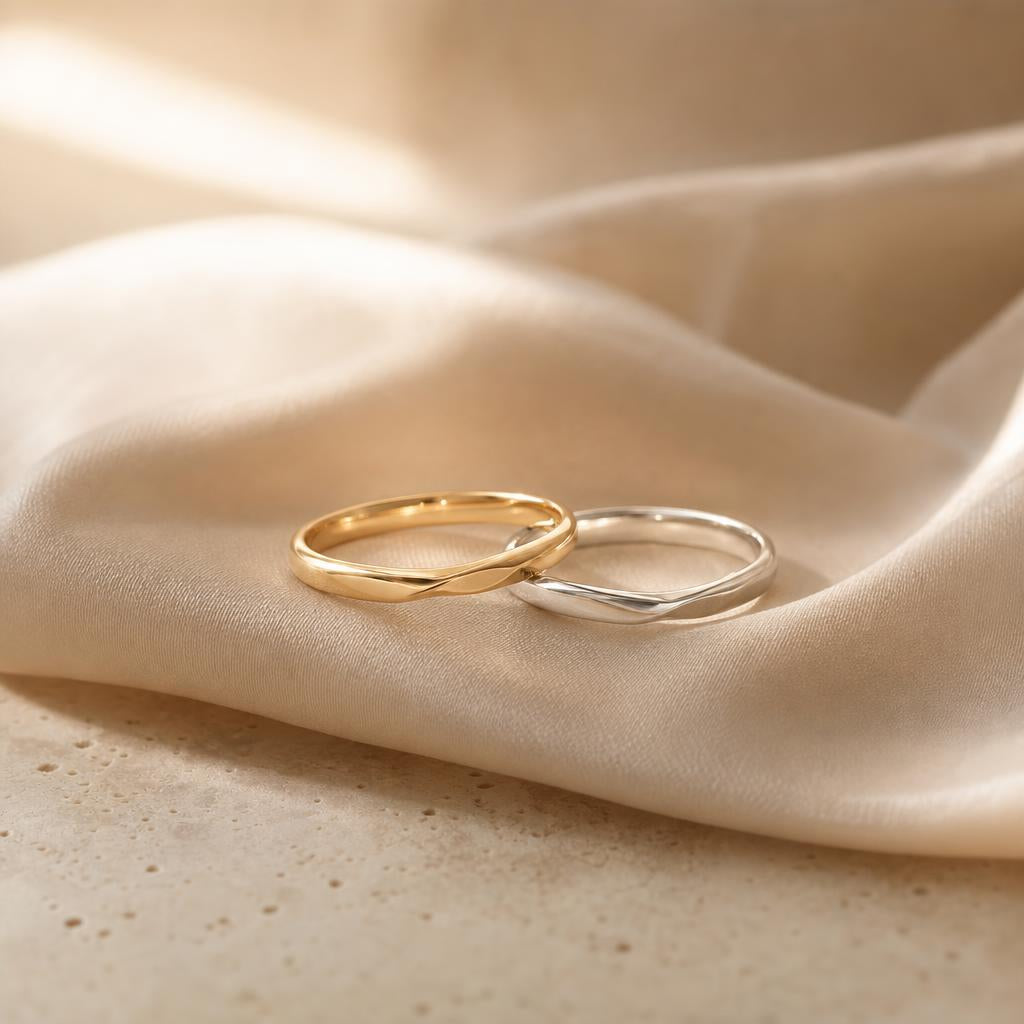
Wedding Bands for Solitaire Rings: A Complete Pairing Guide
A solitaire is the one engagement ring style that never boxes you in. No side stones to clash with, no halo to compete with a band's sparkle — just a single stone and a plain shank, which means the wedding band decision is entirely yours to make. That freedom is exactly why so many women stall out at this step: when almost anything works, "almost anything" doesn't feel like enough of an answer.
Here's the shortcut. The right wedding bands for solitaire rings come down to three questions — how your center stone sits, how you want the metal to read, and whether you're building a stack now or leaving room to add later. Answer those, and the options narrow fast.


Why solitaires are the easiest ring to build a stack around
A halo has a silhouette to protect. A three-stone ring has side stones that dictate width. A solitaire has none of that — just a single stone lifted above a clean shank. That's not a limitation; it's the whole advantage. There's nothing for a new band to clash with, which is exactly why a solitaire engagement ring with wedding band pairing rarely goes wrong the way more ornate settings can.
The decision that actually matters isn't "will this look good" — almost every option will. It's "will this fit the way I wear my hand." That comes down to four real choices.
1. The classic plain band
A smooth, high-polish or brushed band in the same metal tone is the safest and, honestly, the smartest default. It doesn't compete with the center stone, it doesn't date, and it reads as considered rather than an afterthought. If you want your solitaire to stay the obvious star, this is it.
2. The pavé band
Small stones set edge to edge add continuous sparkle without introducing a second focal point. This is the pairing that makes the most sense if your solitaire already has pavé shoulders — like the Soleil or the Solis — since the band simply continues a detail your ring already has, rather than introducing a new one.
3. The curved or contour band
If your solitaire sits low, a straight band will hit the underside of the setting and leave a visible gap. A curved or notched band is cut to dip around the base of the stone so the two rings sit flush, with no light showing through the seam. This is a fit question, not a style question — check how high your setting sits before you assume a straight band will work.
4. The eternity or half-eternity band
For a stack with more visual weight, a full or half circle of stones reads as a deliberate second layer rather than a supporting piece. It's the option worth considering if you already know you want more sparkle in the stack eventually, rather than adding it one thin band at a time.
Worth knowing: Solitaire settings vary in how high they sit. A high 4-prong or 6-prong head often needs a curved band to close the gap; a lower-set stone usually clears a straight band without issue. Try the band against the ring before assuming either will work.
Two of the most useful stacking pieces for this exact situation are built around continuous sparkle rather than a single accent stone — which is what makes them so versatile against almost any solitaire.

The Everlasting
A continuous line of round brilliant stones that reads as a finished second layer rather than a filler piece — built for a stack with real presence.
Shop The Everlasting →
The Forever
A pavé half-eternity band that sits low and slim — the quiet option for anyone who wants a second layer without asking a solitaire to share the spotlight.
Shop The Forever →What actually changes with a round solitaire
Round brilliant is the most common solitaire shape, and it's also the most forgiving — a wedding band for round engagement ring pairing has more built-in flexibility than almost any other cut, because there's no elongation or pointed tip to work around. A round center stone sits symmetrically on the finger, which means a straight band, a curved band, or a full eternity band will all sit evenly on either side without one edge looking more crowded than the other.
The one variable still worth checking is prong height. A 6-prong setting — like the Soleil — tends to sit slightly higher than a 4-prong solitaire, which can mean the difference between a flush fit and a small gap. If you're shopping wedding bands with round solitaire settings specifically, that prong count is worth confirming before you commit to a straight band.
Metal matching, without overthinking it
Keeping the metal tone consistent between your solitaire and its band is the simplest way to make two separately purchased rings read as one considered set. It also protects softer metals from the friction of two different alloys rubbing against each other daily. That said, matching isn't a rule you have to follow — a warm gold band next to a cool white metal solitaire can look entirely intentional if the rest of your jewelry already mixes tones. The only real mistake is an unplanned mismatch, not a deliberate one.
✦ Pro tip: If you're not sure whether you want to commit to a full stack yet, start with one band you're confident about — a plain metal band or a pavé piece that echoes your solitaire's shoulders — and build from there. It's easier to add a second layer later than to unwind three rings you bought all at once.
Getting the band width right
Width is the detail that's easiest to get wrong and hardest to notice until the rings are already on your finger. A delicate 1.5mm solitaire shank paired with a wide, chunky band tends to look like two separate decisions rather than one considered set — the thin ring disappears next to the bold one. The reverse causes the opposite problem: a substantial solitaire can make an ultra-thin band look like an afterthought, barely there at all.
A useful starting point is proportion rather than a fixed number. If your solitaire's shank is on the delicate side, look for a band within a millimeter or so of that width, whether it's a plain metal piece or a pavé line. If your center stone is large and the shank reads substantial, a slightly wider or more textured band — think baguette accents or a bolder pavé width — holds its own instead of getting lost. Try rings on together rather than judging width from a listing photo alone; the same measurement can read very differently once it's actually on your hand.
Building the stack in the right order
Most women layer the wedding band closest to the base of the finger, with the solitaire sitting above it — the reverse of how it's worn on the actual wedding day. Whatever order you land on, the goal is the same: each ring should look like it was chosen for the one next to it, not just tolerated by it.
Quick Takeaways
- A solitaire's plain shank means almost any band style will work — the real question is fit, not style.
- Check your setting height first: a high prong head usually needs a curved or notched band to sit flush.
- Pavé bands echo a solitaire's existing shoulders; eternity bands add more visual weight to the stack.
- Round solitaires are the most forgiving shape to pair, though prong count still affects fit.
- Matching metals is the safer default, but a deliberate mix can look just as considered.
Frequently Asked Questions
What wedding band goes best with a solitaire engagement ring?
A plain metal band in a matching tone is the safest choice, since it won't compete with the center stone. Pavé and curved contour bands are close seconds — pavé if your solitaire already has detail on the shoulders, curved if the setting sits low enough that a straight band would leave a gap.
Do I need to match the metal between my solitaire and its wedding band?
It's the simpler path and protects both rings from wearing unevenly against each other, but it isn't mandatory. A deliberate metal mix — rose gold against a white metal solitaire, for example — can look considered rather than mismatched if the rest of your jewelry already leans that way.
How do I know if I need a curved band instead of a straight one?
It comes down to how high your solitaire's setting sits. A high 4-prong or 6-prong head often leaves a visible gap under a straight band, while a lower-set stone usually clears one without issue. Hold a straight band up against the base of your ring before you buy — the gap, if there is one, is easy to see.
Are solitaire engagement rings still a popular choice?
Yes — the solitaire remains the most requested engagement ring style precisely because of this flexibility. It photographs cleanly, it wears comfortably day to day, and it leaves every future stacking decision open rather than locked in at the time of purchase.
What order should I stack my rings in?
There's no fixed rule, but most women wear the wedding band closest to the hand with the solitaire above it. The more important standard is visual: each ring should look chosen alongside the others, not just added on top.
A solitaire never asks you to decide everything on day one. Start with one band that feels obviously right, live with it, and let the rest of the stack build itself when you're ready — not before.


