

Wearing Multiple Rings on the Same Finger: When It Works and When It Doesn't
There's a moment every ring-lover hits: you own more than one, and you start wondering whether they can live on the same finger. Not stacked around your engagement ring — actually layered, two or three bands sharing a single finger, close enough to catch each other when you move your hand. Done well, it reads as effortless, like the rings arrived together. Done carelessly, it reads as clutter. The difference isn't luck. It comes down to a handful of decisions about width, profile, and restraint that are easy to get right once you know what to look for.
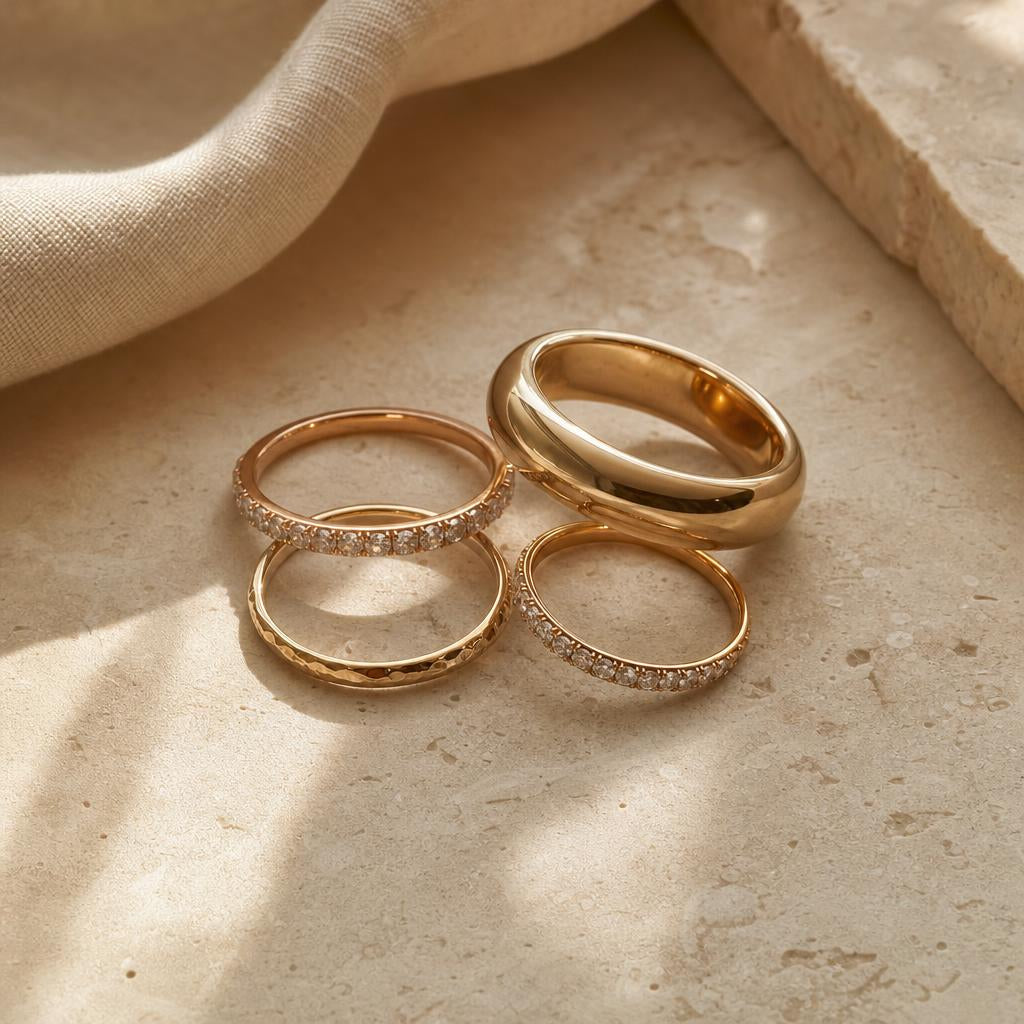
Before we get into the mechanics of a good multi-ring look, it helps to see the kind of pieces that actually make this easy — bands built with stacking in mind, not adapted for it after the fact.


Stacking vs. Loading: There's a Real Difference
Stacking multiple rings on one finger and simply piling on jewelry look similar from a distance, but they read very differently up close. A stack works because each ring was chosen with the others in mind — widths that step down or hold steady, metals that relate to each other, and enough visual breathing room that your eye can still separate one band from the next. A "loaded" finger happens when rings get added one at a time, for one reason at a time, with no plan for how they'll sit together. Nothing is wrong with any single ring in that scenario — the problem is that they were never introduced to each other.
The good news is that the fix isn't about buying fewer rings. It's about being deliberate with the handful you already reach for, and understanding a few practical rules before you add a new one to the mix.
Which Fingers Actually Handle Multiple Rings Well
Not every finger is a good candidate for layering, and that has more to do with anatomy than style. The ring finger and middle finger tend to have the most even width from base to first knuckle, which means two or three slim bands can sit close together without one riding up over another. The index finger, by contrast, often tapers more sharply, so a stack that looks flush at the base can gap noticeably higher up.
The pinky is a genuinely underused option for a single statement band paired with nothing else — it rarely has the width to support more than one ring comfortably, and trying to force a stack there is one of the most common ways a multi-ring look starts to feel cluttered rather than considered.
Worth knowing: A stack that looks perfect standing still can shift the moment you make a fist or type on a keyboard. Try any new combination through a full range of daily movements — not just holding your hand up to the mirror — before deciding it works.
Width and Profile Matter More Than the Rings Themselves
This is the single biggest factor separating a stack that looks intentional from one that doesn't, and it's the one people skip past fastest. Two rings of nearly identical width sitting side by side tend to blur into one thick, indistinct band — you lose the individual character of each piece. The stacks that photograph and wear the best almost always have some variation: a slim pavé band next to a slightly bolder eternity piece, or a low-profile ring paired with one that has a touch more dimension, like a bezel setting. Profile is just as important as width. A domed band and a flat band sitting next to each other can catch and drag on one another throughout the day, which is uncomfortable and, over time, can visibly wear down plating. Pieces with a similarly rounded or flat profile tend to nest together more naturally and move as a unit rather than fighting each other.

The Devotion Ring
A baguette-cut eternity band with a distinct architectural edge — the kind of piece that gives a stack real contrast instead of blending into the rings around it.
Shop The Devotion Ring →Do the Metals Have to Match Exactly?
Not as strictly as most people assume. What matters more than an exact metal match is a consistent undertone — cool tones (sterling silver, white gold, platinum-look finishes) generally sit well together, and warm tones (gold vermeil, rose gold, yellow gold) do the same. Mixing across those two groups is a deliberate style choice that can look sharp when it's intentional and confused when it happens by accident, ring by ring, without ever stepping back to look at the whole hand.
If you're building a stack from scratch and want the lowest-effort path to something that looks put together, start within one metal tone. You can always add a mixed-metal piece later once you know how the base stack behaves — it's much easier to introduce contrast to a settled foundation than to fix a stack that never had one.
How Many Rings Is Actually Too Many?
There's no universal number, but there is a useful test: can you still identify each individual ring when you look at your hand from a normal conversational distance — not a macro photo, just how someone would actually see it across a table? If the answer is yes, you're probably fine. If your stack reads as a single solid mass of metal and sparkle, it's grown past the point where the individual pieces are doing any work.
For most hands, two to three rings on a single finger is the practical ceiling before comfort and visual clarity start to suffer. That's not a design rule so much as a physical one — beyond three slim bands, most fingers simply don't have the flat, even real estate left to support another ring sitting flush.
✦ Pro tip: If you're not ready to commit to a permanent combination, build your stack with pieces you can also wear solo. That way each ring earns its place in your rotation on its own, and the stack becomes a bonus rather than the only way any single piece works.
A Simple Framework for Building Your Own Combination
If you're starting from nothing, work in this order rather than buying rings one at a time as they catch your eye:
- Pick your anchor. Choose the ring you'll wear the most — often the one with the most presence or sentimental weight. Everything else gets built around it.
- Add one contrast piece. A different width or setting style than your anchor, in the same metal tone, so it reads as a deliberate pairing rather than a duplicate.
- Test it for a full week before adding a third. Wear the two-ring combination through real days — typing, cooking, exercising — before deciding whether there's room for another band.
- Only then consider a third. If the first two still feel distinct from each other after a week of daily wear, a slim third piece is usually safe to add.

The Eternity Ring
A continuous line of pavé stones designed to sit flush against another band — a dependable third piece once your stack is ready for one.
Shop The Eternity Ring →None of this is about rules for their own sake. It's about giving each ring you love enough room to still look like itself once it's sharing a finger with something else — which, in the end, is the whole point of wearing more than one in the first place.
Quick Takeaways
- The ring and middle fingers handle multi-ring stacks best; the index taper and the pinky's narrow width make both harder to layer well.
- Vary width and profile between rings — near-identical bands blur together instead of reading as distinct pieces.
- Match undertone (cool vs. warm) more than exact metal for the easiest, lowest-effort cohesive look.
- Two to three slim bands per finger is the practical ceiling for most hands before comfort and clarity both suffer.
- Build in order — anchor, then contrast, then test for a week before adding a third.
Frequently Asked Questions
Can I stack rings from different collections, or do they need to be designed as a set?
They don't need to be designed together. What matters is that they share a consistent metal undertone and that their widths and profiles create some contrast rather than duplicating each other. Plenty of the best-looking stacks are assembled piece by piece over time, not bought as a matched set.
Will stacking multiple rings on one finger damage them over time?
Rings with mismatched profiles — a sharply domed band next to a flat one, for example — can rub against each other and gradually wear down plating faster than a ring worn alone. Choosing pieces with similar profiles and avoiding stacks that pinch or catch on daily movement will keep the wear even.
Is it better to stack on one finger or spread rings across several fingers?
Both work, and they create different effects. Stacking on one finger reads as a single, intentional statement piece. Spreading rings across several fingers reads more like a curated jewelry wardrobe on display. Neither is more "correct" — it depends on whether you want your hand to draw one focal point of attention or several smaller ones.
How do I know if my stack has gotten too tight to wear comfortably?
If you notice indentation marks on the skin after a few hours, difficulty making a full fist, or the rings feeling warm and tight by the end of the day, the stack is too snug for that finger. It's usually a sign to move one ring to a different finger rather than force the combination to work.
Should my engagement ring be part of the stack, or kept separate?
That's entirely personal preference. Some women keep their engagement ring as a standalone statement and build multi-ring looks on other fingers; others prefer everything, including the engagement ring, folded into one cohesive stack. If you do include it, treat it the same way as any anchor piece — build width and metal contrast around it rather than adding bands at random.
However you land on it, a good multi-ring look isn't about owning more rings — it's about understanding how the ones you already love behave next to each other, and giving them a combination that lets each one still do its job.


