

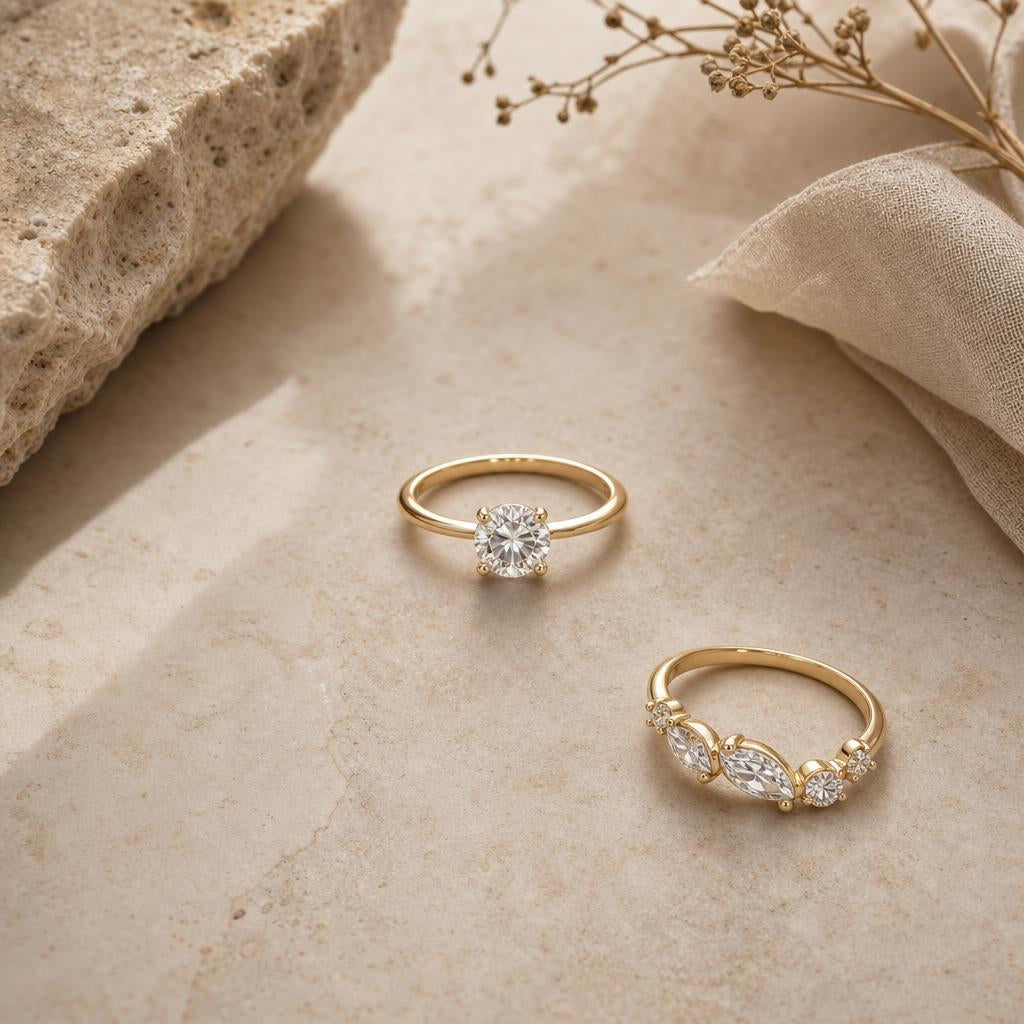
Symmetrical vs. Asymmetrical Engagement Rings: Which Design Philosophy Suits You
Most women can tell you instantly whether they love a ring. Almost none of them can tell you why. More often than not, the answer isn't the carat, the cut, or even the metal — it's symmetry. Whether a ring sits in perfect, mirrored balance or breaks that balance on purpose is one of the quietest, most powerful design decisions in jewelry, and it says more about your taste than almost anything else on your hand.
Once you start looking for it, you can't stop seeing it: some rings are built to be perfectly still, others are built to move. Here's how to figure out which one is actually you.


What "Symmetrical" and "Asymmetrical" Actually Mean in Ring Design
Symmetry, in ring terms, is any design that mirrors itself: a center stone with identical stones or detailing on either side, a halo that circles evenly, a band that reads the same from the left as it does from the right. It's the language of balance — nothing competing for attention, nothing pulling your eye off-center.
Asymmetry is the opposite instinct. It's a ring where the design deliberately refuses to mirror itself — a cluster of stones tumbling unevenly across the band, a stone set slightly off-axis, a shape that reads differently depending on which side you're looking from. Done well, it doesn't look like a mistake. It looks like a decision.
Worth knowing: Neither approach is more "correct" or more expensive to execute well. Symmetry and asymmetry are two separate design philosophies, not a spectrum from safe to bold — plenty of the most confident rings in editorial styling are perfectly symmetrical, and plenty of quiet, understated rings are technically asymmetrical.
This distinction shows up in jewelry design far more than most people realize before they start actively shopping. It's the reason two rings with nearly identical carat weight can feel like completely different pieces on the hand — one reads as composed and orderly, the other as loose and expressive, even though neither is objectively "more" of anything. Once you know to look for it, you'll start noticing which one you keep gravitating toward in every collection you scroll through.
| Design Trait | Symmetrical | Asymmetrical |
|---|---|---|
| Visual effect | Calm, balanced, orderly | Dynamic, expressive, layered |
| Stacks best with | Other symmetrical pieces or a single accent band | Plain bands that let the asymmetry stay the focal point |
| Photographs as | Consistent from every angle | Different depending on the angle and light |
| Feels most like | A tailored, considered wardrobe staple | A one-of-a-kind statement piece |
The Case for Symmetry
Symmetrical settings are the ones that photograph consistently, stack cleanly, and never fight with the rest of what you're wearing. A hidden halo like the one on the Ophelia sits in perfect, even balance around the center stone — the eye lands on the stone itself, not on the setting holding it there. That's the entire point: symmetry is a way of getting out of the stone's way.
It's also the aesthetic behind almost everything in the current wave of minimal rings — clean, four-prong solitaires, single stones with no distractions, settings built to disappear into the hand rather than announce themselves. If your everyday jewelry already leans toward the pared-back and considered, a symmetrical ring is going to feel like an extension of that instinct, not a departure from it.

Maxima Ring
A cushion-cut center stone wrapped in an even hidden halo — proof that symmetry can still make a genuinely dramatic statement.
Shop Maxima Ring →There's a quiet confidence to a symmetrical ring, too. It doesn't need context to make sense — it looks intentional on day one and just as intentional a decade in, because there's no trend attached to "balanced." It's the design equivalent of a well-cut blazer: it works because it isn't trying to prove anything.
The Case for Asymmetry
Asymmetrical rings are having a real moment, and the reason isn't hard to find. In a category that's spent decades rewarding uniformity — matched stones, even settings, predictable proportions — a ring that breaks its own rules reads as personal in a way symmetry rarely does. No two asymmetrical settings look quite the same, which means the ring on your hand genuinely doesn't look like the one on hers.
Cluster and graduated designs are where this shows up most clearly. A ring built from stones that shrink or shift as they move across the band — like the Rivière — isn't trying to look tidy. It's designed to catch the light differently from every angle, which is exactly what makes asymmetrical engagement rings feel more like a piece of art than a piece of hardware. The imbalance is the whole point.

Reine Moissanite Ring
Three round stones held by tall double-claw prongs, each with a hidden accent stone beneath it — asymmetry built into the profile, not just the top view.
Shop Reine Moissanite Ring →Asymmetry isn't reserved for statement pieces, either. An asymmetrical wedding band — one where the stones taper unevenly or the line curves instead of running straight — can sit right up against a perfectly symmetrical center stone and soften it, giving the whole hand a sense of movement a matched set never quite achieves.
Which Philosophy Actually Suits You
The honest answer has nothing to do with trends and everything to do with how you already get dressed. If you gravitate toward matched sets, clean lines, and outfits that don't need explaining, symmetry is going to feel like home. If you're the person who breaks up a monochrome outfit with one deliberately clashing piece, or who'd rather wear one interesting thing than five safe ones, an asymmetrical setting is going to feel far more like you than a perfectly balanced solitaire ever could.
It's also worth trying both on before you decide from photos alone. Asymmetrical cluster engagement rings in particular photograph very differently depending on the angle — a ring that looks slightly chaotic in a flat product shot can look completely composed the moment it's actually on a hand and catching real light. The same goes in reverse: a symmetrical setting that looks almost plain in a photo can look genuinely striking once you see how evenly it catches the light from every direction.
And if you're still torn, remember that this isn't a permanent identity. Plenty of women build a ring wardrobe with both — a symmetrical solitaire for daily wear, an asymmetrical diamond engagement ring or cluster piece kept for the days they want their hand to say something a little louder. You're not required to pick a side.
How It Reads on the Hand
Symmetry and asymmetry don't just affect how a ring looks in a photo — they change how it behaves on an actual hand, day to day. A symmetrical center stone tends to sit visually "still," which makes it a forgiving choice if you have shorter or fuller fingers: there's no extra movement pulling the eye sideways, so the stone itself does all the elongating work. An asymmetrical or cluster design, by contrast, naturally draws the eye along the length of the finger as it follows the uneven line of stones, which can make a longer finger look even longer and more dramatic.
Neither effect is universal — hands vary too much for absolute rules — but it's a genuinely useful thing to keep in mind if you're choosing between two pieces you love equally on a screen. Try both on in natural light before deciding, and pay attention to where your own eye goes first. That instinct is usually more reliable than any styling guide, including this one.
It's also worth thinking about how a ring will live in your day-to-day rotation, not just how it photographs on its own. A symmetrical piece tends to disappear into whatever you're already wearing, which is exactly why it works so well as an everyday ring. An asymmetrical piece asks a little more of an outfit — not in a high-maintenance way, but in the sense that it wants to be noticed, which makes it a natural choice for the days you actually want your hand to be part of the conversation.
Quick Takeaways
- Symmetry means a design that mirrors itself evenly; asymmetry means it deliberately doesn't.
- Symmetrical settings photograph consistently and never compete with the rest of what you're wearing.
- Asymmetrical and cluster designs read as more personal because no two settings look quite the same.
- Your existing style — matched vs. deliberately mismatched — is a better guide than any trend report.
- You don't have to choose permanently. Many women wear both, for different days and different moods.
Frequently Asked Questions
What is an asymmetrical ring?
An asymmetrical ring is any design where the setting deliberately doesn't mirror itself — stones placed unevenly, a band that curves instead of running straight, or a cluster that shifts in size and position across the design rather than repeating evenly on either side of the center.
What is a minimal ring?
A minimal ring is a pared-back design — typically a single stone in a clean setting with little to no additional detailing. Minimal rings are almost always symmetrical, since the entire aesthetic is built around even, uncomplicated balance rather than visual movement.
Is an asymmetrical ring harder to wear every day?
Not at all. Asymmetrical settings are just as durable and comfortable as symmetrical ones — the difference is purely visual. If anything, a well-designed asymmetrical band sits just as flush against the finger, since the imbalance is in the placement of stones or detail, not in the underlying structure.
Can you mix symmetrical and asymmetrical rings on the same hand?
Yes, and it's one of the easiest ways to make a stack look intentional rather than accidental. A symmetrical solitaire paired with one asymmetrical band gives the hand a focal point and a moment of movement, instead of everything competing for the same kind of attention.
At the end of the day, the ring that suits you isn't the one that's currently trending — it's the one that already looks like something you'd have chosen for yourself, symmetry and all (or in spite of it).


