

Why the Solitaire Never Goes Out of Style: The Case for Simple Engagement Rings
Every few years, the jewelry industry tries to convince her that one diamond isn't enough. First it was the halo. Then the hidden halo. Then the pavé band, the triple-halo, the three-stone "upgrade." Somewhere in that arms race, the original engagement ring style — one stone, one band, nothing else asking for attention — got quietly rebranded as "basic." It never stopped being the smartest choice in the case.
The solitaire is the oldest engagement ring style there is, and it is also, unmistakably, having a moment again. Not because trends came back around, but because the woman buying it now understands something the industry would rather she didn't: complexity isn't the same thing as quality, and a single, well-chosen stone reads as more expensive than a ring trying to prove itself with extra sparkle. Here's a look at what actually makes a solitaire work, and a few Gemiros styles built entirely on that idea.


What "Solitaire" Actually Means
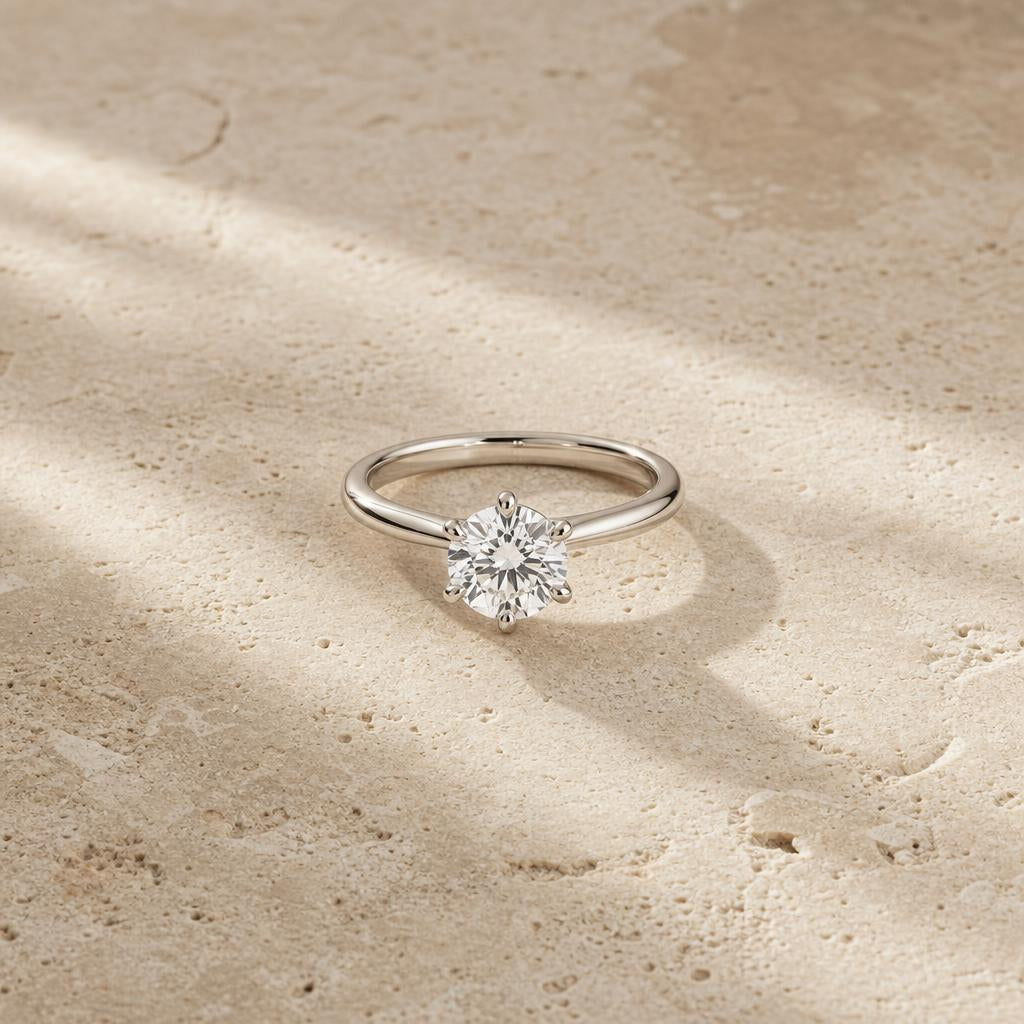
The word gets used loosely, so it's worth being precise about it. A solitaire is a ring with exactly one center stone, held by a setting — usually prongs, sometimes a bezel — on a plain or near-plain band. No side stones. No halo circling the center. No accent diamonds cascading down the shank. The entire design decision is: let one stone do the work.
That restraint is the point, not a limitation. When there's nothing else on the ring competing for attention, the cut, proportion, and placement of the center stone have to be right, because there's nowhere to hide. A solitaire is the format that rewards a genuinely well-made stone and exposes a mediocre one. It's also, not coincidentally, the format that has outlasted every embellishment trend the industry has tried to layer on top of it.
Why One Stone Never Goes Out of Style
Here's the part the traditional jewelry store doesn't lead with: halos, side stones, and elaborate settings often exist to make a smaller or lower-quality center stone look more substantial than it is. They're a workaround. A solitaire doesn't need a workaround — which is exactly why a house can't upsell its way around one. There's no "add a halo for a little more" upsell to pad the receipt when the ring is just a stone and a band. That's not a compromise. That's the ring having nothing to apologize for.
It also means a solitaire is the easiest style on earth to get right the first time. There's no guessing whether a halo will read as elegant or busy on your hand, no wondering if a three-stone setting will look intentional or crowded. One stone, centered, on a band that doesn't fight it. It's the engagement ring equivalent of a perfectly cut white shirt — the kind of choice that looks considered specifically because it isn't trying hard.

The London Ring
A 3-carat emerald-cut center on a smooth, unadorned band — the clean lines and long facets read as architectural rather than decorative, which is exactly the point of a step-cut solitaire.
Shop The London Ring →The Case for Simple Engagement Rings Right Now
Simple engagement rings are back in a way that isn't really about trends cycling — it's about buyers getting more literate. Search around and you'll find entire threads of women comparing notes on why they skipped the halo entirely: it photographs cleaner, it doesn't trap dust and lotion residue in tiny channel settings, and it doesn't date the way an aggressively of-the-moment setting eventually will. A solitaire bought today will look exactly as right in fifteen years as it does now, because it was never chasing a trend to begin with.
Worth knowing: A solitaire setting also makes resizing and inspection simpler, since there's a single stone and no delicate side-stone channels to protect during the process.
There's a quieter reason, too. A solitaire puts all the attention on the actual quality of the stone — the cut, the way it catches light, how clean it looks against your skin — instead of on how much metal and how many accent stones the setting can pile on. There's nowhere for a poorly cut stone to hide behind extra sparkle — which is precisely why it's such a smart format to buy in moissanite. A well-cut moissanite solitaire is indistinguishable from a diamond to the naked eye and passes diamond testers, so the format that rewards genuine quality is also the format that shows off moissanite's brilliance best.
Does a Solitaire Work With a Wedding Band?
Yes — better than almost any other style, in fact. Because a solitaire's band is plain to begin with, it leaves the most room to stack against later without visual conflict. Curved and contoured bands nest flush against a solitaire's rounded profile, while a straight, low-profile band sits cleanly beside a bezel or flat-shank solitaire without any gap to work around. This is one of the practical advantages that gets lost in all the talk about "timelessness" — a solitaire isn't just easy to wear alone, it's easy to build on.

The Solis Ring
A 1.5 carat round center stone in a solitaire setting, paired with a slim pavé stacking band — proof that a solitaire's simplicity is a foundation to build a stack on, not a ceiling.
Shop The Solis Ring →Moissanite Solitaire Rings: Same Power, Smarter Choice
A moissanite solitaire engagement ring isn't a smaller version of the real thing — it's the same design decision, made with the stone that actually deserves that much attention. Moissanite is indistinguishable from a diamond to the naked eye and passes diamond testers, so putting it front and center in a solitaire setting isn't a risk. It's the setting proving the stone can hold its own with nothing to hide behind. Every Gemiros solitaire is 925 sterling silver with rhodium or 18k gold plating, hypoallergenic and nickel-free, so the ring holds up to the kind of daily wear a solitaire is actually meant for.
✦ Pro tip: Clean a solitaire with a soft brush and warm, soapy water every couple of weeks — because there's no halo or channel setting trapping residue, it takes seconds to keep the stone looking freshly polished.
There's also a quieter, more personal case for buying yourself a solitaire specifically. It's the style least likely to be mistaken for anyone else's idea of what your ring should look like. A halo, a three-stone setting, a colored-stone statement piece — those all carry someone else's design opinion built into them. A solitaire is closer to a blank, deliberate choice: this stone, this band, nothing borrowed from what everyone else's ring is doing this year.
Quick Takeaways
- A solitaire ring features exactly one center stone with no side stones, halo, or accent diamonds — the setting exists to showcase the stone, not distract from it.
- Because there's no elaborate setting to fall back on, a solitaire rewards a genuinely well-cut stone — which is exactly why it works so well in moissanite.
- A solitaire's plain band makes it the easiest style to stack a wedding band against later without any visual conflict.
- Simple engagement rings resist dating the way trend-driven settings eventually do, because they were never chasing a trend in the first place.
Frequently Asked Questions
What is a solitaire engagement ring, exactly?
A solitaire engagement ring is a ring set with a single center stone and no side stones, halo, or accent diamonds — typically held in place by prongs or a bezel on a plain band. The word comes from the idea of the stone standing alone as the sole focus of the design.
What is a solitaire diamond, and is it different from a regular diamond?
A solitaire diamond isn't a different kind of stone — it describes how any center stone, including moissanite, is set as the single, standalone centerpiece of a ring. The term is about the setting, not the stone itself.
Does a solitaire ring look plain or unfinished without extra stones?
No — a well-cut center stone in a solitaire setting reads as more deliberate, not less finished. Because there's no halo or pavé to catch the eye first, the stone itself gets full credit for its brilliance, which is why solitaires photograph and wear as more refined rather than more basic.
Can you add a wedding band to a solitaire ring later?
Yes, easily. A solitaire's plain band leaves room to stack a curved, contoured, or straight wedding band against it without redesigning anything. It's one of the most stack-friendly styles precisely because it doesn't already have a busy setting to work around.
Is a moissanite solitaire a good choice for an engagement ring?
Yes. Moissanite is indistinguishable from a diamond to the naked eye and passes diamond testers, and its brilliance holds up especially well in a solitaire setting, where the stone has nothing else on the ring competing for attention.
The solitaire was never actually gone — it was just standing still while everything else tried to out-decorate it. That's the whole argument for it now: in a category that keeps adding halos and side stones to justify a bigger price tag, one well-chosen stone on a clean band is the version that still looks exactly right in a decade. It doesn't need the extra sparkle to prove anything. It never did.


