

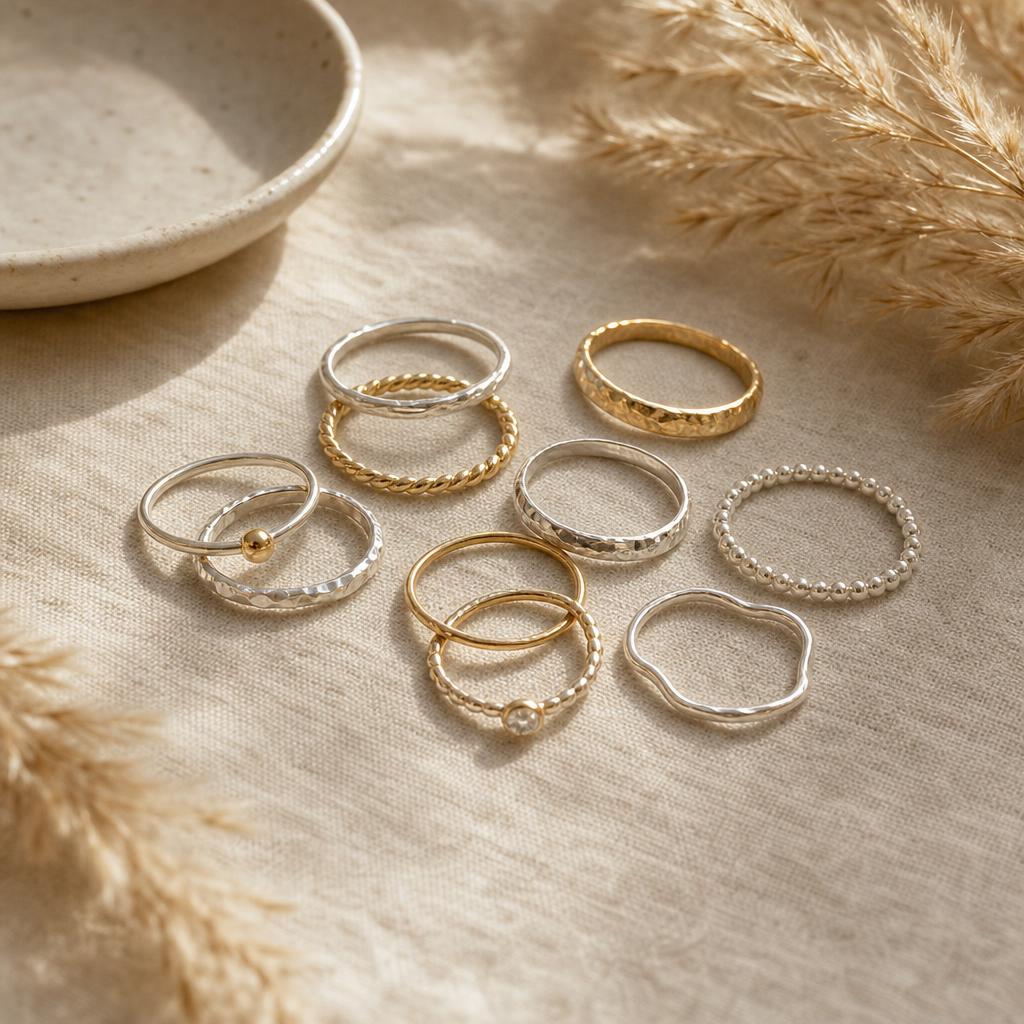
Sterling Silver Stacking Rings: How to Build a Stack That Looks Like You Meant It
There's a specific kind of ring stack that looks like it happened on purpose — not because every piece matches, but because none of it is an accident. That's the version worth building.
Most women don't start with a plan. They start with one ring, add a second because it felt right, and eventually end up somewhere between "curated" and "cluttered" without ever deciding which one they were going for. The good news: the difference between the two comes down to a handful of choices you can make on purpose, starting today.


The Difference Between a Stack and a Pile of Rings
A ring stack is a design decision. A pile of rings is just what happens when you keep buying rings you like without a plan for how they'll sit next to each other. The good sterling silver stacking rings — the ones that photograph well and actually feel good on the hand — share a few things in common: a consistent weight logic, enough contrast to keep the eye moving, and restraint. Not fewer rings, necessarily. Just more intention behind each one.
This is the part most guides skip: stacking isn't about owning more jewelry. It's about knowing why each piece earns its place before you put it on.
Start With a Base, Then Build Outward
Pick Your Anchor
Every stack needs one ring that reads as the point of the whole thing — usually the widest, most detailed, or most textured piece you own. Everything else exists to support it, not compete with it. A bezel-set band like The Cherish Ring works well in this role: it has enough presence to anchor a stack without shouting over the thinner pieces around it.
Add Contrast, Not Chaos
Once you have an anchor, the next rings should differ from it in at least one way — width, texture, or finish — while staying close in metal tone. A smooth polished band next to a channel-set piece like The Devotion Ring reads as deliberate. Three identical smooth bands in a row reads as an afterthought, even if each ring is beautiful on its own.

The Amore Ring
A clean, low-profile band designed to sit flush against a wider anchor piece without adding bulk — the ring most stacks are quietly built around.
Shop The Amore Ring →Worth knowing: Gemiros stacking bands are set in 925 sterling silver with rhodium, gold, or rose gold plating — nickel-free and hypoallergenic, so the metal underneath every piece in your stack is consistent even when the finishes aren't.
Thin, Dainty, or Bold — Pick a Personality Before You Buy
Not every stack should look the same, and trying to build one that does is usually where things go wrong. Before adding another ring, decide which direction you're actually going for.
Thin stacking rings — narrow, low-profile bands stacked two, three, or four at a time — read as quiet and precise. They're the easiest to wear daily because they don't catch on gloves, sleeves, or keyboard edges, and they layer against an engagement ring or solitaire without competing for attention. If your current jewelry drawer already leans minimal, this is the lane to stay in.
If pure simplicity isn't quite the goal, there's a step up worth knowing. Dainty stacking rings sit one notch above thin — still delicate, but with a little more detail: a hint of pavé, a soft twist, a bezel-set accent. They're the middle ground for someone who wants texture without going full statement. A stack built entirely from dainty pieces still reads as cohesive, which is harder to pull off with bolder styles.
If You Want Bold Instead
Bold stacking leans on wider bands, deeper channel settings, or a single dramatic piece anchoring several thinner ones. It takes more confidence to wear well, but it photographs beautifully and tends to be the stack people actually comment on. The trick is discipline: one bold piece per hand is usually the ceiling before it starts competing with itself.
How to Wear Stacking Rings Without Overthinking It
The fastest way to make a stack look accidental is to spread it evenly across every finger, every time. Concentrate weight instead. Build your fuller combination on one or two fingers — often the index or middle — and keep the rest of the hand simpler. Leave at least one finger completely bare on each hand; that negative space is what makes the rest of the stack read as designed rather than default.
Order matters more than people expect, too. Whatever ring sits closest to your knuckle should generally be the widest or most textured, tapering down to the thinnest band at the base of the finger. It's a small detail, but it's the difference between a stack that looks gathered and one that looks stacked on purpose.
When Your Engagement Ring Joins the Stack
If you're building around an existing engagement ring or solitaire, the goal shifts slightly: everything else should support that centerpiece, not fight it for attention. This is where mismatched stacked wedding bands actually work in your favor rather than against you — two bands that don't match each other, but both echo something in the center stone's setting, read as intentional rather than thrown together.

The Infinity Ring
A channel-set band with continuous sparkle along the entire ring — built to sit directly against a solitaire without a visible gap or mismatched height.
Shop The Infinity Ring →One practical note before you buy: bands meant to sit flush against a curved or raised setting often need to be sized to accommodate that shape. If you're unsure how a band will sit against your specific ring, a quick side-by-side check before purchase saves a return later.
Minimalist Stacking, If That's More You
Not everyone wants a five-ring hand, and that's not a lesser version of the trend — it's its own approach. Minimalist stacking rings, usually two or three thin bands in a single metal tone, still deliver the layered look without the visual weight. It's the version that works in professional settings, during workouts, and anywhere jewelry needs to stay quiet without disappearing entirely.
✦ Pro tip: If you're building a minimalist stack, buy your bands in the same width family first, then add one slightly wider piece later once you know how the base feels on your hand.
Quick Takeaways
- Pick one anchor ring first — everything else should support it, not compete with it
- Vary texture and width, not just metal color, for a stack that reads as intentional
- Concentrate rings on one or two fingers and leave at least one finger bare
- Order rings from widest near the knuckle to thinnest at the base of the finger
- Mismatched bands next to an engagement ring work when each one echoes the center setting
Frequently Asked Questions
What are the rules for stacking rings?
There's no strict rulebook, but a reliable structure: start with one anchor ring, add pieces that vary in width or texture rather than repeating the same style, and stop before every finger is full. Leaving space is as much a part of the look as the rings themselves.
Can you stack sterling silver rings with gold ones?
Yes — mixed metals read as a styling choice, not a mistake, when the pairing feels deliberate. Anchor the combination with one ring that already blends both tones, like a two-tone band, so silver and gold feel connected rather than random.
Which finger should stacked rings go on?
There's no single correct finger — balance across the hand matters more than which one you choose. A common approach is building a fuller stack on the index or middle finger while keeping the ring finger and pinky simpler.
Will a stacking band hold up to daily wear?
Gemiros stacking bands are set in 925 sterling silver with rhodium, gold, or rose gold plating, are nickel-free, and are backed by a one-year warranty — built for the kind of everyday layering a real stack requires, not just occasional wear.
Is ring stacking still a trend, or is it here to stay?
It's moved past trend status into a permanent way of building a jewelry collection. Unlike a single ring, a stack can keep growing with you — which is exactly why it's worth building thoughtfully from the start rather than treating it as a passing look.
A stack you actually reach for every morning isn't the one with the most rings on it — it's the one where every piece earned its spot. Start with one anchor, add with intention, and let the rest of your sterling silver stacking rings collection build itself from there.


