

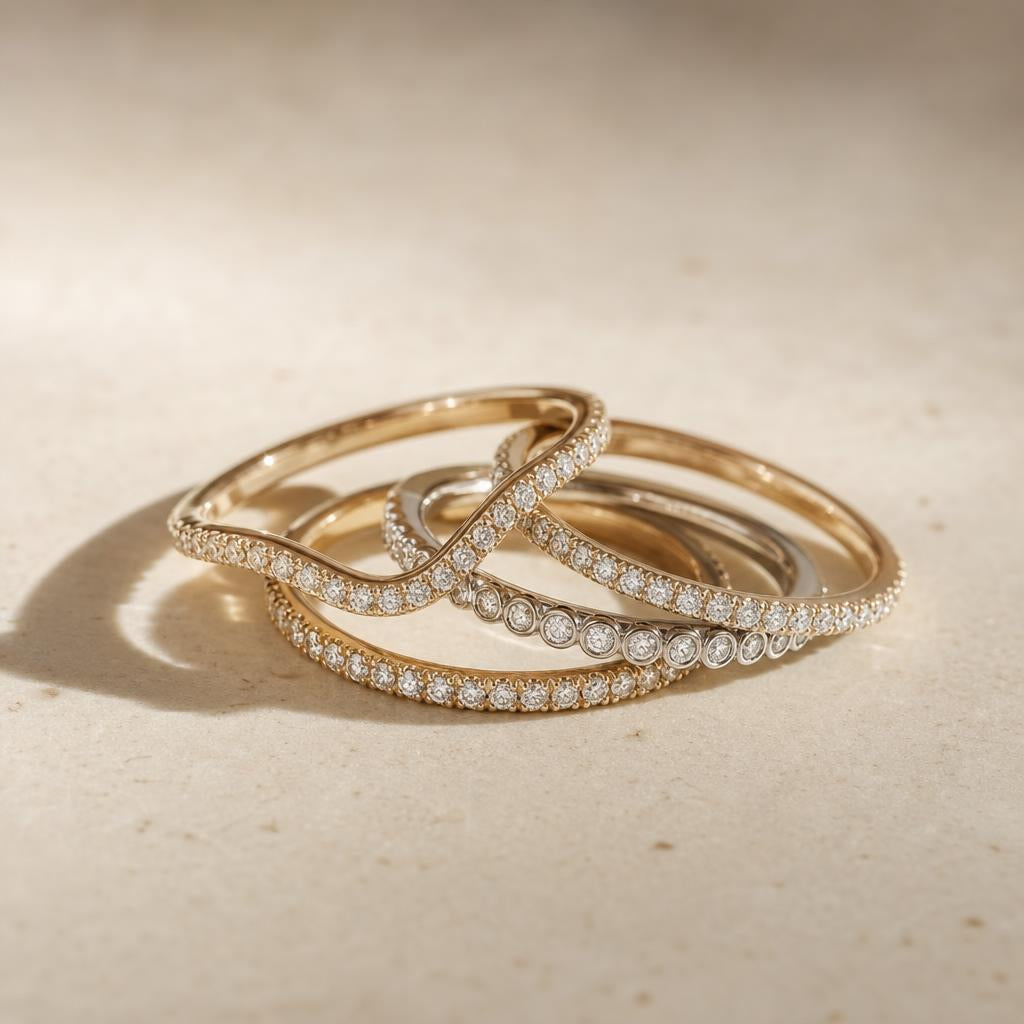
6 Stacking Rings That Sit Flush Against Your Engagement Ring
If you've ever slipped a new stacking ring next to your engagement ring and felt your heart sink a little — because it sat crooked, created a visible gap, or shuffled to the side all day — you're not alone. Most stacking rings are photographed on their own, which makes it impossible to tell how they'll actually behave in a stack. Here's what to look for, and six picks from the Gemiros collection that genuinely sit flat.
The difference between a ring that stays in place and one that spins all day comes down to three things: the shape of the band, the height of the setting, and how the silhouette interacts with your centre stone. Get those right and the rest looks after itself. Here are six rings designed for exactly this — alongside a few notes on why each one works.
Why most stacking rings shift — and what to look for instead
The most common stacking problem isn't the ring itself — it's the combination. A domed or court-profile band has a rounded underside that makes contact with your finger at a single point, which means it can rotate freely. Add a prong-set centre stone on one side, and the whole stack tips. It doesn't look wrong at the jewellery counter; it only reveals itself when you're going about your day.
Three factors determine whether a stacking ring will sit flush and stay there:
- Band profile: A flat-back or D-profile band has more surface area against your finger, which limits how much it can rotate. Comfort-fit bands with a rounded interior feel nice to wear but are more likely to shift.
- Setting height: Bezel and channel settings have no prongs protruding above the stone surface, so they sit lower and don't catch on the ring next to them. Standard prong settings add height and can create a tiny gap between rings.
- Band width: Slimmer bands — generally 1.5mm to 2.5mm — naturally sit closer to the engagement ring than wider bands. They have less surface area to drift and nest more naturally against the base of a solitaire or halo setting.
Worth knowing: Ring stacking isn't an exact science. Two rings can look perfectly matched on someone else's hand and feel awkward on yours, depending on your finger's width and the shank of your centre stone. The rings below are chosen because their design characteristics — low settings, flat profiles, considered silhouettes — make them structurally good stackers, not just visually appealing ones.
The six picks
1. The straight eternity: The Forever Ring
If you're new to stacking and want the safest possible option, a slim straight eternity band is where most people start — and for good reason. The Forever Ring features a continuous row of round simulated diamonds across a flat, low-profile band. There's nothing architectural or unusual about the silhouette; it simply sits level against whatever ring is next to it.
What makes it work as a stacker is the band's modest width. It's slim enough to press close to the side of a solitaire setting without leaving a visible gap at the base, and the continuous pavé means there's no single stone trying to clear a prong on your engagement ring. It reads as a band, not a statement ring, which makes it genuinely versatile — it works beside round cuts, ovals, cushions, and most other shapes without competing for attention.

The Forever Ring
A continuous row of brilliant round simulated diamonds on a slim, flat-back band. No prong height to worry about — just clean, low-profile sparkle that presses flush against any ring beside it. Available in silver, gold, and rose gold.
Shop The Forever Ring →2. The wishbone: The Wishbone Ring
The wishbone (or chevron) shape is one of those design details that seems purely decorative until you understand the engineering behind it. The V-shaped curve dips at the centre, which allows the band to sit directly under the base of a solitaire setting rather than pressing against the side of it. The result: no gap between the engagement ring and the stacker at the bottom, no upward pressure on the centre stone's prongs.
This makes the wishbone shape particularly useful if your engagement ring has a high-set stone. Straight bands sometimes create a visible arc gap where the ring's shank meets the solitaire's base — a wishbone ring eliminates that entirely by curving into the space. It also means the stack looks intentional from the side, not just from the top.

The Wishbone Ring
A V-shaped chevron band set with round pavé simulated diamonds. The curved centre is shaped specifically to cradle a solitaire or halo setting, eliminating the base gap that straight bands sometimes leave. Clean from every angle.
Shop The Wishbone Ring →3. The bezel band: The Cherish Ring
Bezel settings are underrated in the context of stacking. Most eternity bands use prong settings because they show off more of the stone — each simulated diamond sits open to the light on all sides. But that same openness adds height. The metal claws that hold each stone extend above the girdle, adding a millimetre or more to the band's total profile.
The Cherish Ring uses individual bezel settings — each stone is nestled inside its own metal frame, flush with the band surface. There are no prongs. Nothing extends above the stones. It's one of the flattest ring profiles in the Gemiros range, and that translates directly into how well it nestles against its neighbours. It also happens to look extremely modern: the individual frames give it a clean, architectural quality that reads very differently from a traditional pavé band.
✦ Stacking tip: If you're pairing a bezel-set band with a prong-set engagement ring, position the bezel band on the side away from your dominant hand. Daily movement tends to push rings toward the palm, and a flush band on the outer side keeps the whole stack looking intentional throughout the day.

The Cherish Ring
Round simulated diamonds set individually in smooth bezel frames across a slim eternity band. No prong height, no snag risk — just a very flat, very contemporary band that sits right up against any ring beside it without creating gaps or pressure.
Shop The Cherish Ring →The channel-set option: why it matters for stackers
Channel settings work on a similar principle to bezels — stones are held inside a metal channel rather than raised on prongs — but they produce a distinctly different aesthetic. Instead of individual frames around each stone, a channel setting runs two parallel rails of metal with stones nestled between them in a row. The visual effect is more linear, more architectural, and typically suits step-cut stones (like baguettes or princess cuts) better than round stones.
For stacking purposes, what matters is the profile: channel-set bands sit very flat against the finger. There's nothing to catch on a neighbouring ring's prongs. They also tend to be quite rigid compared to a pavé band, which means they stay in position better throughout the day.
4. The baguette band: The Devotion Ring

The Devotion Ring
A full eternity band of baguette-cut simulated diamonds set in a seamless channel. The rectangular step-cut stones catch light differently from round brilliants — a quieter, more understated sparkle that layers beautifully under a round or oval engagement ring without competing with the centre stone.
Shop The Devotion Ring →5. The princess cut band: The Evermore Ring
Princess cuts bring something different to a stack: the square stones have sharp corners that catch light in a geometric, graphic way — quite different from the softer brilliance of round stones. The Evermore Ring channels this into a sleek eternity band with a channel setting that holds each stone securely and flat. It's a modern choice, and one that tends to pair well with larger, more architectural engagement rings (think emerald cuts or cushion cuts) where you want the stacker to feel equally structured.

The Evermore Ring
Princess-cut simulated diamonds in a seamless channel setting. Crisp, geometric, and extremely flat against the finger. The structured line of square stones brings a contemporary edge to a stack and pairs naturally with step-cut engagement rings.
Shop The Evermore Ring →When you want more than a sliver: adding a slightly wider band
Not every stacking ring needs to be minimal. Once you have a slim band sitting flush against your engagement ring, adding a slightly wider ring on the other side can create genuine visual depth — a layered look that feels collected rather than matchy. The key is still choosing a band with a low setting height and a relatively flat profile, even if the width is greater.
The Beloved Ring is a good example. It's slightly wider than a typical half-eternity band and features a continuous row of round simulated diamonds with a subtle milgrain-style detail along the edges — a nod to vintage craftsmanship. That detail adds dimension without adding setting height. Placed beside an engagement ring, it reads as its own piece rather than an afterthought. Worn on the other side from a slim pavé band, it creates a layered stack with distinct character on either side of the centre stone.
6. The vintage option: The Beloved Ring

The Beloved Ring
A slightly wider pavé eternity band with a continuous row of round simulated diamonds and delicate edge detailing. The extra width creates real visual presence beside an engagement ring without adding unwanted height to the setting. A beautiful choice for a stack that wants to feel layered, not minimal.
Shop The Beloved Ring →How to think about your own engagement ring when choosing a stacker
There's no single best stacking ring — the right choice depends partly on what you're stacking against. A few useful frames:
- Round solitaire: Almost any slim straight band or wishbone ring will sit well. The round shape doesn't project sideways, so the base of the setting doesn't create much resistance for a band to work around.
- Oval solitaire: The elongated shape means the stone has more lateral presence. A slim straight band works well; a wishbone or chevron ring is particularly suited here because it curves neatly under the longer setting base.
- Cushion or square cuts: These tend to have a squarer shank, which means straight bands sit flush against them naturally. Channel-set bands like The Devotion Ring or The Evermore Ring pair particularly well because the angular geometry echoes the centre stone.
- Halo settings: Halos project outward, so you need a stacking band slim enough not to compete visually. A single slim pavé band like The Forever Ring looks cleaner than a stack of multiple rings here.
- High-profile settings: If your engagement ring has a tall cathedral or high-prong setting, a wishbone ring is usually the best solution — the curve accommodates the elevated base without creating a visible wedge-shaped gap.
One thing to keep in mind: The flush-fit question is about both vertical alignment (the top surfaces of both rings sitting level) and horizontal contact (the sides of the bands pressing against each other without a gap at the base). These are separate things. A wishbone ring solves the base gap problem for high-profile settings; a low-profile band solves the vertical alignment problem for any setting. Sometimes you need both.
A note on simulated diamond stacking rings and daily wear
A question that comes up often: do simulated diamond stacking rings hold up to constant contact with an engagement ring? The short answer is yes, with reasonable care. Two rings that press against each other throughout the day will always show some micro-abrasion over time — this is true of precious metal rings too. The difference with simulated diamond rings is that you can choose to wear your real engagement ring less often, use the stacking ring as a travel companion, or simply be thoughtful about which rings share a finger.
The Gemiros stacking rings are designed for daily wear, with settings chosen for stability rather than just aesthetics. Bezel and channel settings, in particular, are less prone to stone loosening from contact stress than prong settings — another reason they tend to be recommended for stacking.
The Flush-Fit Shortlist
- The Forever Ring — slim straight pavé eternity; works with almost any engagement ring
- The Wishbone Ring — V-curve designed to sit under a solitaire; eliminates base gaps
- The Cherish Ring — bezel setting; lowest possible profile; no prongs to snag
- The Devotion Ring — baguette channel eternity; flat, structured, and contemporary
- The Evermore Ring — princess cut channel band; pairs especially well with step-cut centres
- The Beloved Ring — slightly wider pavé; for a stack with layered depth rather than minimalism
Frequently asked questions
Do I need a curved ring to stack with an engagement ring, or will a straight band work?
A straight band will work with most engagement rings. The case for a curved or wishbone ring is specifically when your engagement ring has a high-set stone or a wider shank that creates a visible gap where the band meets the base of the setting. For lower-profile settings and solitaires with a slim shank, a straight band usually sits cleanly without any gap.
Can I stack two rings on the same finger as my engagement ring?
Yes, though it helps to think about the arrangement. One ring on each side of the engagement ring tends to look more considered than three rings all crowded together on one side. Two slim bands flanking a solitaire is a classic look; three tends to feel crowded unless at least two of the bands are very narrow.
Will a stacking ring scratch my engagement ring?
Any two rings worn together will eventually show micro-abrasion where they contact each other — this is normal and affects even mined diamond rings. To reduce contact wear, choose rings in the same or similar metal, and avoid very narrow-edged metal bands against a soft gold setting. Sterling silver and harder metal plating are generally more scratch-resistant than soft yellow gold.
What's the difference between a half eternity and a full eternity band for stacking?
A half eternity band has stones only on the visible top half of the ring, with a plain metal underside. A full eternity band has stones all the way around. For stacking, both work equally well in terms of fit. The main practical difference: a full eternity band cannot usually be resized after purchase, while a half eternity can. If you're between ring sizes, a half eternity is the safer choice.
The right stacking ring isn't the most beautiful one in isolation — it's the one that disappears into the stack in the best possible way, making the whole combination look like it was always meant to be there. Any of the six rings above will do exactly that.


