

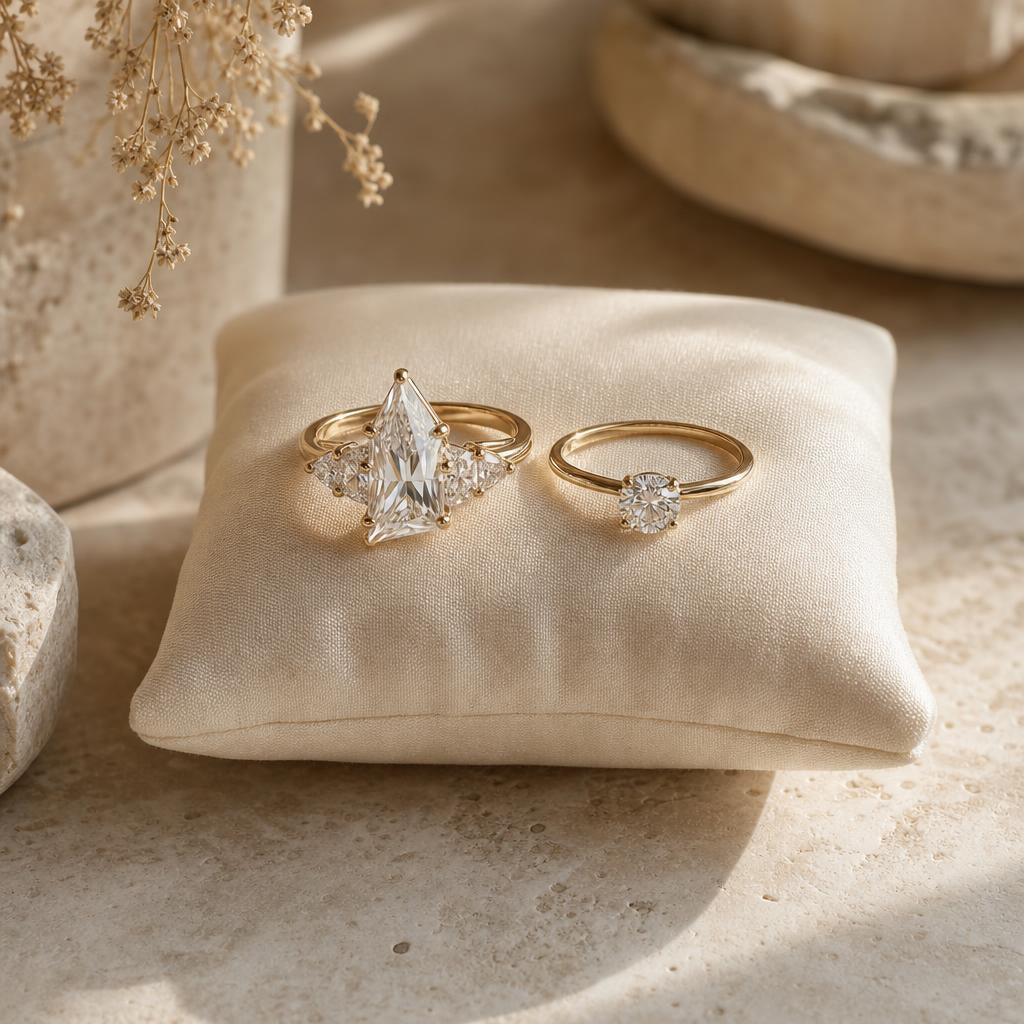
Statement Ring vs. Solitaire Ring: What the Terms Actually Mean
Ask ten women what makes a ring a "statement ring" and you'll get ten different answers — bigger stone, bolder setting, more sparkle. Ask what makes a solitaire a solitaire, and most people say "simple," then can't quite explain why simple sometimes reads as confident and other times reads as forgettable. Both terms describe something more specific than vibe, and once you know what that is, you shop faster and second-guess yourself less.
Knowing the real difference matters before you spend money, not after. A solitaire and a bold, layered ring solve different problems on the hand — one is about quiet precision, the other about deliberate presence — and the sharpest collections usually have room for both.


What Makes a Ring Bold Enough to Be a Statement Piece
What most people mean by the term — "big and loud" — is only half right. A bold, focal-point ring earns the name through layered design, not size alone: a larger center stone, added side stones, a wider band, or a setting with visible architecture, all working together so the ring reads as the centerpiece of the hand rather than a supporting piece. The radiant-cut design in our grid above, flanked by heart-cut side stones, is a clean example — built to catch light from more than one angle at once.
A statement piece isn't a category of stone or a price point. It's a design decision about how much visual information one ring is allowed to carry. That's a different job than an engagement ring or a stacking band is doing, which is part of why so many women eventually end up owning one of each.
What "Solitaire" Actually Means
Solitaire ring meaning is simpler than most buying guides make it sound: one center stone, no side stones competing for attention, set on a band that exists to hold the stone rather than decorate the hand. That's the whole definition. It doesn't mean small, and it doesn't mean plain — a 4-carat round brilliant solitaire like the Lumière commands plenty of attention with a single stone doing all the work.
What a solitaire skips is complexity. No halo, no pavé, no second stone shape pulling the eye elsewhere. The confidence comes from restraint rather than scale, which is exactly why a well-cut solitaire can end up looking more expensive than a ring with three times the stones on it.
The Real Dividing Line: Complexity, Not Size
Here's where most people get it wrong: they assume statement means big and solitaire means small. Plenty of solitaires are large — the Odette's 3.5-carat oval is not a shy ring by any measure. And plenty of bold designs are actually modest in carat weight, leaning on an unusual setting or detailed metalwork instead of a huge center stone to do the talking.
The dividing line is how many design elements are doing work at the same time. A solitaire has one job and does it cleanly. A bold ring stacks two or three details — a bold cut, side stones, an architectural band — so the whole piece reads as more elaborate, even when no single element is dramatic on its own.
Which One Actually Suits Your Hand and Your Day
Solitaires tend to win for daily wear. There's less to snag on gloves or sweaters, less visual noise while you're typing or cooking, and less chance of clashing with whatever else you've put on that morning. They're also easier to stack — a clean single stone leaves room for bands on either side without competing for attention.
Bold, layered rings ask for a little more intention. They photograph beautifully, they carry a room on their own, and they're genuinely satisfying on days you want your hands to say something without you having to. But they generally work best worn solo rather than at the center of a stack, since anything placed next to a bold ring has to compete with it instead of complementing it.
Worth knowing: A bold ring and a solitaire are usually built from the exact same materials — 925 sterling silver with rhodium or gold plating, and a moissanite or simulated diamond center that's indistinguishable from a mined stone to the eye and passes diamond testers. The metal and stone quality don't change between categories. Only the design does.
Solitaire Styles That Still Read as a Statement
The two categories blur more than most guides admit. A solitaire cut unusually — oversized, angled, or set sideways — can carry as much visual weight as a ring with three stones on it.

The Stella Ring
A round-cut solitaire scaled up and set in a 4-prong mount built to be noticed — proof that "solitaire" and "quiet" aren't actually the same word.
Shop Stella →Orientation changes the read on a solitaire, too. Setting a stone sideways instead of the way it's typically worn shifts a simple single-stone ring into something with real movement across the hand.

The Ondine Ring
A 2-carat pear-cut solitaire set east-west instead of the usual point-up orientation — technically a single-stone ring, but it reads like a statement piece the moment it catches light.
Shop Ondine →What About Engagement Rings?
Neither term is exclusive to engagement rings, though solitaires dominate that category for a practical reason: a single, unobstructed stone is the easiest style to build a wedding band around later, since there's nothing else on the shank competing for space. A bold, multi-element design can absolutely serve as an engagement ring too — it just asks more of whatever gets stacked next to it down the line.
Spotting the Difference in a Product Listing
Once you know what to look for, a product photo tells you almost everything before you read a word of copy. Count the visible stones: one clean center stone with an unbroken band is a solitaire, full stop. The moment you see a halo circling the center, pavé running down the shank, or a second stone shape sharing the setting, you're looking at a bolder, more layered design — regardless of what the listing title calls it. Carat weight on its own tells you nothing about which category a ring falls into; a 4-carat single stone is still a solitaire, and a 1-carat ring with three design elements stacked together is still a bolder piece. Learning to read a listing this way — rather than trusting the title alone — saves you from ordering something that looks nothing like what you pictured.
How to Decide Which One to Buy First
If you only own one ring right now, a solitaire is the more versatile first purchase — it works alone, it works stacked, and it won't compete with whatever else ends up on that hand later. A bold, layered design is usually the second purchase: the one you buy once you already know how you like to wear jewelry and want a piece that doesn't have to share the spotlight with anything else.
Neither is objectively better. One is the ring you reach for without thinking. The other is the ring people ask about.
Quick Takeaways
- A solitaire is defined by one clean center stone with no competing details — not by size.
- A bold ring earns that description by stacking two or more design elements: cut, side stones, band width.
- Solitaires stack and layer more easily; bolder designs usually work best worn alone.
- Unusual settings — oversized cuts, east-west orientation — can make a technical solitaire read as a showpiece.
- Both are built the same way at Gemiros: 925 sterling silver, rhodium or gold plating, and moissanite or simulated diamond stones that pass diamond testers.
Frequently Asked Questions
What is a statement ring?
It's a design built around visual presence rather than one stone doing quiet work alone — usually through a larger cut, added side stones, or a more architectural setting. It's meant to be the focal point of the hand, not a supporting piece.
What is a solitaire ring?
A ring featuring a single center stone with no side stones or halo competing for attention. The band exists to hold and elevate that one stone — nothing more.
Can a solitaire also work as a bold, eye-catching ring?
Yes. An oversized stone, an unusual orientation like east-west, or a dramatic cut can make a technically simple one-stone ring read as a showpiece. The categories describe design complexity, not a strict rulebook.
What finger do you wear a bold ring on?
Most women wear their boldest ring on the index or middle finger, where a larger design has room to stand out without competing with an engagement ring or wedding band on the ring finger.
What's the difference between a statement ring and a cocktail ring?
Every cocktail ring qualifies as a statement piece, but not every statement piece is a cocktail ring. Cocktail rings specifically reference the bold, single-large-stone evening pieces that became popular in the 1920s; the broader category also includes sculptural bands and multi-stone designs.
Whichever one you're drawn to right now, the two aren't in competition — they're answering different questions about the same hand. Reach for the solitaire on the days you want to disappear into what you're doing. Reach for the bolder piece on the days you don't.


